QUESTION IMAGE
Question
question 17
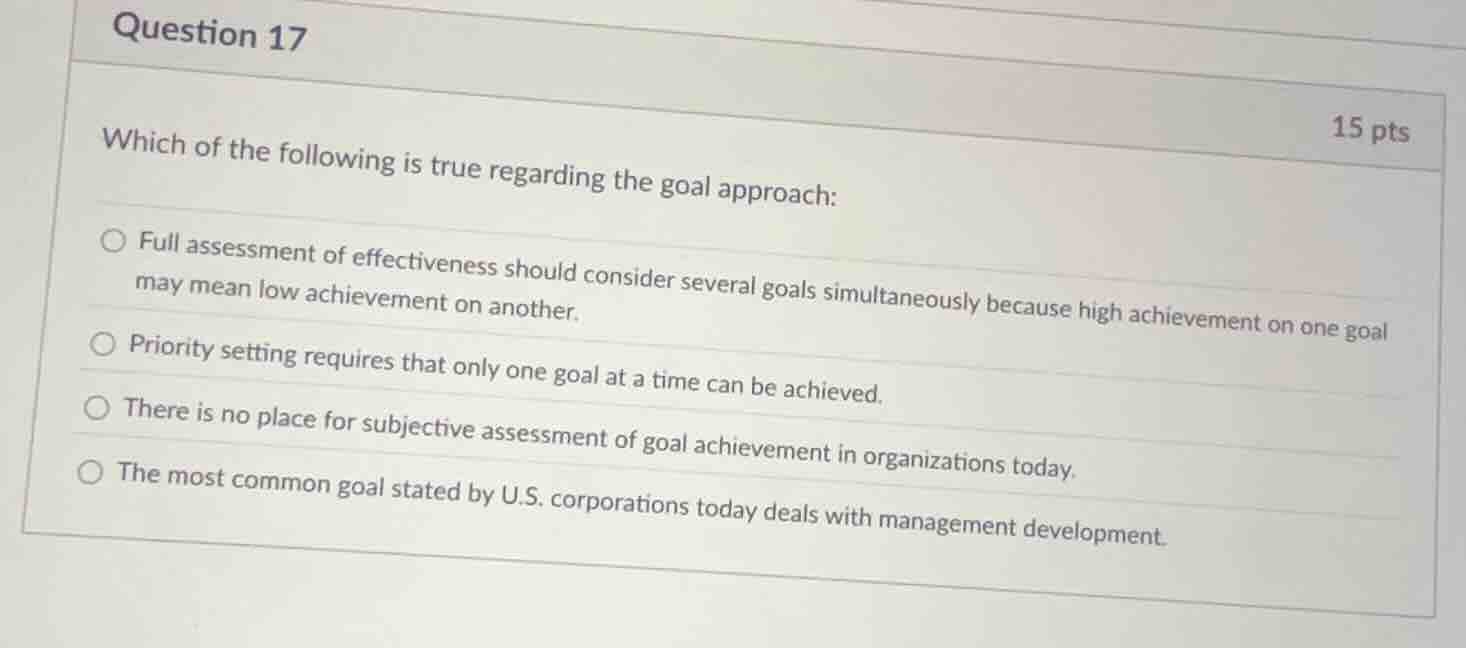
which of the following is true regarding the goal approach:
- full assessment of effectiveness should consider several goals simultaneously because high achievement on one goal may mean low achievement on another.
- priority setting requires that only one goal at a time can be achieved.
- there is no place for subjective assessment of goal achievement in organizations today.
- the most common goal stated by u.s. corporations today deals with management development.
🆕 New Concept Discovered: Organizational Effectiveness Models
Evaluating how organizations define and measure success.
Step 1: Understand the Goal Approach
The goal approach (or goal-attainment approach) is a classic model used to measure organizational effectiveness. It defines effectiveness in terms of whether an organization achieves its preferred operational and official goals.
Step 2: Analyze the Limitations and Realities of Goals
In real organizations, goals are rarely simple, isolated targets. Instead, organizations must balance multiple goals at the same time.
Because resources (like time, money, and personnel) are limited, focusing heavily on achieving one goal often comes at the expense of another. For example, maximizing short-term profit (Goal A) might lead to lower employee satisfaction or reduced product quality (Goal B). Therefore, to fully assess an organization's effectiveness, we must look at several goals simultaneously to see these trade-offs.
Step 3: Evaluate the Given Options
- Option 1: "Full assessment of effectiveness should consider several goals simultaneously because high achievement on one goal may mean low achievement on another."
- Analysis: This is true. Because organizational goals often conflict or compete for resources, a comprehensive evaluation must look at multiple goals together to understand these trade-offs.
- Option 2: "Priority setting requires that only one goal at a time can be achieved."
- Analysis: This is incorrect. Organizations can and do achieve multiple goals at the same time, even if they have to prioritize them.
- Option 3: "There is no place for subjective assessment of goal achievement in organizations today."
- Analysis: This is incorrect. Many qualitative goals (such as employee morale, brand reputation, or ethical standards) require subjective assessment.
- Option 4: "The most common goal stated by U.S. corporations today deals with management development."
- Analysis: This is incorrect. The most common stated goals for corporations typically revolve around financial performance, profitability, market share, or customer satisfaction.

Snap & solve any problem in the app
Get step-by-step solutions on Sovi AI
Photo-based solutions with guided steps
Explore more problems and detailed explanations
Full assessment of effectiveness should consider several goals simultaneously because high achievement on one goal may mean low achievement on another.