Sovi.AI - AI Math Tutor

Scan to solve math questions

QUESTION IMAGE

question 16 of 26 which aspect of dna determines the genetic code? a. t…

Question

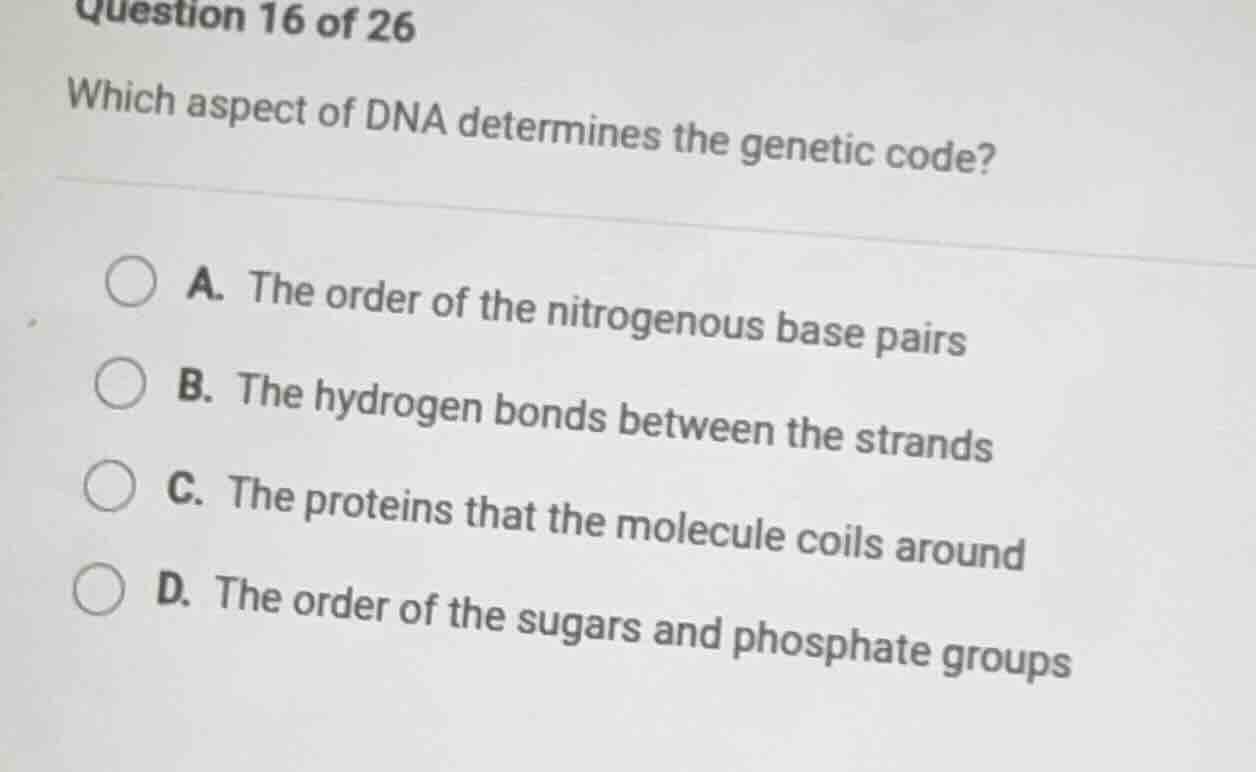
question 16 of 26

which aspect of dna determines the genetic code?

a. the order of the nitrogenous base pairs
b. the hydrogen bonds between the strands
c. the proteins that the molecule coils around
d. the order of the sugars and phosphate groups

Explanation:

Response

<pre_analysis>
{
"quality": "clear",
"question_count": 1,
"skills_matched": [
"direct_cot",
"multiple_choice_formatter",
"explain_then_answer",
"quick"
],
"needs_drawing": false,
"concepts_used": [],
"new_concepts": [
"Genetic Code"
],
"current_concepts": [
"DNA Structure",
"Genetic Code"
]
}
</pre_analysis>

<reasoning>

Analyze the function of DNA components

The genetic code is the set of rules by which information encoded within genetic material is translated into proteins. This information is stored in the sequence of nitrogenous bases (adenine, thymine, cytosine, and guanine) along the DNA strand.

Evaluate the given options

  • A. The order of the nitrogenous base pairs: The specific sequence of these bases acts as the biological "alphabet" that determines the genetic instructions. This is correct.
  • B. The hydrogen bonds between the strands: Hydrogen bonds stabilize the double helix structure but do not carry informational sequence variation.
  • C. The proteins that the molecule coils around: Histone proteins help package DNA into chromatin but do not determine the genetic code.
  • D. The order of the sugars and phosphate groups: The sugar-phosphate backbone is highly repetitive and identical throughout the DNA molecule, so it cannot encode unique genetic information.

</reasoning>

<answer>
<mcq-correct>A. The order of the nitrogenous base pairs</mcq-correct>
<mcq-option>B. The hydrogen bonds between the strands</mcq-option>
<mcq-option>C. The proteins that the molecule coils around</mcq-option>
<mcq-option>D. The order of the sugars and phosphate groups</mcq-option>
</answer>

<post_analysis>
{
"subject": "Natural Science",
"question_type": "Multiple Choice",
"knowledge_point": [
"Natural Science",
"Biology",
"DNA Structure and Function"
]
}
</post_analysis>

Answer:

<pre_analysis>
{
"quality": "clear",
"question_count": 1,
"skills_matched": [
"direct_cot",
"multiple_choice_formatter",
"explain_then_answer",
"quick"
],
"needs_drawing": false,
"concepts_used": [],
"new_concepts": [
"Genetic Code"
],
"current_concepts": [
"DNA Structure",
"Genetic Code"
]
}
</pre_analysis>

<reasoning>

Analyze the function of DNA components

The genetic code is the set of rules by which information encoded within genetic material is translated into proteins. This information is stored in the sequence of nitrogenous bases (adenine, thymine, cytosine, and guanine) along the DNA strand.

Evaluate the given options

  • A. The order of the nitrogenous base pairs: The specific sequence of these bases acts as the biological "alphabet" that determines the genetic instructions. This is correct.
  • B. The hydrogen bonds between the strands: Hydrogen bonds stabilize the double helix structure but do not carry informational sequence variation.
  • C. The proteins that the molecule coils around: Histone proteins help package DNA into chromatin but do not determine the genetic code.
  • D. The order of the sugars and phosphate groups: The sugar-phosphate backbone is highly repetitive and identical throughout the DNA molecule, so it cannot encode unique genetic information.

</reasoning>

<answer>
<mcq-correct>A. The order of the nitrogenous base pairs</mcq-correct>
<mcq-option>B. The hydrogen bonds between the strands</mcq-option>
<mcq-option>C. The proteins that the molecule coils around</mcq-option>
<mcq-option>D. The order of the sugars and phosphate groups</mcq-option>
</answer>

<post_analysis>
{
"subject": "Natural Science",
"question_type": "Multiple Choice",
"knowledge_point": [
"Natural Science",
"Biology",
"DNA Structure and Function"
]
}
</post_analysis>