QUESTION IMAGE
Question
question #7 of 10
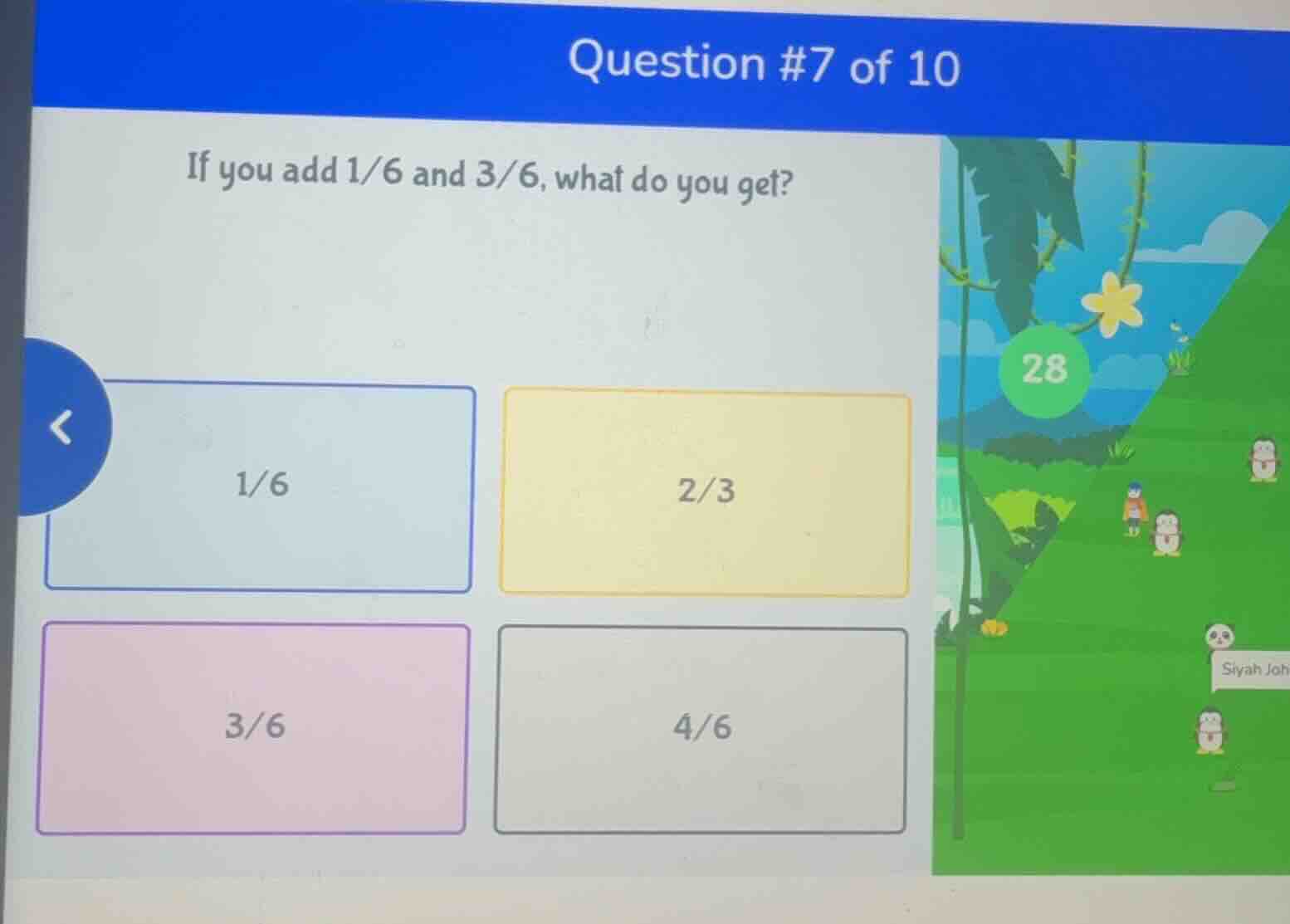
if you add 1/6 and 3/6, what do you get?
1/6 2/3
3/6 4/6
Step1: Add the numerators
To add two fractions with the same denominator, we add their numerators and keep the denominator the same. So, for $\frac{1}{6} + \frac{3}{6}$, we add the numerators 1 and 3: $1 + 3 = 4$. The denominator remains 6, so we get $\frac{4}{6}$.
Step2: Simplify the fraction (optional, but check the options)
We can simplify $\frac{4}{6}$ by dividing both the numerator and the denominator by their greatest common divisor, which is 2. So, $\frac{4 \div 2}{6 \div 2} = \frac{2}{3}$. Also, $\frac{4}{6}$ is one of the options, and $\frac{2}{3}$ is also an option. Let's check the calculation again. $\frac{1}{6} + \frac{3}{6} = \frac{1 + 3}{6} = \frac{4}{6}$, and simplifying $\frac{4}{6}$ gives $\frac{2}{3}$. Both $\frac{4}{6}$ and $\frac{2}{3}$ are correct, but let's see the options. The options are $1/6$, $2/3$, $3/6$, $4/6$. So both $\frac{4}{6}$ (which is equal to $\frac{2}{3}$ when simplified) are correct, but let's check the addition first. The sum of the numerators is 4, denominator 6, so $\frac{4}{6}$, and simplifying gives $\frac{2}{3}$.

Snap & solve any problem in the app
Get step-by-step solutions on Sovi AI
Photo-based solutions with guided steps
Explore more problems and detailed explanations
The correct answers are: B. 2/3, D. 4/6 (assuming the options are labeled as A. 1/6, B. 2/3, C. 3/6, D. 4/6). But let's confirm the addition: $\frac{1}{6} + \frac{3}{6} = \frac{4}{6} = \frac{2}{3}$. So both $\frac{4}{6}$ and $\frac{2}{3}$ are correct. If we consider the initial sum before simplification, it's $\frac{4}{6}$, and after simplification, it's $\frac{2}{3}$.