QUESTION IMAGE
Question
question 2 of 10
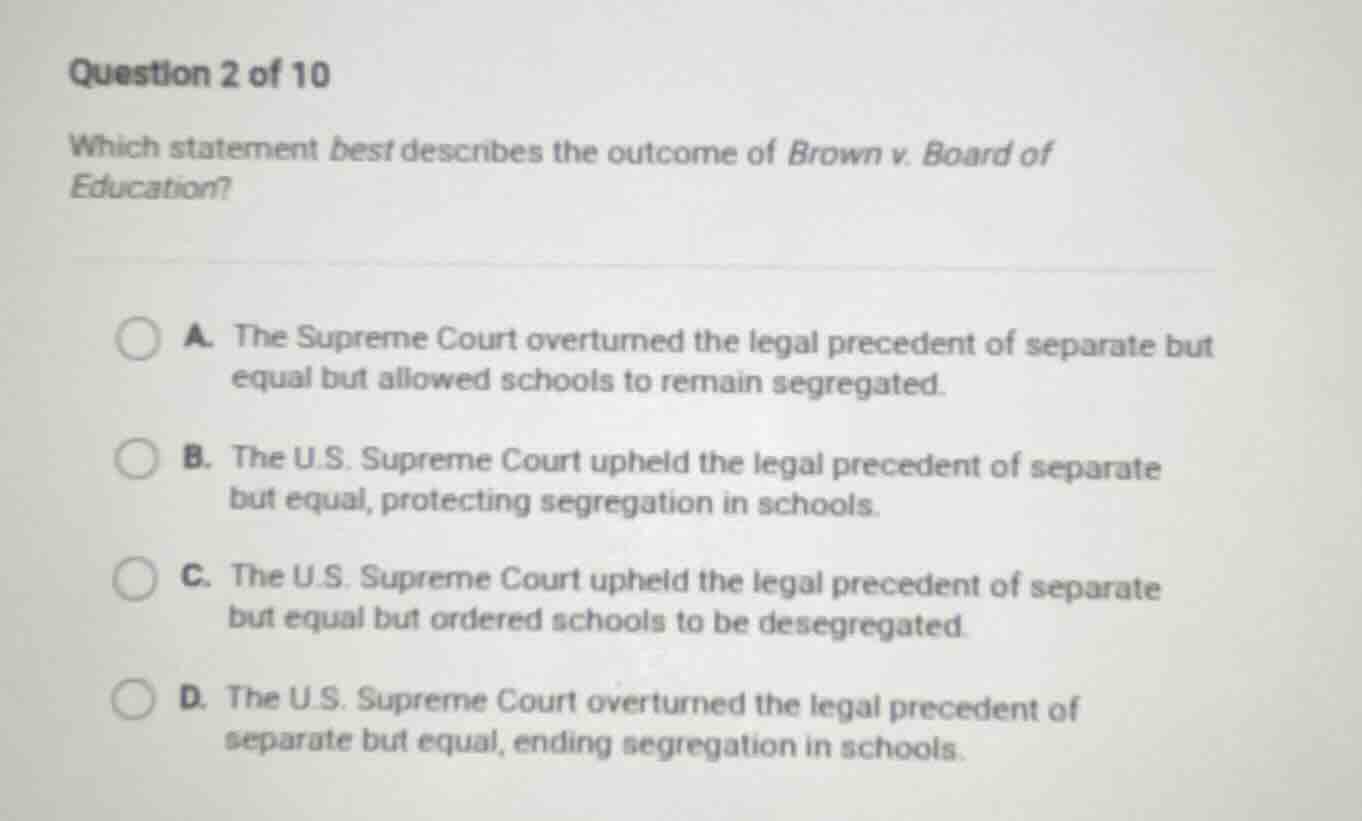
which statement best describes the outcome of brown v. board of education?
a. the supreme court overturned the legal precedent of separate but equal but allowed schools to remain segregated.
b. the u.s. supreme court upheld the legal precedent of separate but equal, protecting segregation in schools.
c. the u.s. supreme court upheld the legal precedent of separate but equal but ordered schools to be desegregated.
d. the u.s. supreme court overturned the legal precedent of separate but equal, ending segregation in schools.
Identify the core legal question
The question asks for the statement that best describes the outcome of the landmark Supreme Court case Brown v. Board of Education (1954).
Analyze the historical precedent
Prior to 1954, the legal standard for racial segregation in public facilities was established by the 1896 case Plessy v. Ferguson, which created the Separate but Equal Doctrine. This doctrine ruled that racially segregated public facilities did not violate the Fourteenth Amendment as long as they were equal in quality.
Evaluate the ruling of Brown v. Board of Education
In Brown v. Board of Education, the Supreme Court unanimously ruled that "separate educational facilities are inherently unequal." This landmark decision directly overturned the Separate but Equal Doctrine established in Plessy v. Ferguson, declaring segregation in public schools unconstitutional and legally ending state-sponsored school segregation.
Assess the given options
- Option A is incorrect because the Court did not allow public schools to remain legally segregated.
- Option B is incorrect because the Court overturned, rather than upheld, the precedent of separate but equal.
- Option C is incorrect because it states the Court upheld the precedent of separate but equal.
- Option D is correct because it accurately states that the Supreme Court overturned the legal precedent of separate but equal, ending legal segregation in public schools.

Snap & solve any problem in the app
Get step-by-step solutions on Sovi AI
Photo-based solutions with guided steps
Explore more problems and detailed explanations
- (A) The Supreme Court overturned the legal precedent of separate but equal but allowed schools to remain segregated.
- (B) The U.S. Supreme Court upheld the legal precedent of separate but equal, protecting segregation in schools.
- (C) The U.S. Supreme Court upheld the legal precedent of separate but equal but ordered schools to be desegregated.
- (D) The U.S. Supreme Court overturned the legal precedent of separate but equal, ending segregation in schools. (Correct answer)