QUESTION IMAGE
Question
question 4 of 10
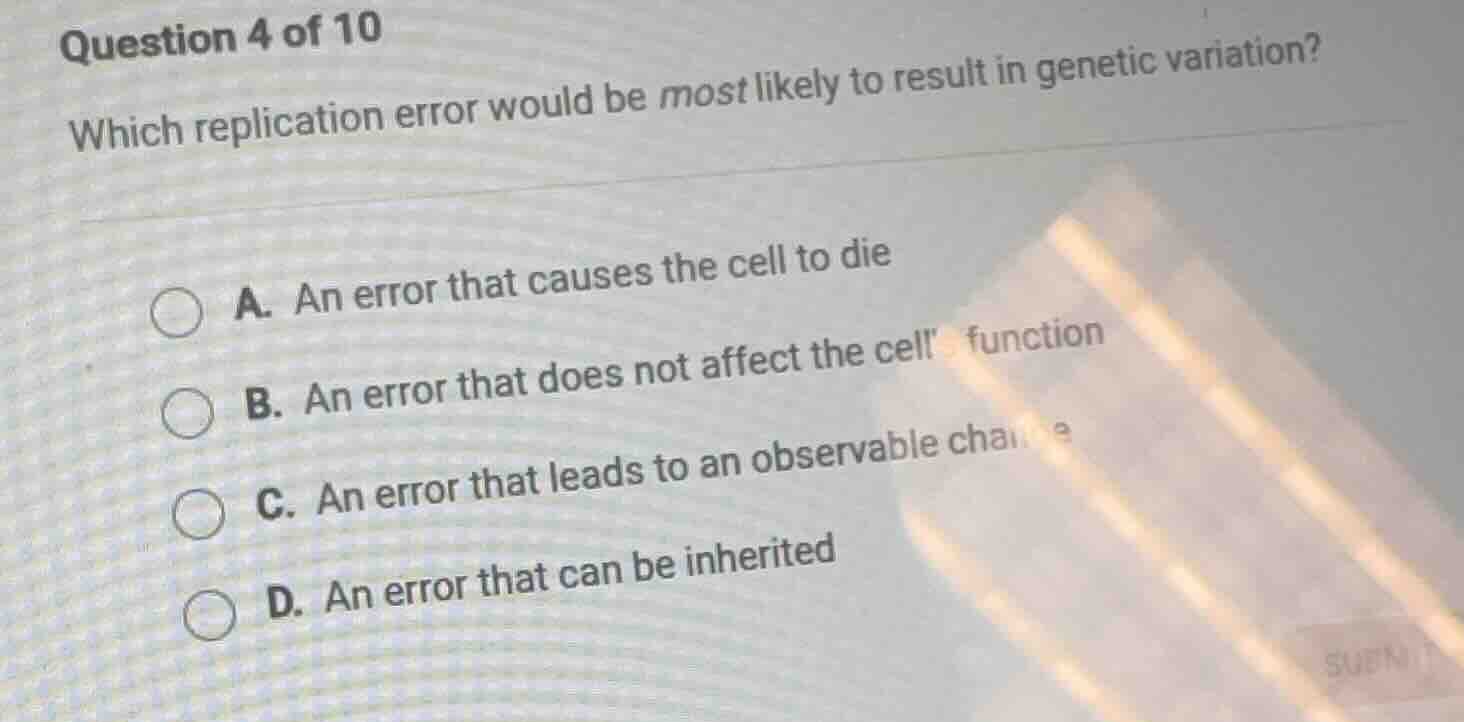
which replication error would be most likely to result in genetic variation?
a. an error that causes the cell to die
b. an error that does not affect the cells function
c. an error that leads to an observable change
d. an error that can be inherited
<pre_analysis>
{
"quality": "clear",
"question_count": 1,
"skills_matched": [
"direct_cot",
"multiple_choice_formatter",
"explain_then_answer",
"tutor"
],
"needs_drawing": false,
"concepts_used": [
"DNA Replication Errors",
"Genetic Variation"
],
"new_concepts": [],
"current_concepts": [
"DNA Replication Errors",
"Genetic Variation",
"Heritability"
]
}
</pre_analysis>
<reasoning>
Analyze the requirements for genetic variation
To contribute to Genetic Variation within a population, a genetic change or mutation must persist and spread. If a replication error occurs in a somatic cell or causes cell death, it cannot be passed down to future generations. Therefore, the most critical factor for a replication error to result in long-term genetic variation in a population is that it must be capable of being passed on to offspring.
Evaluate the given options
- Option A: If an error causes the cell to die, the genetic change is lost immediately and cannot contribute to variation.
- Option B: An error that does not affect cell function (such as a silent mutation) might persist, but it does not produce a phenotypic change that contributes to observable variation, and its impact is limited if it cannot be inherited.
- Option C: An observable change in a single somatic cell does not lead to population-wide variation unless it can be transmitted to the next generation.
- Option D: An error that can be inherited (occurring in germline cells) is transmitted to offspring, directly introducing new alleles into the gene pool and resulting in Genetic Variation.
Determine the correct choice
Based on the principles of DNA Replication Errors and how they relate to evolution and population genetics, heritability is the key mechanism that allows replication errors to become a source of lasting genetic diversity. Thus, Option D is the correct choice.
</reasoning>
<answer>
<mcq-option>(A) An error that causes the cell to die</mcq-option>
<mcq-option>(B) An error that does not affect the cell's function</mcq-option>
<mcq-option>(C) An error that leads to an observable change</mcq-option>
<mcq-correct>(D) An error that can be inherited</mcq-correct>
</answer>
<post_analysis>
{
"subject": "Natural Science",
"question_type": "Multiple Choice",
"knowledge_point": [
"Natural Science",
"Biology",
"Genetics"
]
}
</post_analysis>
Snap & solve any problem in the app
Get step-by-step solutions on Sovi AI
Photo-based solutions with guided steps
Explore more problems and detailed explanations
<pre_analysis>
{
"quality": "clear",
"question_count": 1,
"skills_matched": [
"direct_cot",
"multiple_choice_formatter",
"explain_then_answer",
"tutor"
],
"needs_drawing": false,
"concepts_used": [
"DNA Replication Errors",
"Genetic Variation"
],
"new_concepts": [],
"current_concepts": [
"DNA Replication Errors",
"Genetic Variation",
"Heritability"
]
}
</pre_analysis>
<reasoning>
Analyze the requirements for genetic variation
To contribute to Genetic Variation within a population, a genetic change or mutation must persist and spread. If a replication error occurs in a somatic cell or causes cell death, it cannot be passed down to future generations. Therefore, the most critical factor for a replication error to result in long-term genetic variation in a population is that it must be capable of being passed on to offspring.
Evaluate the given options
- Option A: If an error causes the cell to die, the genetic change is lost immediately and cannot contribute to variation.
- Option B: An error that does not affect cell function (such as a silent mutation) might persist, but it does not produce a phenotypic change that contributes to observable variation, and its impact is limited if it cannot be inherited.
- Option C: An observable change in a single somatic cell does not lead to population-wide variation unless it can be transmitted to the next generation.
- Option D: An error that can be inherited (occurring in germline cells) is transmitted to offspring, directly introducing new alleles into the gene pool and resulting in Genetic Variation.
Determine the correct choice
Based on the principles of DNA Replication Errors and how they relate to evolution and population genetics, heritability is the key mechanism that allows replication errors to become a source of lasting genetic diversity. Thus, Option D is the correct choice.
</reasoning>
<answer>
<mcq-option>(A) An error that causes the cell to die</mcq-option>
<mcq-option>(B) An error that does not affect the cell's function</mcq-option>
<mcq-option>(C) An error that leads to an observable change</mcq-option>
<mcq-correct>(D) An error that can be inherited</mcq-correct>
</answer>
<post_analysis>
{
"subject": "Natural Science",
"question_type": "Multiple Choice",
"knowledge_point": [
"Natural Science",
"Biology",
"Genetics"
]
}
</post_analysis>