QUESTION IMAGE
Question
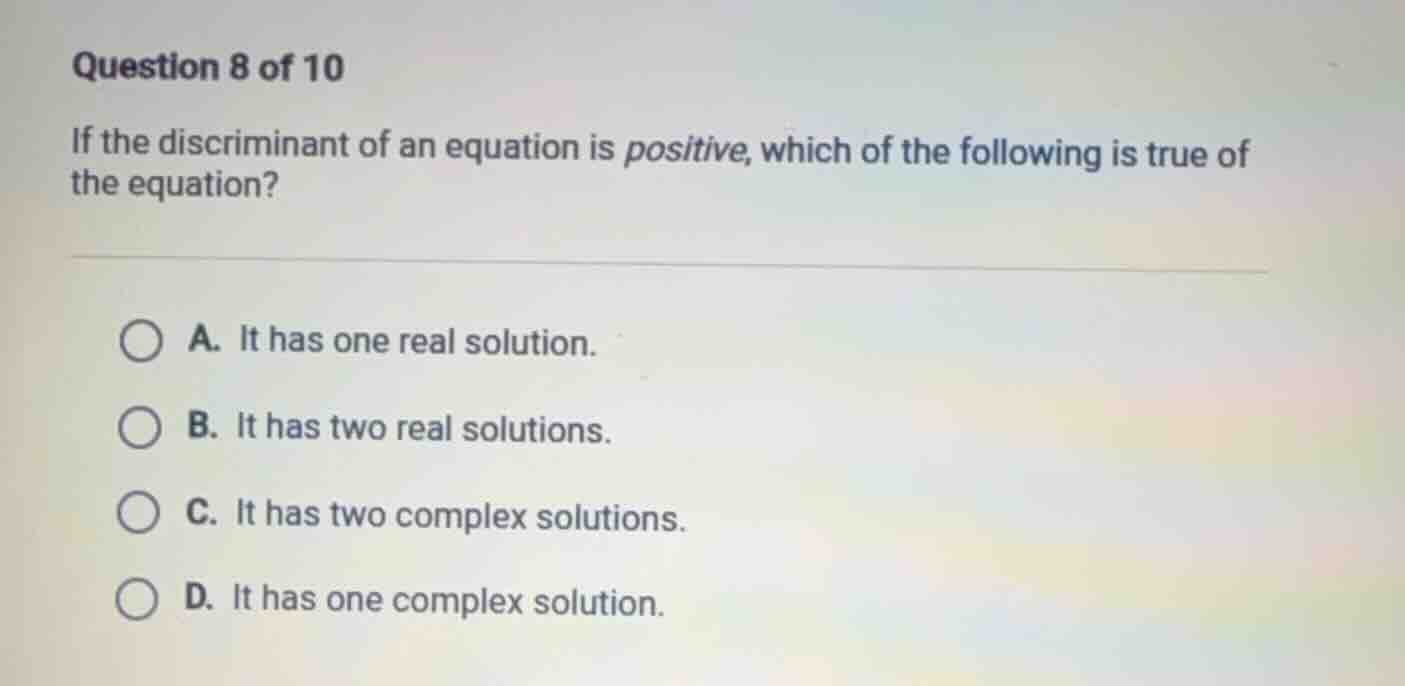
question 8 of 10
if the discriminant of an equation is positive, which of the following is true of
the equation?
a. it has one real solution.
b. it has two real solutions.
c. it has two complex solutions.
d. it has one complex solution.
Brief Explanations
For a quadratic equation \(ax^2 + bx + c = 0\) (where \(a
eq0\)), the discriminant is given by \(D = b^2 - 4ac\). The nature of the roots (solutions) is determined by the discriminant:
- If \(D>0\) (positive), the equation has two distinct real solutions.
- If \(D = 0\), the equation has one real solution (a repeated root).
- If \(D<0\) (negative), the equation has two complex conjugate solutions (since we get a negative number under the square root in the quadratic formula, leading to imaginary parts).
Now let's analyze each option:
- Option A: One real solution occurs when \(D = 0\), not when \(D>0\). So A is incorrect.
- Option B: When the discriminant is positive, the quadratic formula \(\frac{-b\pm\sqrt{D}}{2a}\) will give two distinct real values because \(\sqrt{D}\) is a real number (since \(D>0\)) and we have two different values (\(-b+\sqrt{D}\) and \(-b - \sqrt{D}\)) divided by \(2a\). So B is correct.
- Option C: Two complex solutions occur when \(D<0\), not when \(D>0\). So C is incorrect.
- Option D: The concept of "one complex solution" is not applicable here. Complex solutions for quadratics come in conjugate pairs (two solutions) when \(D<0\), and real solutions when \(D\geq0\). So D is incorrect.

Snap & solve any problem in the app
Get step-by-step solutions on Sovi AI
Photo-based solutions with guided steps
Explore more problems and detailed explanations
B. It has two real solutions.