QUESTION IMAGE
Question
question 10 of 20
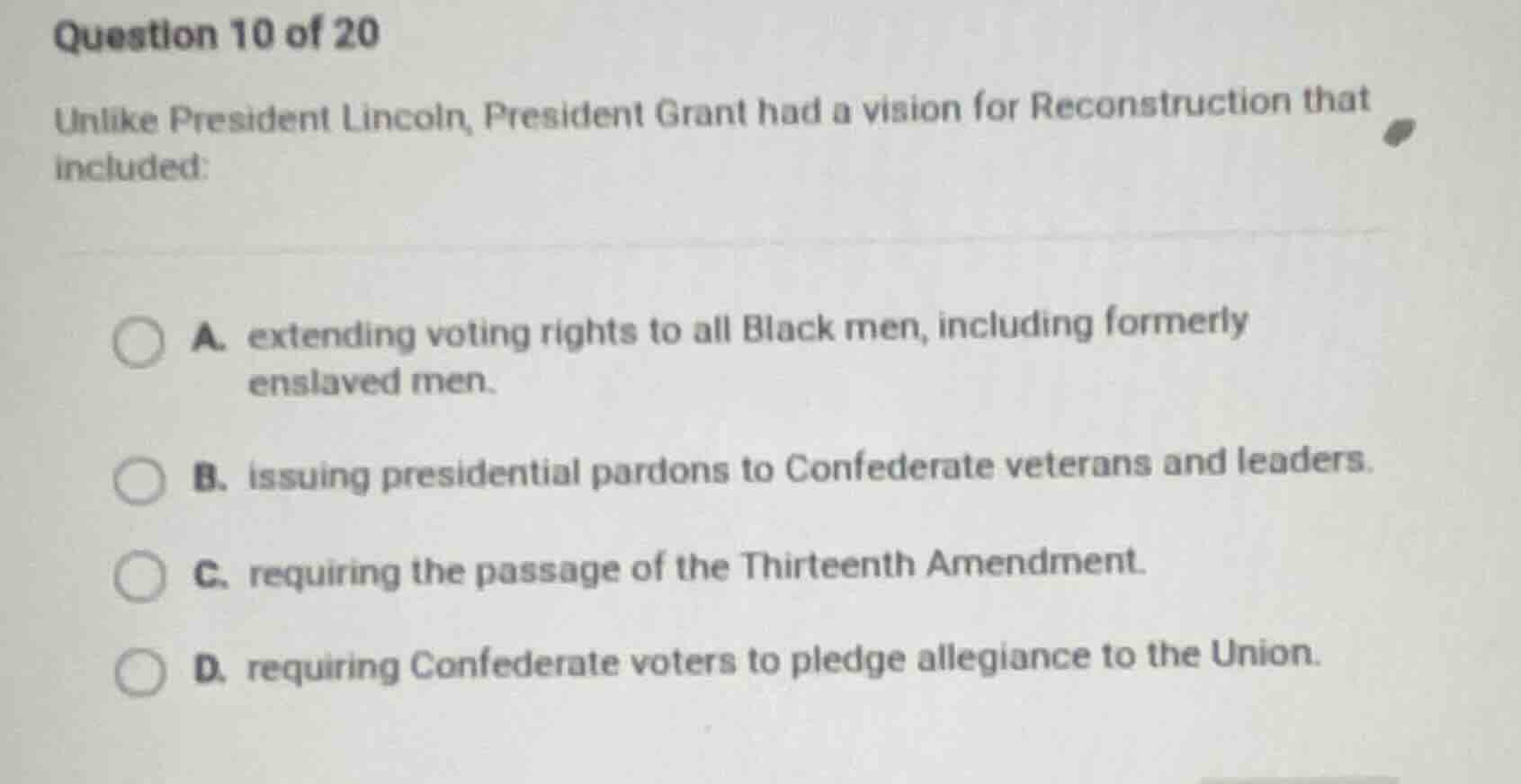
unlike president lincoln, president grant had a vision for reconstruction that included:
a. extending voting rights to all black men, including formerly enslaved men.
b. issuing presidential pardons to confederate veterans and leaders.
c. requiring the passage of the thirteenth amendment.
d. requiring confederate voters to pledge allegiance to the union.
Analyze Lincoln's Reconstruction vision
President Abraham Lincoln's approach to Reconstruction, notably his Lincolns Ten Percent Plan, focused primarily on rapid national reconciliation. While Lincoln supported the abolition of slavery, he did not initially advocate for immediate, universal federal voting rights for all newly freed Black men, preferring a more gradual state-level transition.
Analyze Grant's Reconstruction vision
President Ulysses S. Grant aligned closely with the Radical Republicans. Under Grants Reconstruction Plan, he actively championed and enforced the Fifteenth Amendment, which federally guaranteed that the right to vote could not be denied based on race, color, or previous condition of servitude.
Compare the options
- Option A: Grant supported universal federal voting rights for Black men, whereas Lincoln did not make this a requirement for readmission. This represents a key difference.
- Option B: Both presidents issued pardons, but Lincoln's plan was famously lenient with pardons, making this incorrect as a point of contrast.
- Option C: Lincoln supported the Thirteenth Amendment before his death, so this was not a point of difference.
- Option D: Lincoln's plan explicitly required a percentage of voters to take an oath of allegiance, so this is not unique to Grant.

Snap & solve any problem in the app
Get step-by-step solutions on Sovi AI
Photo-based solutions with guided steps
Explore more problems and detailed explanations
- (A) extending voting rights to all Black men, including formerly enslaved men. (Correct answer)
- (B) issuing presidential pardons to Confederate veterans and leaders.
- (C) requiring the passage of the Thirteenth Amendment.
- (D) requiring Confederate voters to pledge allegiance to the Union.