QUESTION IMAGE
Question
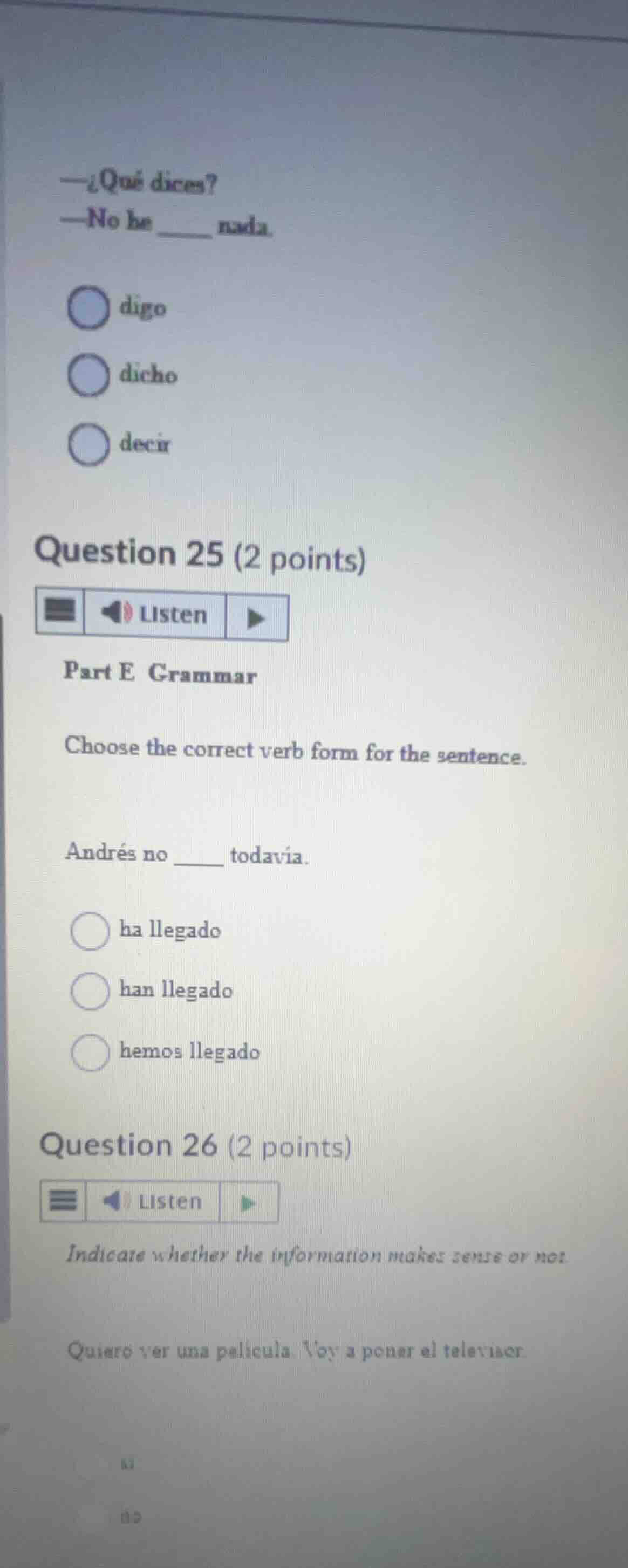
—¿qué dices?
—no he _____ nada.
digo
dicho
decir
question 25 (2 points)
part e grammar
choose the correct verb form for the sentence.
andrés no _____ todavía.
ha llegado
han llegado
hemos llegado
question 26 (2 points)
indicate whether the information makes sense or not.
quiero ver una película. voy a poner el televisor.
<pre_analysis>
{
"quality": "clear",
"question_count": 3,
"skills_matched": [
"direct_cot",
"multiple_choice_formatter",
"explain_then_answer",
"quick"
],
"needs_drawing": false,
"concepts_used": [],
"new_concepts": [
"Spanish Present Perfect",
"Spanish Reading Analysis"
],
"current_concepts": [
"Spanish Present Perfect",
"Spanish Reading Analysis"
]
}
</pre_analysis>
<reasoning>
Analyze the first question
The sentence is: "—¿Qué dices? —No he ______ nada."
The auxiliary verb "he" (from "haber") requires a past participle to form the present perfect tense.
The verb is "decir" (to say/tell), which has an irregular past participle: "dicho".
Therefore, the correct choice is "dicho".
Analyze Question 25
The sentence is: "Andrés no ______ todavía."
The subject is "Andrés" (third-person singular, "él").
The present perfect conjugation of "llegar" for "él" is "ha llegado".
Therefore, the correct choice is "ha llegado".
Analyze Question 26
The prompt is: "Indicate whether the information makes sense or not."
The statement is: "Quiero ver una película. Voy a poner el televisor." (I want to watch a movie. I am going to turn on the television.)
This statement is logically coherent and makes sense.
Therefore, the correct choice is "sí" (yes / makes sense).
</reasoning>
<answer>
Question 1
<mcq-option>digo</mcq-option>
<mcq-correct>dicho</mcq-correct>
<mcq-option>decir</mcq-option>
Question 25
<mcq-correct>ha llegado</mcq-correct>
<mcq-option>han llegado</mcq-option>
<mcq-option>hemos llegado</mcq-option>
Question 26
<mcq-correct>sí</mcq-correct>
<mcq-option>no</mcq-option>
</answer>
<post_analysis>
{
"subject": "Others",
"question_type": "Multiple Choice",
"knowledge_point": [
"Others",
"Spanish",
"Spanish Present Perfect"
]
}
</post_analysis>
Snap & solve any problem in the app
Get step-by-step solutions on Sovi AI
Photo-based solutions with guided steps
Explore more problems and detailed explanations
<pre_analysis>
{
"quality": "clear",
"question_count": 3,
"skills_matched": [
"direct_cot",
"multiple_choice_formatter",
"explain_then_answer",
"quick"
],
"needs_drawing": false,
"concepts_used": [],
"new_concepts": [
"Spanish Present Perfect",
"Spanish Reading Analysis"
],
"current_concepts": [
"Spanish Present Perfect",
"Spanish Reading Analysis"
]
}
</pre_analysis>
<reasoning>
Analyze the first question
The sentence is: "—¿Qué dices? —No he ______ nada."
The auxiliary verb "he" (from "haber") requires a past participle to form the present perfect tense.
The verb is "decir" (to say/tell), which has an irregular past participle: "dicho".
Therefore, the correct choice is "dicho".
Analyze Question 25
The sentence is: "Andrés no ______ todavía."
The subject is "Andrés" (third-person singular, "él").
The present perfect conjugation of "llegar" for "él" is "ha llegado".
Therefore, the correct choice is "ha llegado".
Analyze Question 26
The prompt is: "Indicate whether the information makes sense or not."
The statement is: "Quiero ver una película. Voy a poner el televisor." (I want to watch a movie. I am going to turn on the television.)
This statement is logically coherent and makes sense.
Therefore, the correct choice is "sí" (yes / makes sense).
</reasoning>
<answer>
Question 1
<mcq-option>digo</mcq-option>
<mcq-correct>dicho</mcq-correct>
<mcq-option>decir</mcq-option>
Question 25
<mcq-correct>ha llegado</mcq-correct>
<mcq-option>han llegado</mcq-option>
<mcq-option>hemos llegado</mcq-option>
Question 26
<mcq-correct>sí</mcq-correct>
<mcq-option>no</mcq-option>
</answer>
<post_analysis>
{
"subject": "Others",
"question_type": "Multiple Choice",
"knowledge_point": [
"Others",
"Spanish",
"Spanish Present Perfect"
]
}
</post_analysis>