QUESTION IMAGE
Question
prove that the two circles shown below are similar. (10 points)
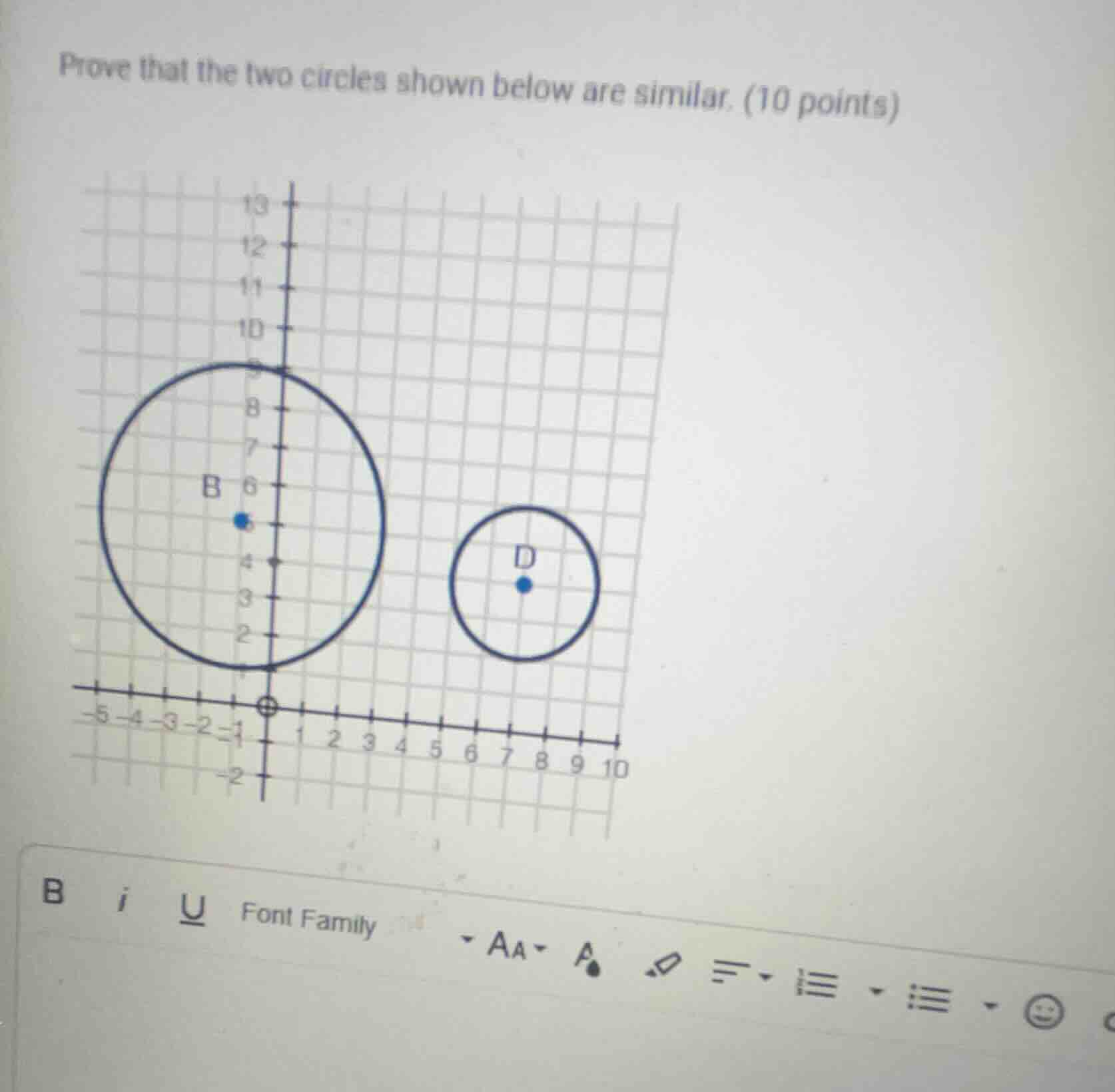
Identify circle centers and radii
Using the Circle Geometry knowledge point, we first determine the coordinates of the center and the length of the radius for each circle from the given coordinate grid.
For Circle \(B\):
- Center \(B = (-1, 5)\)
- The circle passes through \((-1, 9)\) and \((-1, 1)\), so the radius is:
For Circle \(D\):
- Center \(D = (7.5, 3.5)\)
- The circle passes through \((7.5, 5.5)\) and \((7.5, 1.5)\), so the radius is:
Translate Circle B to align centers
To show similarity, we can map Circle \(B\) onto Circle \(D\) using a sequence of similarity transformations (translation and dilation).
First, translate Circle \(B\) so that its center \(B(-1, 5)\) coincides with the center \(D(7.5, 3.5)\).
The translation vector \(\vec{v}\) is:
This translation maps any point \((x, y)\) on Circle \(B\) to \((x + 8.5, y - 1.5)\), resulting in a concentric circle centered at \(D\) with radius \(r_B = 4\).
Dilate the translated circle
Next, dilate the translated circle about its new center \(D(7.5, 3.5)\) to match the radius of Circle \(D\).
The scale factor \(k\) is the ratio of the target radius to the starting radius:
A dilation by a scale factor of \(0.5\) centered at \(D\) maps the radius of \(4\) to a radius of \(2\), perfectly coinciding with Circle \(D\).
Conclude the similarity proof
Since a sequence of similarity transformations (a translation followed by a dilation) maps Circle \(B\) exactly onto Circle \(D\), the two circles are similar.

Snap & solve any problem in the app
Get step-by-step solutions on Sovi AI
Photo-based solutions with guided steps
Explore more problems and detailed explanations
To prove that Circle \(B\) and Circle \(D\) are similar, we establish a sequence of similarity transformations that maps Circle \(B\) onto Circle \(D\):
- Identify Key Properties:
- Circle \(B\) has center \(B(-1, 5)\) and radius \(r_B = 4\).
- Circle \(D\) has center \(D(7.5, 3.5)\) and radius \(r_D = 2\).
- Translation:
Translate Circle \(B\) by the vector \(\langle 8.5, -1.5
angle\) so that its center \(B(-1, 5)\) maps directly onto center \(D(7.5, 3.5)\).
- Dilation:
Dilate the translated circle about its center \(D\) by a scale factor of:
Because a translation and a dilation map Circle \(B\) precisely onto Circle \(D\), the two circles are similar.