QUESTION IMAGE
Question
prove: if two angles are supplementary, then one of the angles must be obtuse.
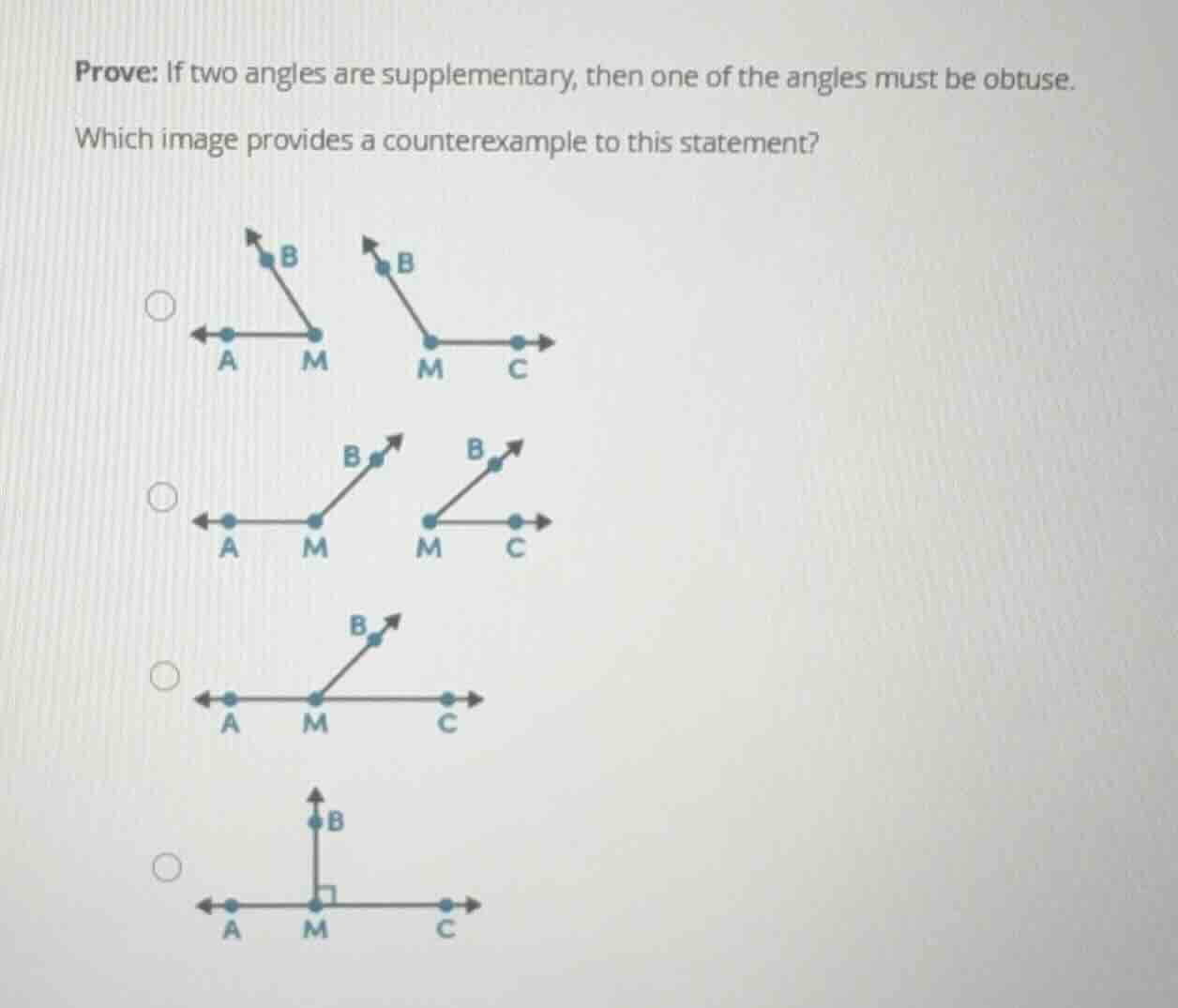
which image provides a counterexample to this statement?
Analyze the conditional statement
The statement is: "If two angles are supplementary, then one of the angles must be obtuse."
A counterexample must satisfy the hypothesis (two angles are supplementary) but violate the conclusion (neither angle is obtuse).
Evaluate the conditions for a counterexample
- Supplementary angles sum to \(180^\circ\).
- An obtuse angle is strictly greater than \(90^\circ\) and less than \(180^\circ\).
- To violate the conclusion, both supplementary angles must be non-obtuse (i.e., acute or right angles).
- Two right angles (\(90^\circ\) and \(90^\circ\)) sum to \(180^\circ\) (supplementary), and neither is obtuse.
Identify the matching image
The fourth option shows a line \(AC\) with a perpendicular ray \(MB\), creating two adjacent right angles, \(\angle AMB\) and \(\angle BMC\). Both are \(90^\circ\) (right angles), which are supplementary but neither is obtuse.

Snap & solve any problem in the app
Get step-by-step solutions on Sovi AI
Photo-based solutions with guided steps
Explore more problems and detailed explanations
- (A) Two separate angles: one acute and one obtuse
- (B) Two separate acute angles
- (C) A linear pair consisting of one acute and one obtuse angle
- (D) A linear pair consisting of two right angles (Correct answer)