QUESTION IMAGE
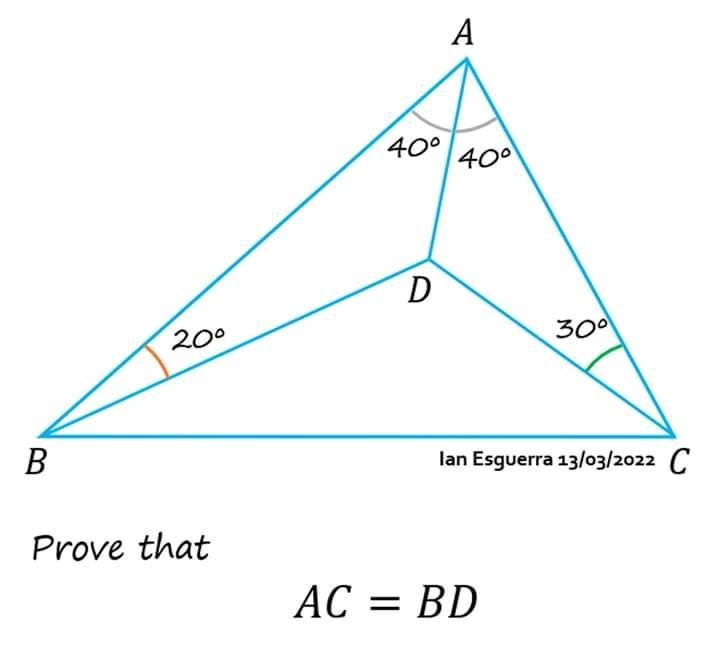
Question
prove that
\ac = bd\\
🆕 New Concept Discovered: Trigonometric Form of Ceva's Theorem
Using ratios of sines to relate non-adjacent segments and angles.
Step 1: Identify the given angles
Let the angles at the vertices be split by the interior lines meeting at point \(D\):
- At vertex \(A\): \(\angle BAD = 40^\circ\) and \(\angle CAD = 40^\circ\). Thus, \(AD\) is the angle bisector of \(\angle BAC\), and \(\angle BAC = 80^\circ\).
- At vertex \(B\): \(\angle ABD = 20^\circ\). Let \(\angle DBC = x\).
- At vertex \(C\): \(\angle ACD = 30^\circ\). Let \(\angle DCB = y\).
Step 2: Apply the Law of Sines in triangles containing the segments of interest
To prove that \(AC = BD\), we can express both lengths in terms of a common side or use trigonometric relations. Let's apply the Law of Sines in \(\triangle ABD\) and \(\triangle ACD\):
In \(\triangle ABD\):
Using the double-angle identity \(\sin(40^\circ) = 2\sin(20^\circ)\cos(20^\circ)\):
Step 3: Express AC in terms of AD
In \(\triangle ACD\), let \(\angle ADC = \theta\). The sum of angles in \(\triangle ACD\) is:
Now, apply the Law of Sines in \(\triangle ACD\):
Since \(\sin(110^\circ) = \sin(180^\circ - 70^\circ) = \sin(70^\circ) = \cos(20^\circ)\), and \(\sin(30^\circ) = \frac{1}{2}\):
Step 4: Compare the expressions for BD and AC
From Step 2, we have:
From Step 3, we have:
Since both segments are equal to the same expression:

Snap & solve any problem in the app
Get step-by-step solutions on Sovi AI
Photo-based solutions with guided steps
Explore more problems and detailed explanations
By applying the Law of Sines to \(\triangle ABD\) and \(\triangle ACD\):
- In \(\triangle ABD\):
- In \(\triangle ACD\):
Therefore, \(AC = BD\).