QUESTION IMAGE
Question
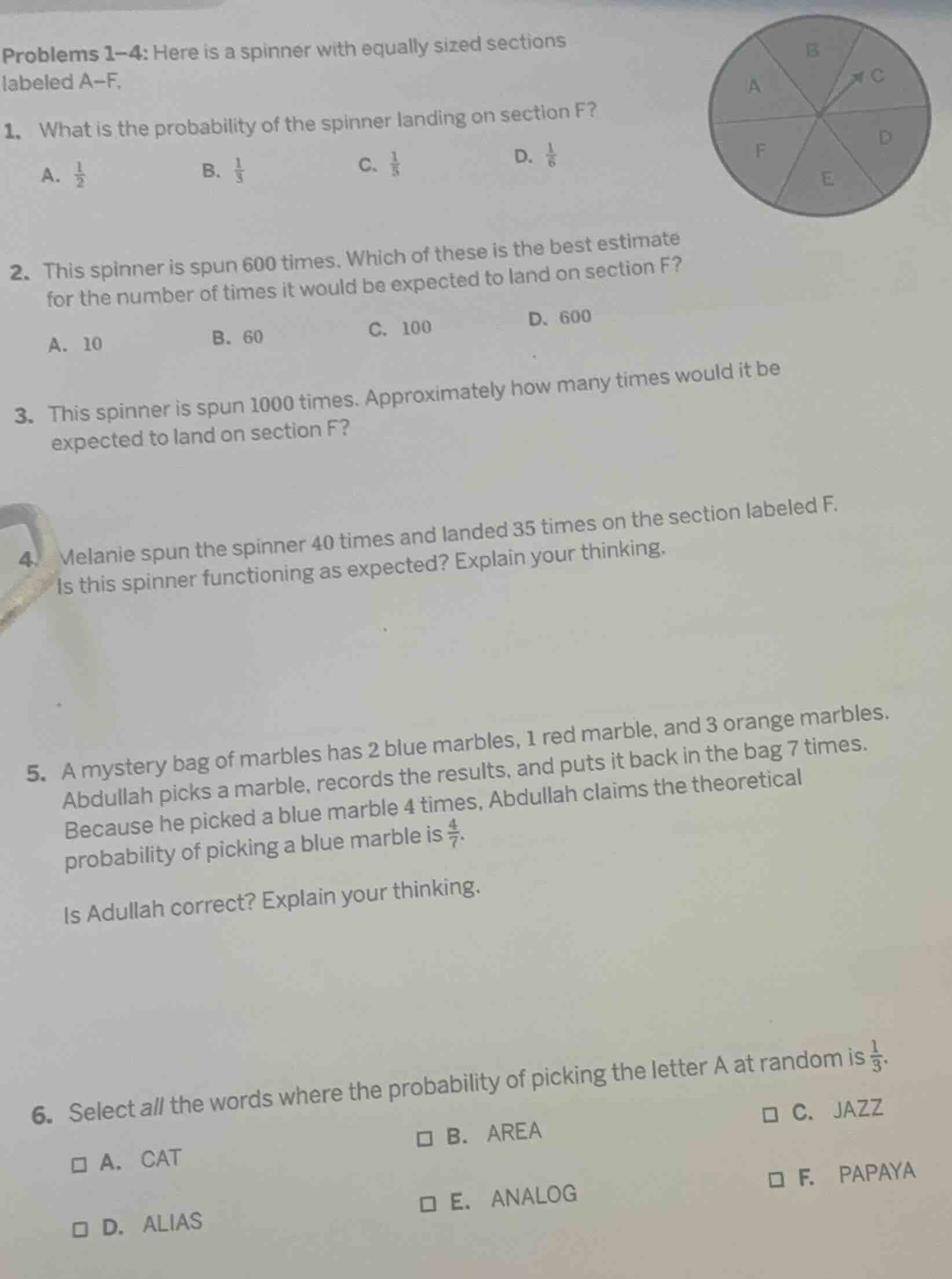
problems 1-4: here is a spinner with equally sized sections labeled a-f.
- what is the probability of the spinner landing on section f?
a. \\(\frac{1}{2}\\)
b. \\(\frac{1}{3}\\)
c. \\(\frac{1}{5}\\)
d. \\(\frac{1}{6}\\)
- this spinner is spun 600 times. which of these is the best estimate for the number of times it would be expected to land on section f?
a. 10
b. 60
c. 100
d. 600
- this spinner is spun 1000 times. approximately how many times would it be expected to land on section f?
- melanie spun the spinner 40 times and landed 35 times on the section labeled f. is this spinner functioning as expected? explain your thinking.
- a mystery bag of marbles has 2 blue marbles, 1 red marble, and 3 orange marbles. abdullah picks a marble, records the results, and puts it back in the bag 7 times. because he picked a blue marble 4 times, abdullah claims the theoretical probability of picking a blue marble is \\(\frac{4}{7}\\).
is abdullah correct? explain your thinking.
- select all the words where the probability of picking the letter a at random is \\(\frac{1}{3}\\).
a. cat
b. area
c. jazz
d. alias
e. analog
f. papaya
Determine probability of landing on F
The spinner has 6 equally sized sections labeled A, B, C, D, E, and F.
The theoretical probability \(P(F)\) of landing on section F is:
Calculate expected value for 600 spins
Using the theoretical probability \(P(F) = \frac{1}{6}\), the expected number of times to land on F in 600 spins is:
Calculate expected value for 1000 spins
The expected number of times to land on F in 1000 spins is:
Rounding to the nearest whole number gives approximately 167 times.
Analyze spinner functionality
Melanie landed on F 35 times out of 40 spins.
The experimental probability is:
The theoretical probability is:
Since \(0.875\) is significantly higher than \(0.167\), the spinner is not functioning as expected (it is likely biased or unfair).
Evaluate Abdullah's probability claim
The bag contains 2 blue, 1 red, and 3 orange marbles, totaling \(2 + 1 + 3 = 6\) marbles.
The theoretical probability of picking a blue marble is:
Abdullah calculated the experimental probability \(\frac{4}{7}\) based on his 7 trials.
Abdullah is incorrect because theoretical probability is based on the physical composition of the bag, not the results of a small sample of trials.
Analyze letter probabilities in words
We calculate the probability of picking 'A' at random from each word:
- CAT: 3 letters, 1 'A' \(
ightarrow P(A) = \frac{1}{3}\)
- AREA: 4 letters, 2 'A's \(
ightarrow P(A) = \frac{2}{4} = \frac{1}{2}\)
- JAZZ: 4 letters, 1 'A' \(
ightarrow P(A) = \frac{1}{4}\)
- ALIAS: 5 letters, 2 'A's \(
ightarrow P(A) = \frac{2}{5}\)
- ANALOG: 6 letters, 2 'A's \(
ightarrow P(A) = \frac{2}{6} = \frac{1}{3}\)
- PAPAYA: 6 letters, 3 'A's \(
ightarrow P(A) = \frac{3}{6} = \frac{1}{2}\)
The words with a probability of \(\frac{1}{3}\) are CAT and ANALOG.

Snap & solve any problem in the app
Get step-by-step solutions on Sovi AI
Photo-based solutions with guided steps
Explore more problems and detailed explanations
Question 1
- A. \(\frac{1}{2}\)
- B. \(\frac{1}{3}\)
- C. \(\frac{1}{5}\)
- D. \(\frac{1}{6}\) (Correct answer)
Question 2
- A. 10
- B. 60
- C. 100 (Correct answer)
- D. 600
Question 3
Approximately 167 times (or about 166.7 times).
Question 4
No, the spinner is not functioning as expected. The experimental probability of landing on F is \(\frac{35}{40} = 87.5\%\), which is extremely high compared to the theoretical probability of \(\frac{1}{6} \approx 16.7\%\).
Question 5
No, Abdullah is incorrect. The theoretical probability is determined by the ratio of blue marbles to the total number of marbles in the bag, which is \(\frac{2}{6} = \frac{1}{3}\). Abdullah confused experimental probability (\(\frac{4}{7}\)) with theoretical probability.
Question 6
- A. CAT (Correct answer)
- B. AREA
- C. JAZZ
- D. ALIAS
- E. ANALOG (Correct answer)
- F. PAPAYA