QUESTION IMAGE
Question
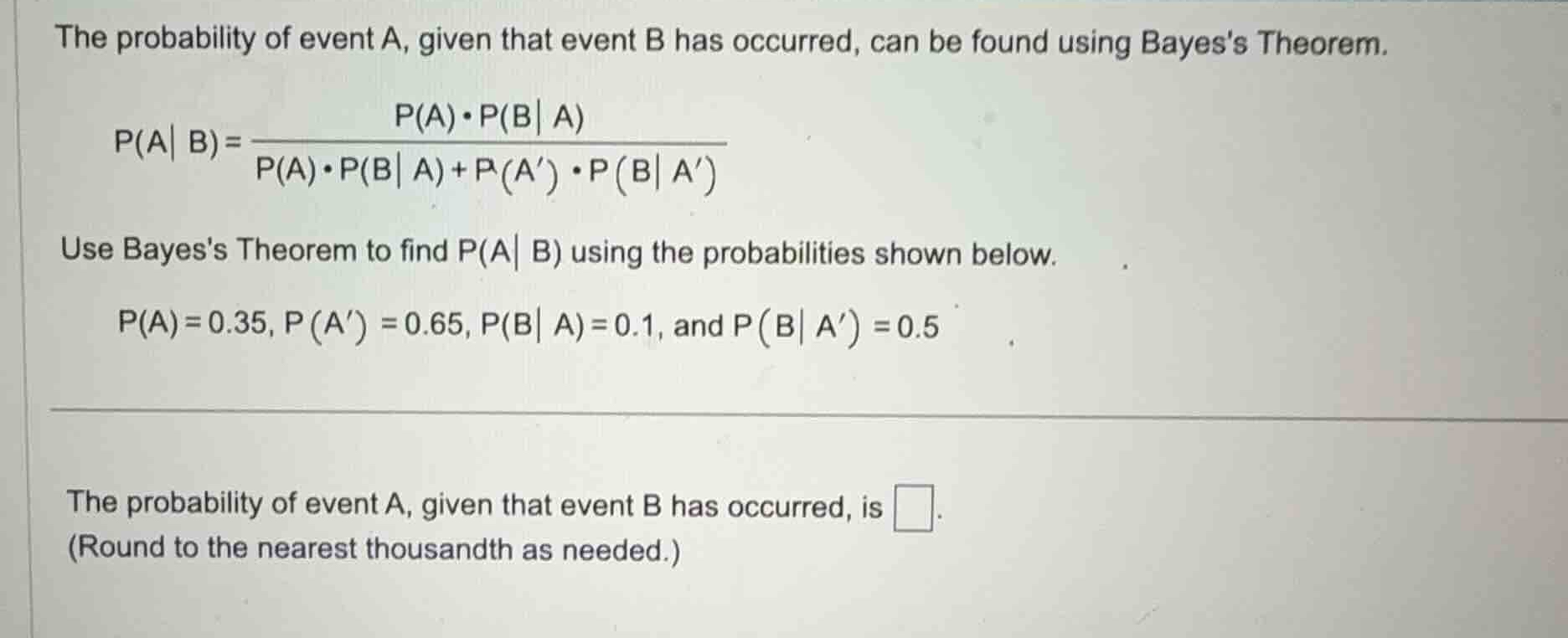
the probability of event a, given that event b has occurred, can be found using bayess theorem.
\\p(a \mid b) = \frac{p(a) \cdot p(b \mid a)}{p(a) \cdot p(b \mid a) + p(a) \cdot p(b \mid a)}\\
use bayess theorem to find \\(p(a \mid b)\\) using the probabilities shown below.
\\(p(a) = 0.35\\), \\(p(a) = 0.65\\), \\(p(b \mid a) = 0.1\\), and \\(p(b \mid a) = 0.5\\)
the probability of event a, given that event b has occurred, is .
(round to the nearest thousandth as needed.)
Identify the given probabilities
Using the Conditional Probability Notation knowledge point, we extract the values from the problem statement:
Calculate the joint probabilities
Using the Joint Probability Calculation knowledge point:
Calculate total probability of event B
We sum the joint probabilities to find the total probability of the conditioning event:
Apply Bayes's Theorem
We substitute the calculated values into the formula to find the posterior probability:
Simplify and round the final value
We perform the division and round to the nearest thousandth:

Snap & solve any problem in the app
Get step-by-step solutions on Sovi AI
Photo-based solutions with guided steps
Explore more problems and detailed explanations
The probability of event A, given that event B has occurred, is <blank>0.097</blank>.