QUESTION IMAGE
Question
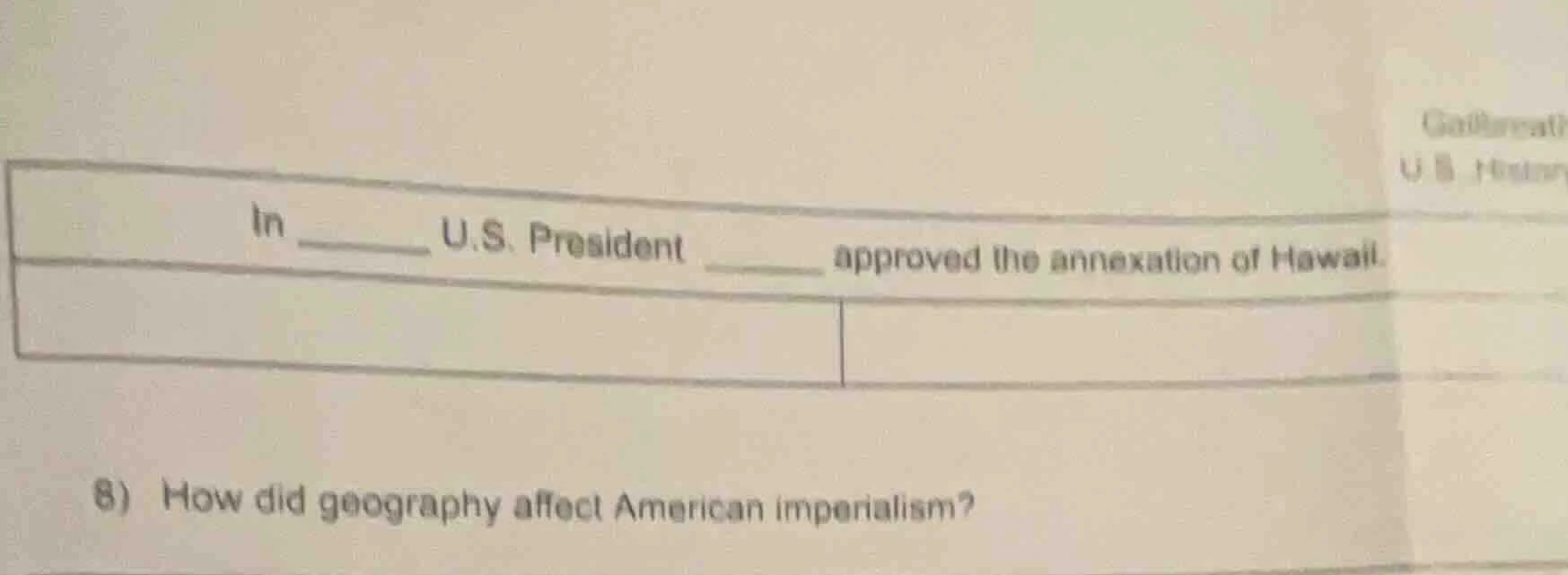
in ____ u.s. president ____ approved the annexation of hawaii.
- how did geography affect american imperialism?
For the fill - in - the - blank question:
Brief Explanations
To answer the fill - in - the - blank “In ____ U.S. President ____ approved the annexation of Hawaii”, we refer to historical facts. In 1898, U.S. President William McKinley approved the annexation of Hawaii.
Brief Explanations
- Strategic Locations: Places like Hawaii (in the Pacific) and the Philippines (in Southeast Asia) had strategic geographic positions. Hawaii was a mid - Pacific outpost that was valuable for naval operations and trade routes between the U.S. and Asia. The Philippines, with its location in the western Pacific, was seen as a gateway to Asian markets. Controlling these areas allowed the U.S. to project military power and protect its commercial interests in the Pacific and Asian regions.
- Natural Resources: Geographic regions with rich natural resources were targets of American imperialism. For example, in Latin America, countries with resources like rubber, minerals, and agricultural products (such as sugar in Hawaii) were of interest. The U.S. sought to gain access to these resources to fuel its growing industrial economy. Hawaii's fertile lands for sugar cultivation and its potential for other agricultural and later, military uses (due to its location) made it an attractive target for annexation.
- Trade Routes: The U.S. wanted to control key trade routes. The Caribbean and Central American regions (like the area around the future Panama Canal) were important for trade between the Atlantic and Pacific Oceans. By influencing or controlling countries in these regions, the U.S. could ensure the smooth flow of goods to and from its ports and also to international markets. The construction of the Panama Canal was a major example of how geography (the narrow isthmus of Panama) influenced American imperialist efforts to gain a strategic advantage in global trade.
- Borders and Expansion on the Continent: Earlier in American history, the geography of the North American continent influenced westward expansion. The availability of land, the presence of rivers (for transportation and trade), and the natural resources in the western territories (like gold in California) spurred American settlement and the expansion of the nation's territory. This internal expansion was a precursor to later overseas imperialism as the U.S. looked beyond its continental borders for new opportunities.

Snap & solve any problem in the app
Get step-by-step solutions on Sovi AI
Photo-based solutions with guided steps
Explore more problems and detailed explanations
In 1898 U.S. President William McKinley approved the annexation of Hawaii.