QUESTION IMAGE
Question
3.1.d practice: applying reflections
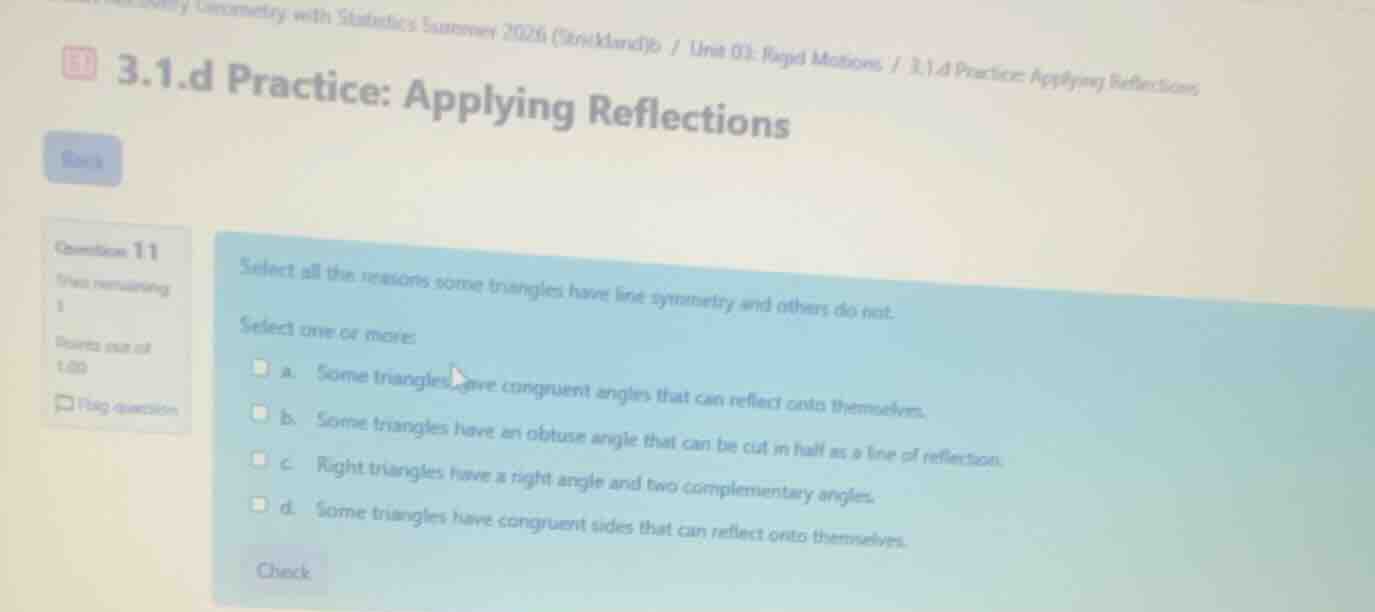
select all the reasons some triangles have line symmetry and others do not.
select one or more:
a. some triangles have congruent angles that can reflect onto themselves.
b. some triangles have an obtuse angle that can be cut in half as a line of reflection.
c. right triangles have a right angle and two complementary angles.
d. some triangles have congruent sides that can reflect onto themselves.
⚡ Using what you learned: Symmetry in Shapes
Step 1: Analyze the conditions for line symmetry in triangles
For a triangle to have line symmetry, it must be possible to draw a line of reflection through it such that one half of the triangle reflects perfectly onto the other half.
- This reflection maps one side of the triangle onto another side of equal length, meaning the triangle must have at least two congruent sides (an isosceles or equilateral triangle).
- This reflection also maps one angle onto another angle of equal measure, meaning the triangle must have at least two congruent angles.
Step 2: Evaluate the given options
- a. Some triangles have congruent angles that can reflect onto themselves.
- True: In an isosceles triangle, the two congruent base angles reflect onto each other across the line of symmetry passing through the vertex angle.
- b. Some triangles have an obtuse angle that can be cut in half as a line of reflection.
- False: Simply having an obtuse angle cut in half does not guarantee symmetry unless the adjacent sides forming that angle are congruent. For example, a scalene obtuse triangle has no line of symmetry.
- c. Right triangles have a right angle and two complementary angles.
- False: While this statement is mathematically true about right triangles, it does not explain why some triangles have line symmetry and others do not. A scalene right triangle has no line of symmetry.
- d. Some triangles have congruent sides that can reflect onto themselves.
- True: In an isosceles or equilateral triangle, the congruent sides reflect onto each other across the line of symmetry.

Snap & solve any problem in the app
Get step-by-step solutions on Sovi AI
Photo-based solutions with guided steps
Explore more problems and detailed explanations
- a. Some triangles have congruent angles that can reflect onto themselves.
- d. Some triangles have congruent sides that can reflect onto themselves.