QUESTION IMAGE
Question
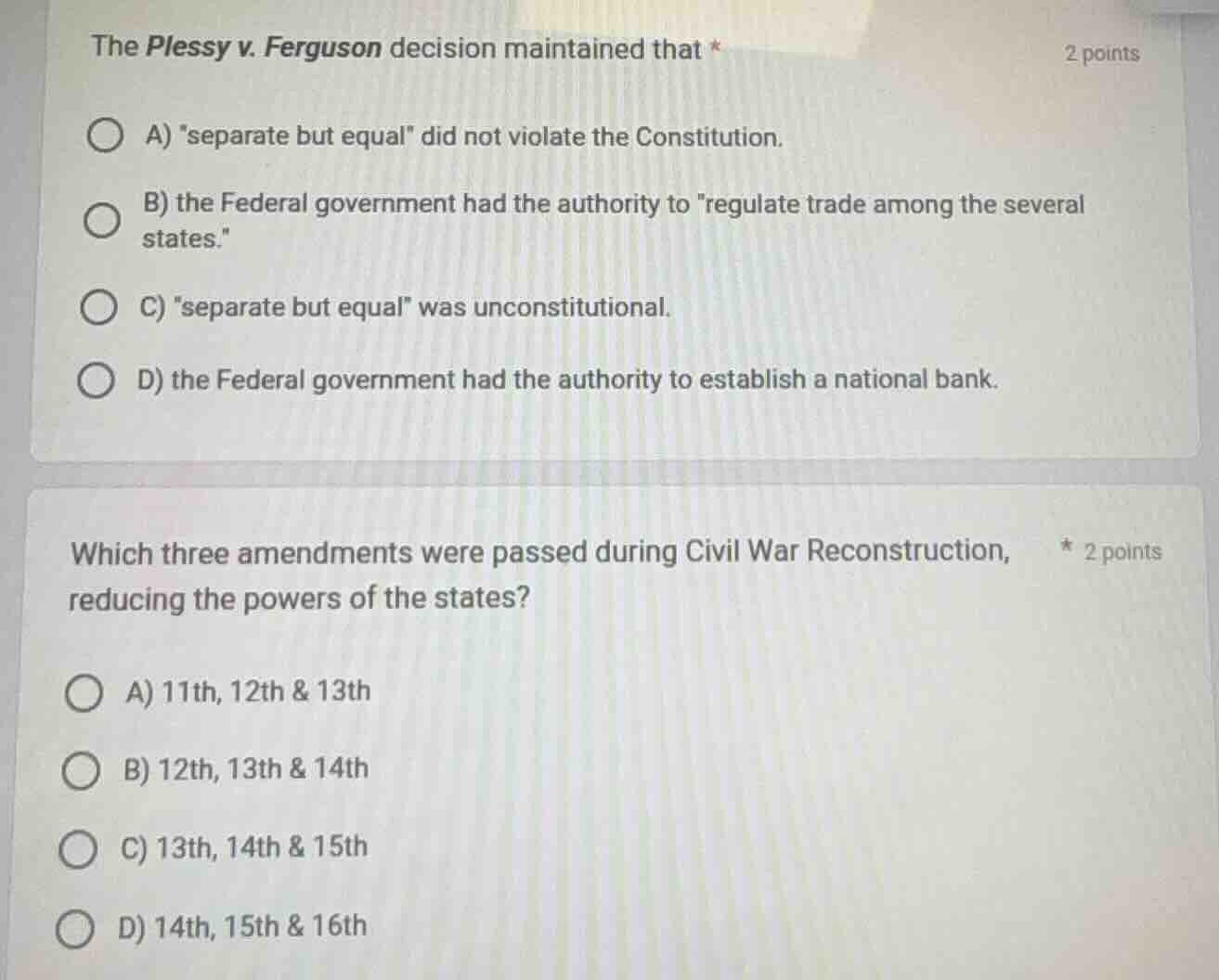
the plessy v. ferguson decision maintained that *
a) \separate but equal\ did not violate the constitution.
b) the federal government had the authority to
egulate trade among the several states.\
c) \separate but equal\ was unconstitutional.
d) the federal government had the authority to establish a national bank.
which three amendments were passed during civil war reconstruction, reducing the powers of the states? *
a) 11th, 12th & 13th
b) 12th, 13th & 14th
c) 13th, 14th & 15th
d) 14th, 15th & 16th
For the first question: Plessy v. Ferguson was a 1896 U.S. Supreme Court case that upheld the legality of racial segregation under the "separate but equal" doctrine, ruling it did not violate the Constitution. Options B and D refer to other federal authority cases, and option C is the opposite of the ruling.
For the second question: The Reconstruction Amendments (passed post-Civil War to expand civil rights and limit state power over marginalized groups) are the 13th (abolished slavery), 14th (equal protection under law), and 15th (voting rights for Black men). The 11th, 12th, and 16th amendments are not part of this Reconstruction set.

Snap & solve any problem in the app
Get step-by-step solutions on Sovi AI
Photo-based solutions with guided steps
Explore more problems and detailed explanations
- A) "separate but equal" did not violate the Constitution.
- C) 13th, 14th & 15th