QUESTION IMAGE
Question
personal care
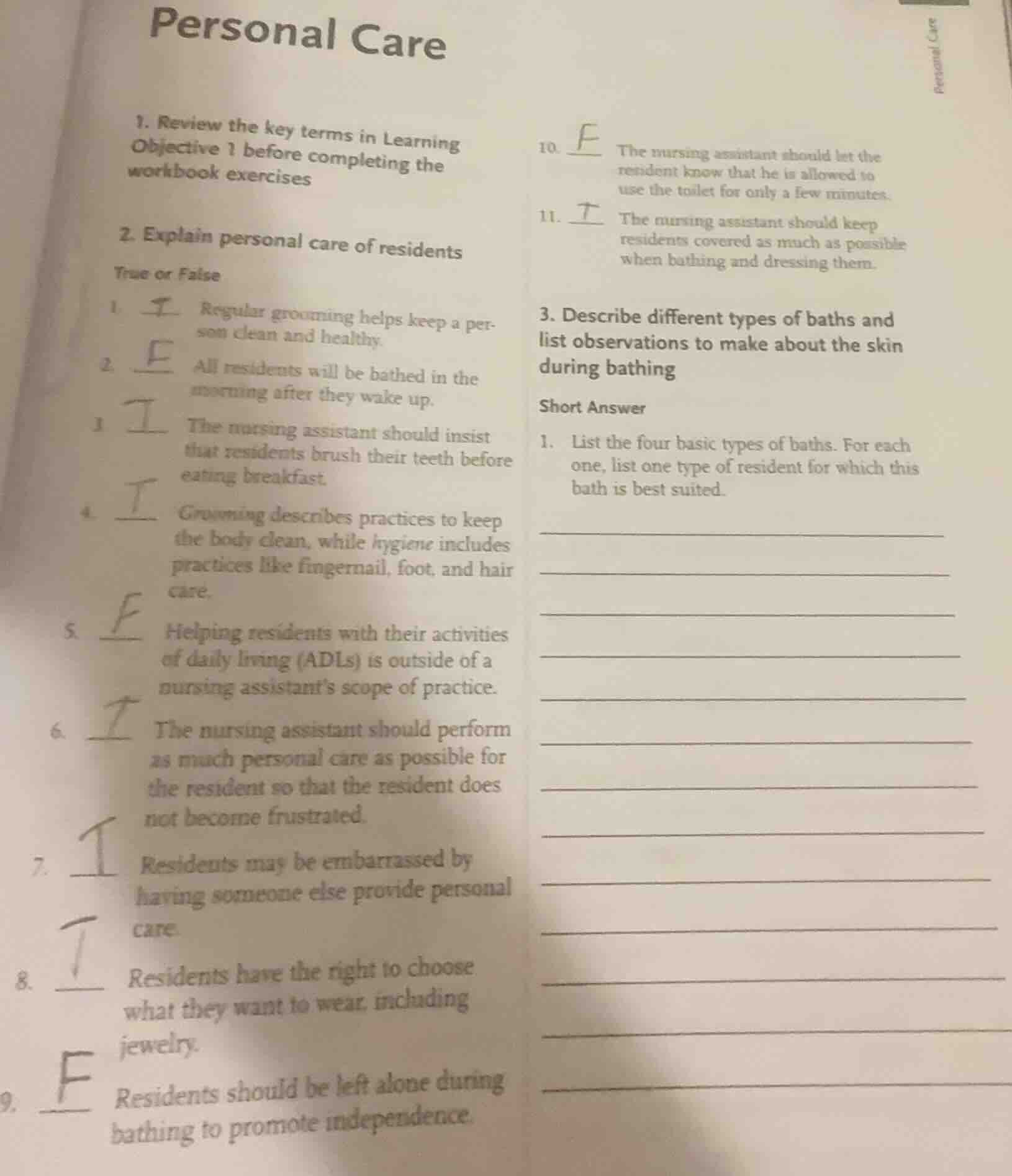
- review the key terms in learning objective 1 before completing the workbook exercises
- explain personal care of residents
true or false
- regular grooming helps keep a person clean and healthy.
- all residents will be bathed in the morning after they wake up.
- the nursing assistant should insist that residents brush their teeth before eating breakfast.
- grooming describes practices to keep the body clean, while hygiene includes practices like fingernail, foot, and hair care.
- helping residents with their activities of daily living (adls) is outside of a nursing assistants scope of practice.
- the nursing assistant should perform as much personal care as possible for the resident so that the resident does not become frustrated.
- residents may be embarrassed by having someone else provide personal care.
- residents have the right to choose what they want to wear, including jewelry.
- residents should be left alone during bathing to promote independence.
- the nursing assistant should let the resident know that he is allowed to use the toilet for only a few minutes.
- the nursing assistant should keep residents covered as much as possible when bathing and dressing them.
- describe different types of baths and list observations to make about the skin during bathing
short answer
- list the four basic types of baths. for each one, list one type of resident for which this bath is best suited.
Identify the four basic types of baths in nursing care
The four basic types of baths commonly taught in nursing assistant curricula are:
- Complete bed bath
- Partial bed bath
- Tub bath
- Shower
Determine the best-suited resident type for each bath
- Complete bed bath: Best suited for residents who are completely bedridden, paralyzed, comatose, or unable to assist with bathing.
- Partial bed bath: Best suited for residents who cannot take a full bath or shower but can wash some parts of their body, or those with very dry/sensitive skin who should not have a full bath daily.
- Tub bath: Best suited for residents who can sit up and support themselves but may have difficulty standing, or those who find a warm soak therapeutic for relaxation or muscle stiffness.
- Shower: Best suited for residents who are able to stand or sit safely on a shower chair and are relatively stable and mobile.

Snap & solve any problem in the app
Get step-by-step solutions on Sovi AI
Photo-based solutions with guided steps
Explore more problems and detailed explanations
- Complete bed bath: Best suited for a resident who is completely bedridden, comatose, or unable to assist with bathing.
- Partial bed bath: Best suited for a resident who cannot tolerate a full bath, has extremely dry skin, or only needs help washing specific areas (like the face, hands, underarms, and perineal area).
- Tub bath: Best suited for a resident who can sit up safely, enjoys soaking, and finds a warm bath therapeutic for relaxation or joint stiffness.
- Shower: Best suited for a resident who is mobile, able to stand safely, or can sit securely on a shower chair.