QUESTION IMAGE
Question
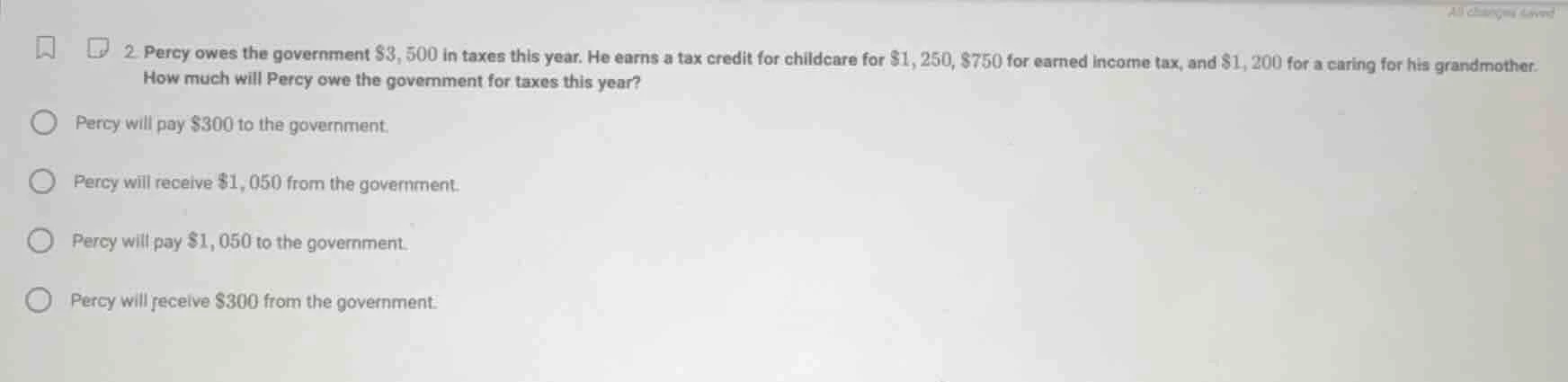
- percy owes the government $3,500 in taxes this year. he earns a tax credit for childcare for $1,250, $750 for earned income tax, and $1,200 for a caring for his grandmother. how much will percy owe the government for taxes this year?
percy will pay $300 to the government.
percy will receive $1,050 from the government.
percy will pay $1,050 to the government.
percy will receive $300 from the government.
Step1: Calculate total tax credits
First, we sum up all the tax credits. The tax credits are $1,250 (childcare), $750 (earned income tax), and $1,200 (caring for grandmother). So, we calculate $1250 + 750 + 1200$.
$1250 + 750 = 2000$, then $2000 + 1200 = 3200$. So total tax credits are $3,200.
Step2: Subtract tax credits from owed taxes
Percy owes $3,500 in taxes. We subtract the total tax credits from the amount owed: $3500 - 3200 = 300$. Wait, no, wait. Wait, tax credits reduce the amount owed. Wait, if owed is $3500 and credits are $3200, then 3500 - 3200 = 300? But that would mean he owes $300? But wait, maybe I miscalculated the credits. Wait, let's recheck: $1,250 + $750 is $2,000, plus $1,200 is $3,200. Then $3,500 - $3,200 = $300. But the options: one says he will pay $300, another says he will receive $300. Wait, tax credits are amounts that reduce the tax liability. So if you owe $3,500 and have $3,200 in credits, then you owe $3,500 - $3,200 = $300. But wait, maybe I made a mistake. Wait, let's check the options again. Wait, the options:
- Percy will pay $300 to the government.
- Percy will receive $1,050 from the government.
- Percy will pay $1,050 to the government.
- Percy will receive $300 from the government.
Wait, maybe my calculation is wrong. Wait, let's recalculate the total tax credits: $1,250 + $750 + $1,200. Let's add $1,250 + $750 first: that's $2,000. Then $2,000 + $1,200 = $3,200. Then the amount owed is $3,500. So $3,500 - $3,200 = $300. So he owes $300, which means he will pay $300 to the government? But wait, maybe the tax credits are refundable? Wait, the problem says "earns a tax credit"—tax credits can be refundable or non - refundable. But in this case, if the tax credit is non - refundable, then you can only use it to reduce the tax to zero. But if it's refundable, you can get the excess back. But the problem is about how much he owes. Wait, maybe I made a mistake in the addition. Wait, $1,250 + $750 is $2,000, plus $1,200 is $3,200. $3,500 - $3,200 is $300. So he still owes $300, so he will pay $300 to the government. But let's check the options. The first option is "Percy will pay $300 to the government." But wait, another way: maybe the tax credits are more than the owed amount? Wait, no, $3,200 is less than $3,500. Wait, no, $3,200 is less than $3,500, so 3500 - 3200 = 300. So he owes $300. So the correct option should be "Percy will pay $300 to the government." But wait, let's check the options again. Wait, the first option is "Percy will pay $300 to the government." The fourth option is "Percy will receive $300 from the government." So which is correct?
Wait, maybe I messed up the direction. Tax credits: if you have a tax credit, it's a reduction in the tax you owe. So if you owe $3,500 and have $3,200 in credits, you owe $3,500 - $3,200 = $300. So you pay $300. So the first option: "Percy will pay $300 to the government."
But wait, let's check the arithmetic again. $1,250 + $750 = $2,000; $2,000 + $1,200 = $3,200. $3,500 - $3,200 = $300. So yes, he owes $300, so he will pay $300 to the government. So the correct option is the first one: "Percy will pay $300 to the government." Wait, but let's check the options again. The options are:
- Percy will pay $300 to the government.
- Percy will receive $1,050 from the government.
- Percy will pay $1,050 to the government.
- Percy will receive $300 from the government.
So according to the calculation, the first option is correct.
Wait, but maybe I made a mistake in adding the credits. Let's check again: $1,250 (childcare) +…

Snap & solve any problem in the app
Get step-by-step solutions on Sovi AI
Photo-based solutions with guided steps
Explore more problems and detailed explanations
A. Percy will pay $300 to the government.