QUESTION IMAGE
Question
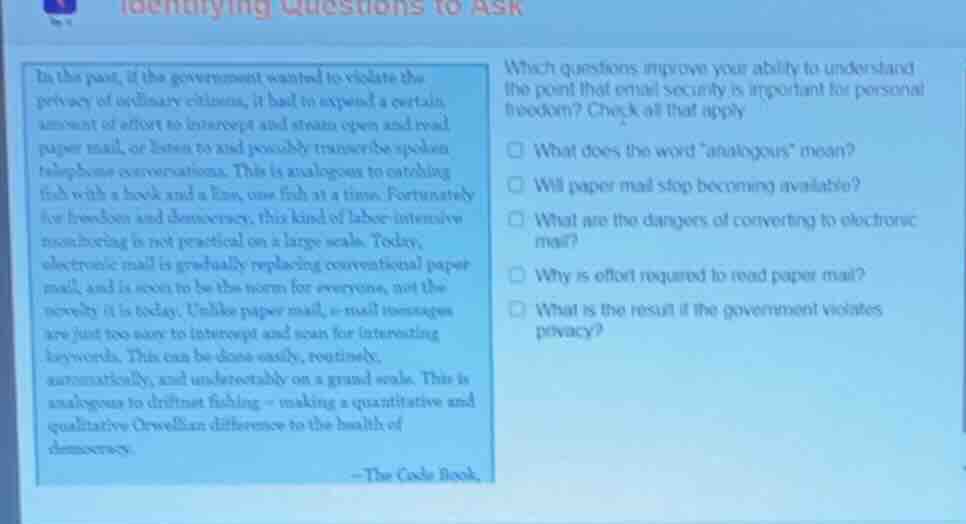
in the past, if the government wanted to violate the privacy of ordinary citizens, it had to expend a certain amount of effort to intercept and steam open and read paper mail, or listen to and possibly transcribe spoken telephone conversations. this is analogous to catching fish with a hook and a line, one fish at a time. fortunately for freedom and democracy, this kind of labor-intensive monitoring is not practical on a large scale. today, electronic mail is gradually replacing conventional paper mail, and is soon to be the norm for everyone, not the novelty it is today. unlike paper mail, e-mail messages are just too easy to intercept and scan for interesting keywords. this can be done easily, routinely, automatically, and undetectably on a grand scale. this is analogous to driftnet fishing - making a quantitative and qualitative orwellian difference to the health of democracy.
-the code book
which questions improve your ability to understand the point that email security is important for personal freedom? check all that apply
what does the word \analogous\ mean?
will paper mail stop becoming available?
what are the dangers of converting to electronic mail?
why is effort required to read paper mail?
what is the result if the government violates privacy?
Analyze the core argument of the text
The passage from The Code Book contrasts the labor-intensive nature of intercepting physical mail (analogous to catching fish with a hook and line) with the ease of intercepting electronic mail (analogous to driftnet fishing). The author argues that because electronic mail can be scanned easily, routinely, automatically, and undetectably on a grand scale, it poses a qualitative and quantitative "Orwellian" threat to democracy and personal freedom. Thus, understanding the importance of email security is directly tied to understanding these differences and their consequences. We apply Textual Analysis to trace this central claim.
Evaluate the relevance of each question
To improve the ability to understand the point that email security is important for personal freedom, we evaluate which questions help clarify the author's core Authors Argument:
- What does the word "analogous" mean?
- This is a vocabulary question. While it helps with basic comprehension of a single word, it does not directly deepen the conceptual understanding of why email security is vital for personal freedom.
- Will paper mail stop becoming available?
- The text mentions electronic mail is replacing paper mail, but whether paper mail disappears entirely is irrelevant to the core argument about surveillance and freedom.
- What are the dangers of converting to electronic mail?
- This question directly addresses the core transition described in the text. By asking about the dangers (such as mass, automated, undetectable surveillance), a reader directly engages with why security is necessary to protect personal freedom.
- Why is effort required to read paper mail?
- The text explains that physical mail requires individual effort to intercept, which historically limited government surveillance. Understanding this limitation helps highlight why electronic mail is uniquely dangerous, but the question itself is a minor detail compared to the larger implications.
- What is the result if the government violates privacy?
- This question directly targets the ultimate consequence of the passage: the "Orwellian difference to the health of democracy." Understanding the results of privacy violations directly explains why securing email is crucial for maintaining personal freedom.
Select the correct options
The questions that most directly improve a reader's conceptual grasp of the relationship between email security and personal freedom are:
- "What are the dangers of converting to electronic mail?" (explores the vulnerability of the new medium)
- "What is the result if the government violates privacy?" (explores the ultimate threat to freedom and democracy)

Snap & solve any problem in the app
Get step-by-step solutions on Sovi AI
Photo-based solutions with guided steps
Explore more problems and detailed explanations
- What does the word "analogous" mean?
- Will paper mail stop becoming available?
- What are the dangers of converting to electronic mail? (Correct answer)
- Why is effort required to read paper mail?
- What is the result if the government violates privacy? (Correct answer)