QUESTION IMAGE
Question
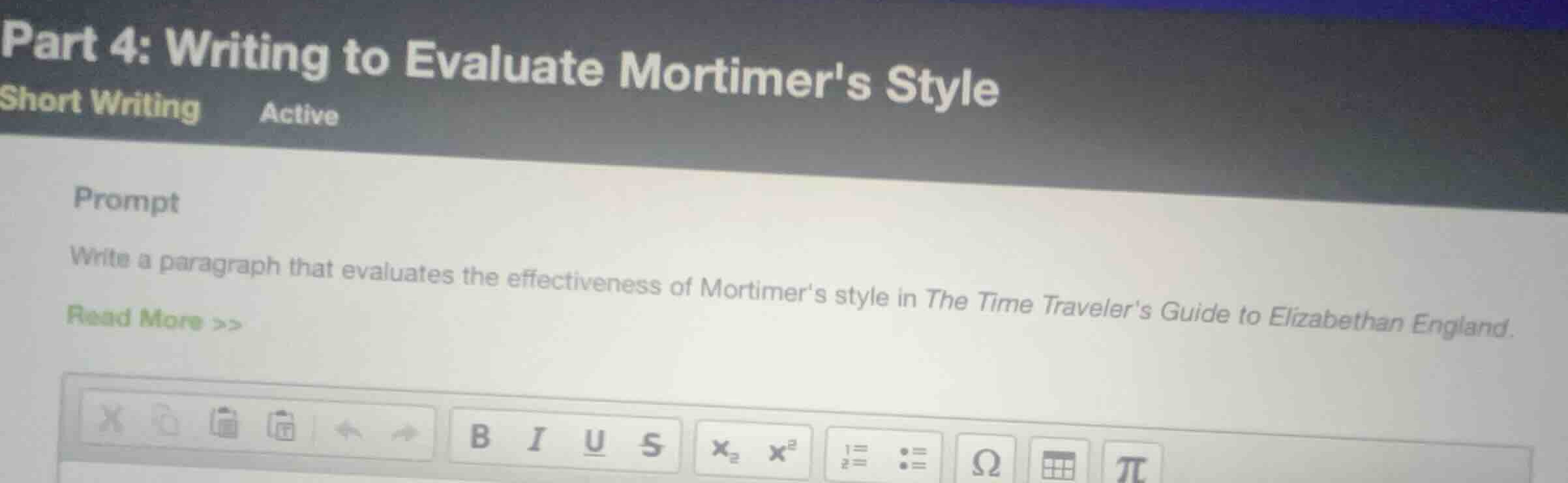
part 4: writing to evaluate mortimers style
short writing active
prompt
write a paragraph that evaluates the effectiveness of mortimers style in the time travelers guide to elizabethan england.
Analyze the writing prompt
The prompt asks to write a paragraph evaluating the effectiveness of Ian Mortimer's style in The Time Traveler's Guide to Elizabethan England. This requires applying Evaluating Style and analyzing Authorial Style to construct a cohesive literary response.
Identify key stylistic elements
Mortimer's style is characterized by:
- Use of second-person point of view ("you") to create an immersive, immediate experience.
- Rich, sensory details that bring the Elizabethan era to life.
- A conversational yet highly informative tone that bridges academic history and popular nonfiction.
Formulate the evaluation thesis
A strong paragraph must state a clear claim about why his style is effective (e.g., it makes historical facts accessible and engaging by placing the reader directly into the historical setting).
Draft the response with supporting details
- Claim: Mortimer's style is highly effective because it uses the second-person perspective to immerse readers in the daily life of Elizabethan England.
- Evidence/Elaboration: By addressing the reader as "you," he transforms dry historical data into an active travel guide. His vivid sensory details—such as the sights, sounds, and smells of London streets—make the past feel immediate and real.
- Conclusion: This stylistic choice successfully bridges the gap between academic history and engaging narrative, making the historical period accessible to a modern audience.

Snap & solve any problem in the app
Get step-by-step solutions on Sovi AI
Photo-based solutions with guided steps
Explore more problems and detailed explanations
In The Time Traveler's Guide to Elizabethan England, Ian Mortimer’s writing style is highly effective because it uses a unique second-person perspective to create an immersive and engaging historical experience. By addressing the reader directly as "you," Mortimer transforms what could be dry historical data into an active, personal journey through the 16th century. This narrative choice, combined with rich sensory details and a conversational yet authoritative tone, allows readers to feel as though they are walking the streets of London themselves. Ultimately, Mortimer's style successfully bridges the gap between academic history and popular nonfiction, making the complexities of Elizabethan daily life accessible, vivid, and deeply memorable for a modern audience.