QUESTION IMAGE
Question
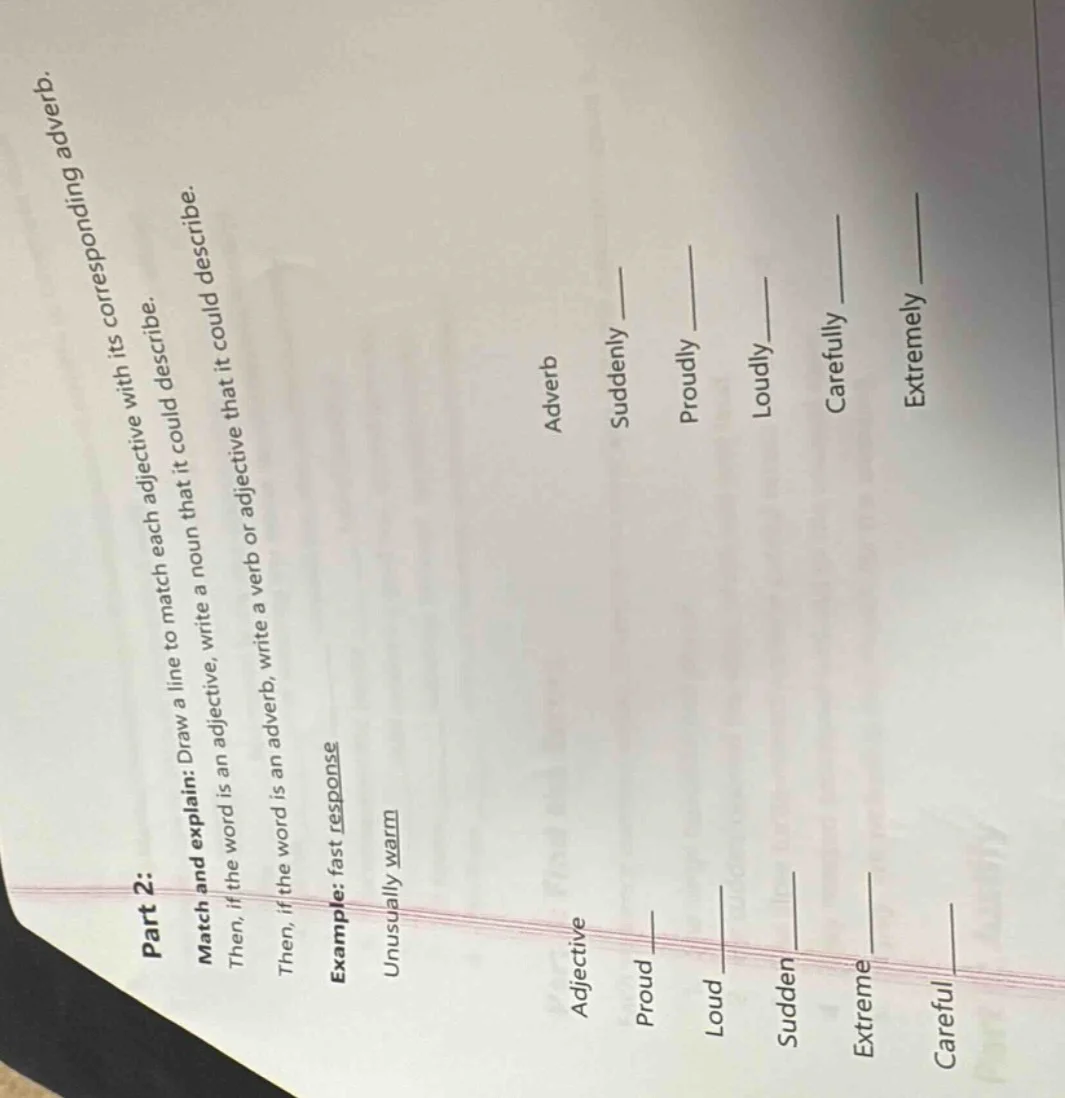
part 2:
match and explain: draw a line to match each adjective with its corresponding adverb.
then, if the word is an adjective, write a noun that it could describe.
then, if the word is an adverb, write a verb or adjective that it could describe.
example: fast response
unusually warm
adjective \t\tadverb
proud \t\t\tsuddenly
loud \t\t\tproudly
sudden \t\t\tloudly
extreme \t\tcarefully
careful \t\textremely
__ \t\t__
__ \t\t__
__ \t\t__
__ \t\t__
__ \t\t__
To solve this, we match each adjective to its corresponding adverb (usually by adding "-ly" or modifying the form) and then describe what they can modify:
1. Adjective: Proud → Adverb: Proudly
- Description: "Proudly" (adverb) can describe a verb like "She proudly presented her project". "Proud" (adjective) can describe a noun like "a proud mother".
2. Adjective: Loud → Adverb: Loudly
- Description: "Loudly" (adverb) can describe a verb like "He spoke loudly". "Loud" (adjective) can describe a noun like "a loud noise".
3. Adjective: Sudden → Adverb: Suddenly
- Description: "Suddenly" (adverb) can describe a verb like "The storm suddenly arrived". "Sudden" (adjective) can describe a noun like "a sudden change".
4. Adjective: Extreme → Adverb: Extremely
- Description: "Extremely" (adverb) can describe an adjective like "extremely hot" (modifying "hot"). "Extreme" (adjective) can describe a noun like "extreme weather".
5. Adjective: Careful → Adverb: Carefully
- Description: "Carefully" (adverb) can describe a verb like "She carefully handled the glass". "Careful" (adjective) can describe a noun like "a careful driver".
Final Matches:
- Proud ↔ Proudly
- Loud ↔ Loudly
- Sudden ↔ Suddenly
- Extreme ↔ Extremely
- Careful ↔ Carefully
(For the "describe" part, use the examples above or similar context-specific descriptions.)

Snap & solve any problem in the app
Get step-by-step solutions on Sovi AI
Photo-based solutions with guided steps
Explore more problems and detailed explanations
To solve this, we match each adjective to its corresponding adverb (usually by adding "-ly" or modifying the form) and then describe what they can modify:
1. Adjective: Proud → Adverb: Proudly
- Description: "Proudly" (adverb) can describe a verb like "She proudly presented her project". "Proud" (adjective) can describe a noun like "a proud mother".
2. Adjective: Loud → Adverb: Loudly
- Description: "Loudly" (adverb) can describe a verb like "He spoke loudly". "Loud" (adjective) can describe a noun like "a loud noise".
3. Adjective: Sudden → Adverb: Suddenly
- Description: "Suddenly" (adverb) can describe a verb like "The storm suddenly arrived". "Sudden" (adjective) can describe a noun like "a sudden change".
4. Adjective: Extreme → Adverb: Extremely
- Description: "Extremely" (adverb) can describe an adjective like "extremely hot" (modifying "hot"). "Extreme" (adjective) can describe a noun like "extreme weather".
5. Adjective: Careful → Adverb: Carefully
- Description: "Carefully" (adverb) can describe a verb like "She carefully handled the glass". "Careful" (adjective) can describe a noun like "a careful driver".
Final Matches:
- Proud ↔ Proudly
- Loud ↔ Loudly
- Sudden ↔ Suddenly
- Extreme ↔ Extremely
- Careful ↔ Carefully
(For the "describe" part, use the examples above or similar context-specific descriptions.)