QUESTION IMAGE
Question
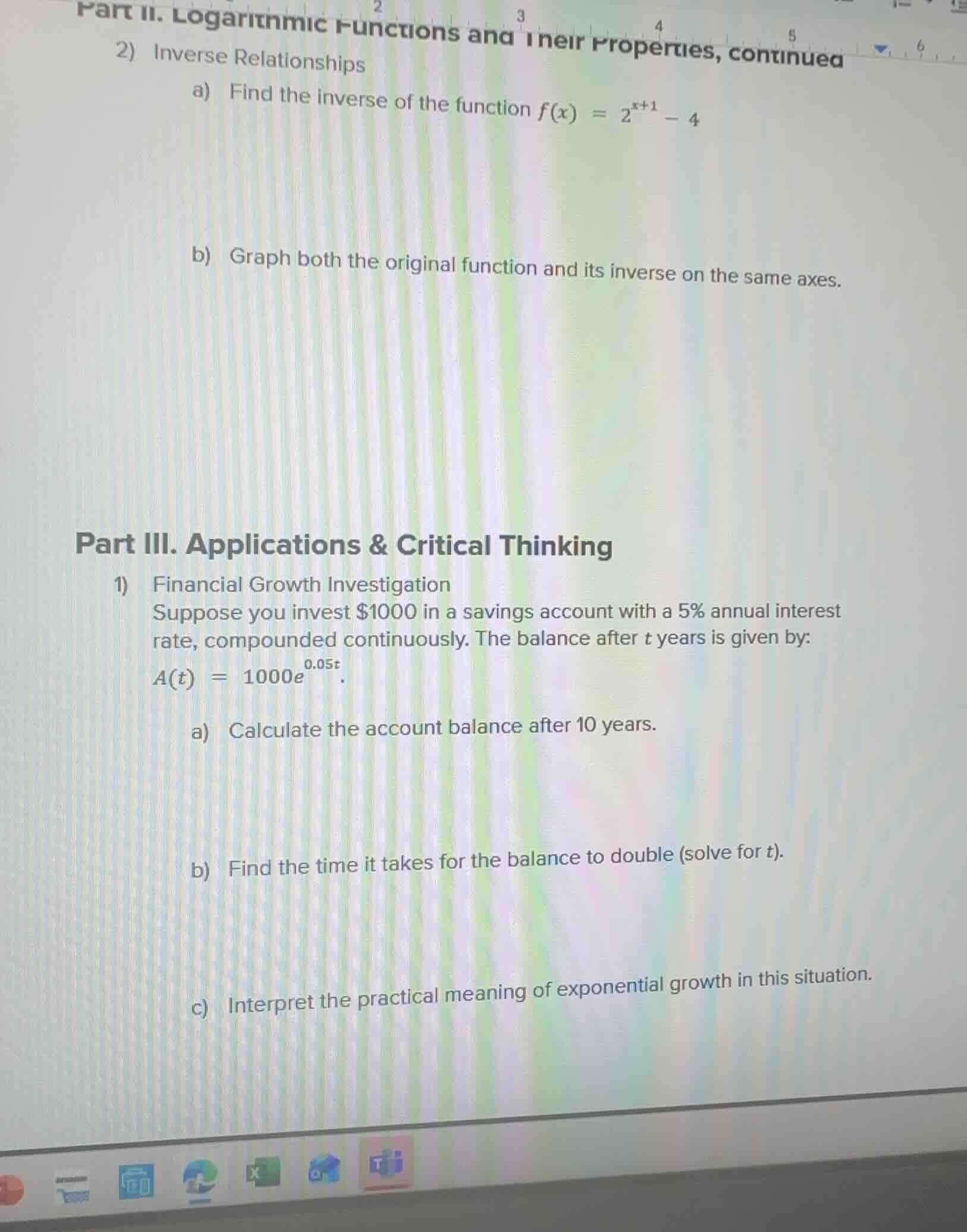
part ii. logarithmic functions and their properties, continued
- inverse relationships
a) find the inverse of the function (f(x) = 2^{x+1} - 4)
b) graph both the original function and its inverse on the same axes.
part iii. applications & critical thinking
- financial growth investigation
suppose you invest $1000 in a savings account with a 5% annual interest rate, compounded continuously. the balance after (t) years is given by:
(a(t) = 1000e^{0.05t}).
a) calculate the account balance after 10 years.
b) find the time it takes for the balance to double (solve for (t)).
c) interpret the practical meaning of exponential growth in this situation.
Find the inverse function
Using the Logarithmic Functions and Function Transformations knowledge points
Graph both functions
Using the Function Transformations knowledge point
Calculate the account balance after 10 years
Substitute \(t = 10\) into the continuous compounding formula:
Find the doubling time
Set the balance \(A(t) = 2000\) to find when the investment doubles:
Interpret the practical meaning
Explain the real-world behavior of continuous interest:
- The account balance grows at a rate proportional to its current value.
- Interest is continuously earned and reinvested, leading to faster growth over time.

Snap & solve any problem in the app
Get step-by-step solutions on Sovi AI
Photo-based solutions with guided steps
Explore more problems and detailed explanations
Part II: Logarithmic Functions and Their Properties, continued
Question 2
a) The inverse function is:
b) The graphs of \(f(x) = 2^{x+1} - 4\) and \(f^{-1}(x) = \log_2(x+4) - 1\) are plotted on the same axes below. They are symmetric reflections across the line \(y = x\).
---
Part III: Applications & Critical Thinking
Question 1
a) The account balance after 10 years is:
b) The time it takes for the balance to double is:
c) Practical interpretation:
Exponential growth means that the money in the savings account grows at a rate proportional to its current balance. As the balance increases, the amount of interest earned each instant also increases, causing the account value to grow faster and faster over time.