QUESTION IMAGE
Question
part 3
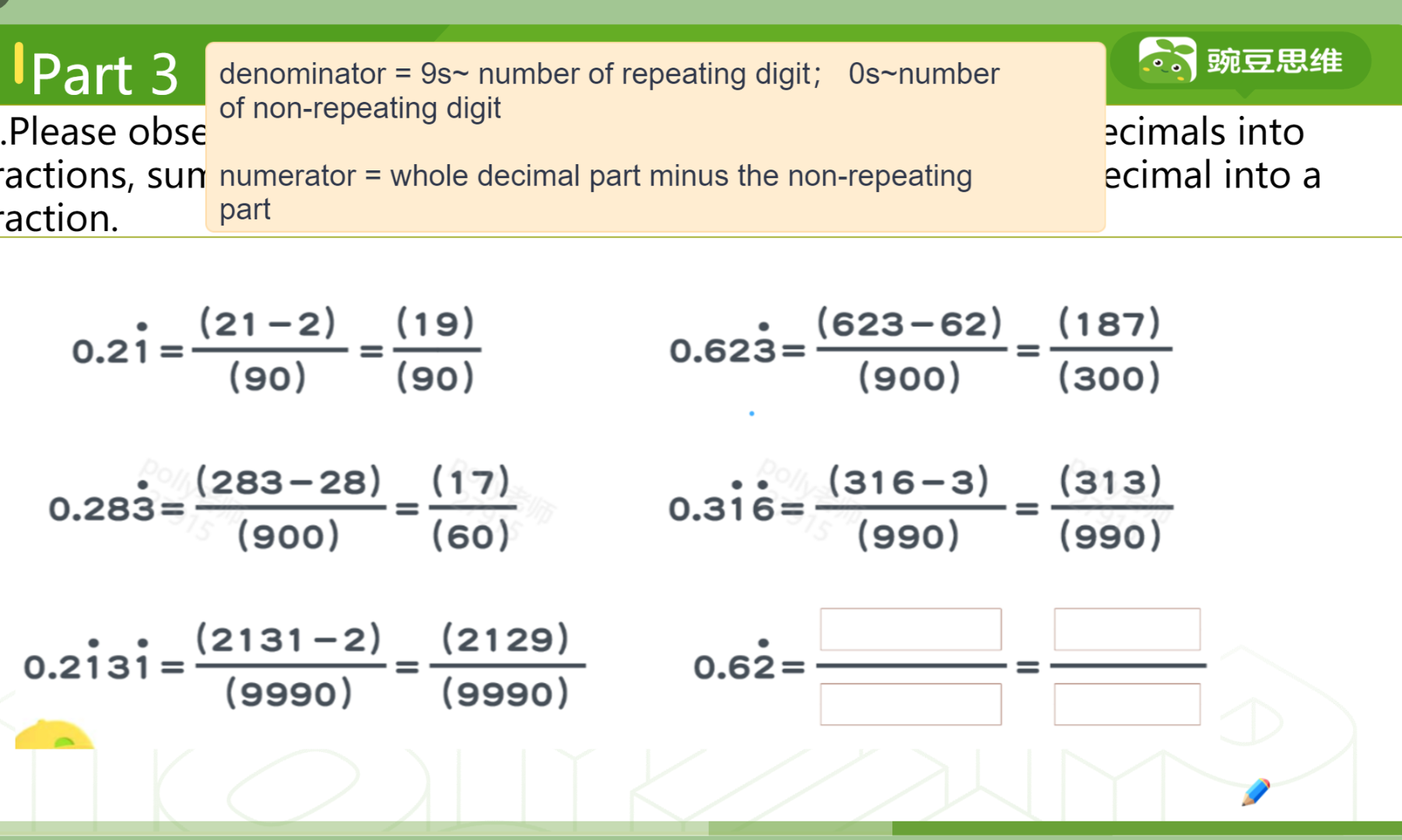
denominator = 9s ~ number of repeating digit; 0s ~ number of non-repeating digit
numerator = whole decimal part minus the non-repeating part
please observe the rules of converting repeating decimals into fractions, summarize the rules, and convert the repeating decimal into a fraction.
(0.2dot{1} = \frac{(21-2)}{(90)} = \frac{(19)}{(90)})
(0.62dot{3} = \frac{(623-62)}{(900)} = \frac{(187)}{(300)})
(0.28dot{3} = \frac{(283-28)}{(900)} = \frac{(17)}{(60)})
(0.3dot{1}dot{6} = \frac{(316-3)}{(990)} = \frac{(313)}{(990)})
(0.2dot{1}3dot{1} = \frac{(2131-2)}{(9900)} = \frac{(2129)}{(9900)})
(0.6dot{2} = \frac{quad}{quad} = \frac{quad}{quad})
🆕 New Concept Discovered: Converting Repeating Decimals to Fractions
Turn repeating decimals into fractions using a simple pattern.
Step 1: Analyze the decimal structure
The given decimal is \( 0.6\dot{2} \).
- The dot above the \( 2 \) means only the digit \( 2 \) repeats: \( 0.6222... \)
- The non-repeating part in the decimal is \( 6 \) (1 digit).
- The repeating part is \( 2 \) (1 digit).
Step 2: Determine the denominator
Following the rule provided in the image:
- The number of \( 9 \)s equals the number of repeating digits. Since there is \( 1 \) repeating digit (\( 2 \)), we write one \( 9 \).
- The number of \( 0 \)s equals the number of non-repeating digits after the decimal point. Since there is \( 1 \) non-repeating digit (\( 6 \)), we write one \( 0 \).
Step 3: Determine the numerator
Following the rule:
- Subtract the non-repeating part from the whole decimal part.
- Whole decimal part: \( 62 \)
- Non-repeating part: \( 6 \)
So, the unsimplified fraction is:
Step 4: Simplify the fraction
To simplify \( \frac{56}{90} \), divide both the numerator and the denominator by their greatest common divisor, which is \( 2 \):

Snap & solve any problem in the app
Get step-by-step solutions on Sovi AI
Photo-based solutions with guided steps
Explore more problems and detailed explanations