QUESTION IMAGE
Question
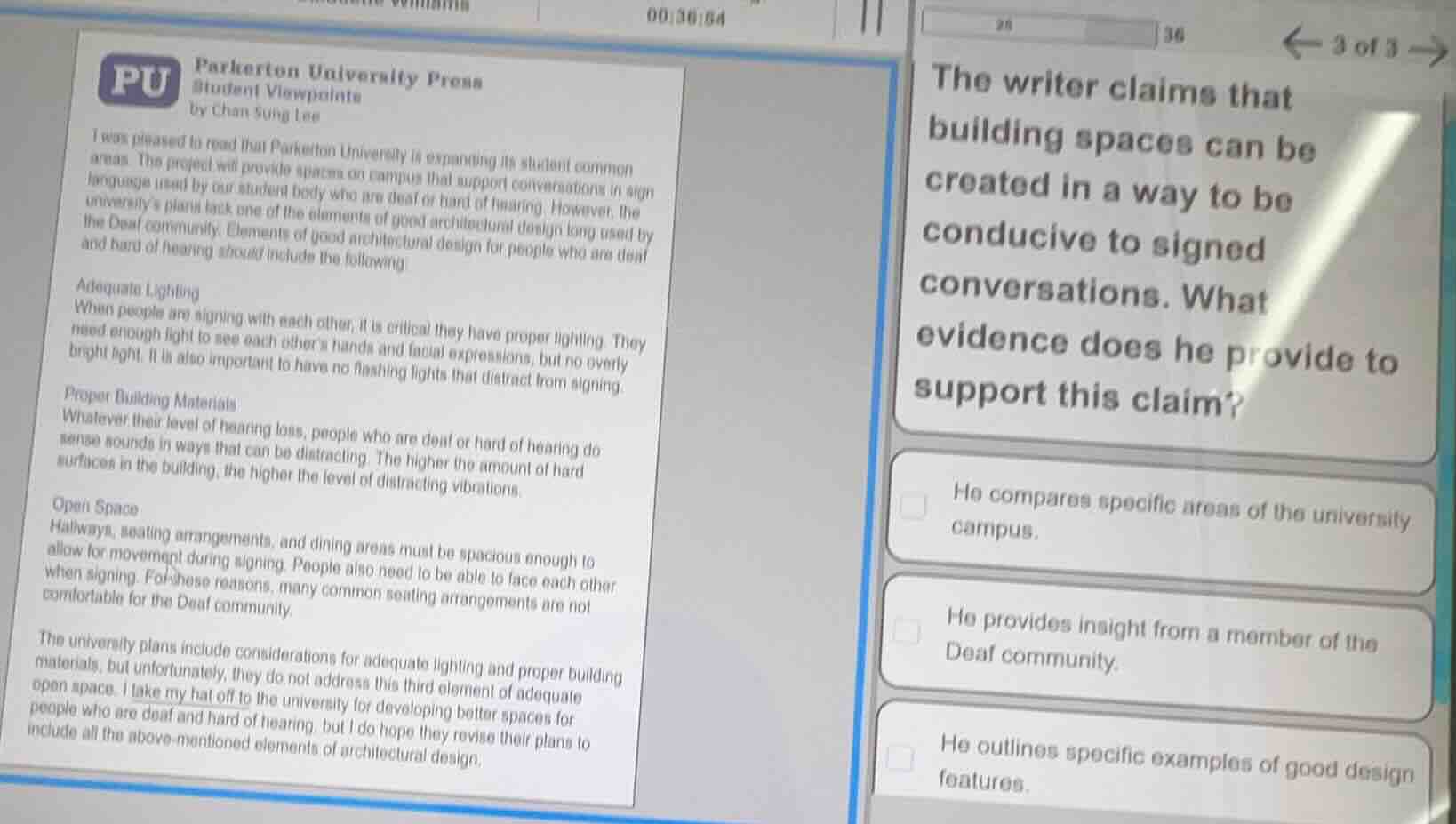
parkerton university press
student viewpoints
by chan sung lee
i was pleased to read that parkerton university is expanding its student common areas. the project will provide spaces on campus that support conversations in sign language used by our student body who are deaf or hard of hearing. however, the universitys plans lack one of the elements of good architectural design long used by the deaf community. elements of good architectural design for people who are deaf and hard of hearing should include the following:
adequate lighting
when people are signing with each other, it is critical they have proper lighting. they need enough light to see each others hands and facial expressions, but no overly bright light. it is also important to have no flashing lights that distract from signing.
proper building materials
whatever their level of hearing loss, people who are deaf or hard of hearing do sense sounds in ways that can be distracting. the higher the amount of hard surfaces in the building, the higher the level of distracting vibrations.
open space
hallways, seating arrangements, and dining areas must be spacious enough to allow for movement during signing. people also need to be able to face each other when signing. for these reasons, many common seating arrangements are not comfortable for the deaf community.
the university plans include considerations for adequate lighting and proper building materials, but unfortunately, they do not address this third element of adequate open space. i take my hat off to the university for developing better spaces for people who are deaf and hard of hearing, but i do hope they revise their plans to include all the above-mentioned elements of architectural design.
the writer claims that building spaces can be created in a way to be conducive to signed conversations. what evidence does he provide to support this claim?
- he compares specific areas of the university campus.
- he provides insight from a member of the deaf community.
- he outlines specific examples of good design features.
Analyze the writer's claim and supporting evidence
The writer claims that building spaces can be designed to support signed conversations. To support this claim, the writer outlines three specific elements of good architectural design for the Deaf and hard-of-hearing community: "Adequate Lighting," "Proper Building Materials," and "Open Space."
Evaluate the given options
- Option 1 ("He compares specific areas of the university campus") is incorrect because the text does not compare different campus areas.
- Option 2 ("He provides insight from a member of the Deaf community") is incorrect because the author, Chan Sung Lee, writes from his own perspective as a student without citing external interviews or insights from other community members.
- Option 3 ("He outlines specific examples of good design features") is correct because he lists and describes three concrete design features: adequate lighting, proper building materials, and open spaces.

Snap & solve any problem in the app
Get step-by-step solutions on Sovi AI
Photo-based solutions with guided steps
Explore more problems and detailed explanations
- (A) He compares specific areas of the university campus.
- (B) He provides insight from a member of the Deaf community.
- (C) He outlines specific examples of good design features. (Correct answer)