QUESTION IMAGE
Question
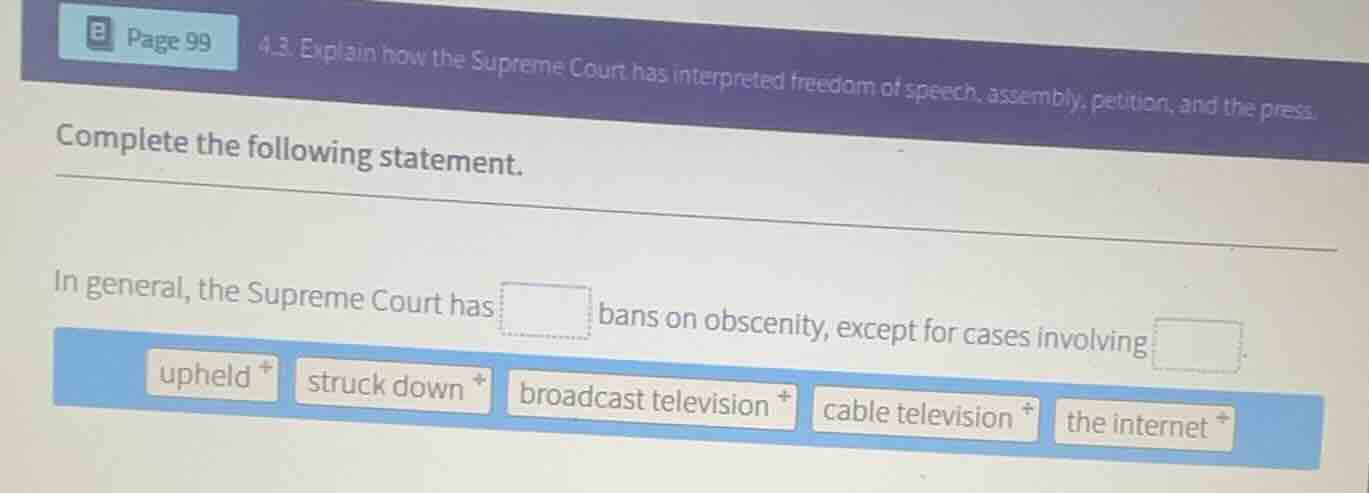
page 99 4.3. explain how the supreme court has interpreted freedom of speech, assembly, petition, and the press.
complete the following statement.
in general, the supreme court has bans on obscenity, except for cases involving .
upheld
struck down
broadcast television
cable television
the internet
Analyze First Amendment obscenity doctrine
Under U.S. constitutional law, obscenity is not protected by the First Amendment. Consequently, the Supreme Court has generally upheld government bans on obscenity, provided they meet the legal standards established in cases like Miller v. California.
Analyze the exception for specific media
While the Supreme Court has upheld bans on obscenity in general, it has struck down broad regulations attempting to restrict indecent or obscene material on the internet (such as in Reno v. ACLU), establishing that the internet receives the highest level of First Amendment protection, unlike broadcast media. Therefore, the Court has upheld bans on obscenity, except for cases involving the internet.

Snap & solve any problem in the app
Get step-by-step solutions on Sovi AI
Photo-based solutions with guided steps
Explore more problems and detailed explanations
Complete the following statement.
In general, the Supreme Court has <blank>upheld</blank> bans on obscenity, except for cases involving <blank>the internet</blank>.