QUESTION IMAGE
Question
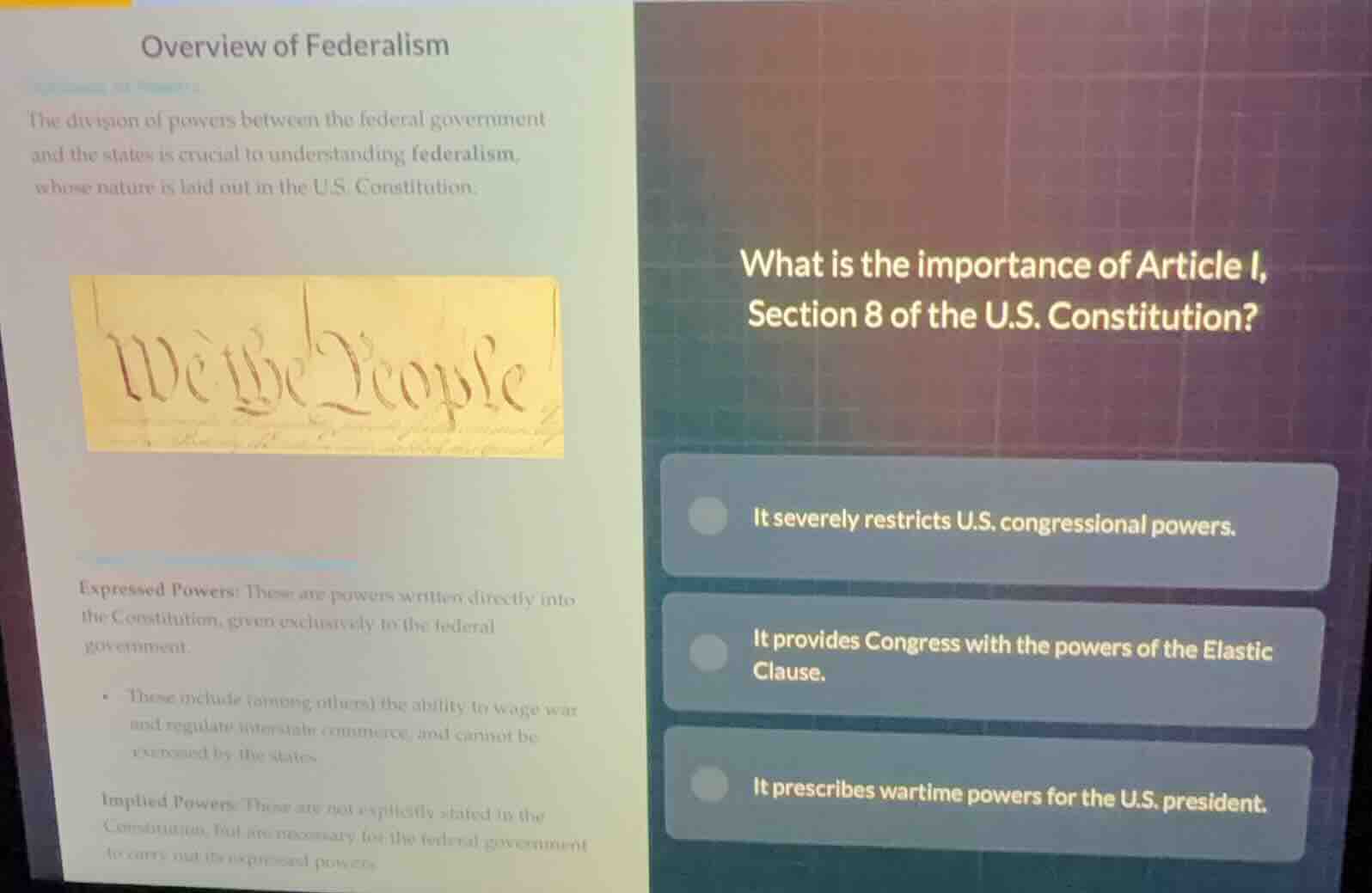
overview of federalism
the division of powers between the federal government
and the states is crucial to understanding federalism,
whose nature is laid out in the u.s. constitution.
expressed powers: these are powers written directly into
the constitution, given exclusively to the federal
government.
- these include (among others) the ability to wage war
and regulate interstate commerce, and cannot be
exercised by the states
implied powers: these are not explicitly stated in the
constitution, but are necessary for the federal government
to carry out its expressed powers
what is the importance of article i,
section 8 of the u.s. constitution?
- it severely restricts u.s. congressional powers.
- it provides congress with the powers of the elastic
clause.
- it prescribes wartime powers for the u.s. president.
Article I, Section 8 of the U.S. Constitution outlines the expressed powers of Congress, and it includes the Necessary and Proper Clause (Elastic Clause) at the end, which grants Congress implied powers to carry out its expressed duties. The first option is incorrect because it expands, not restricts, congressional powers. The third option is incorrect because wartime powers for the president are not defined in this section; this section focuses on congressional powers.

Snap & solve any problem in the app
Get step-by-step solutions on Sovi AI
Photo-based solutions with guided steps
Explore more problems and detailed explanations
It provides Congress with the powers of the Elastic Clause.