QUESTION IMAGE
Question
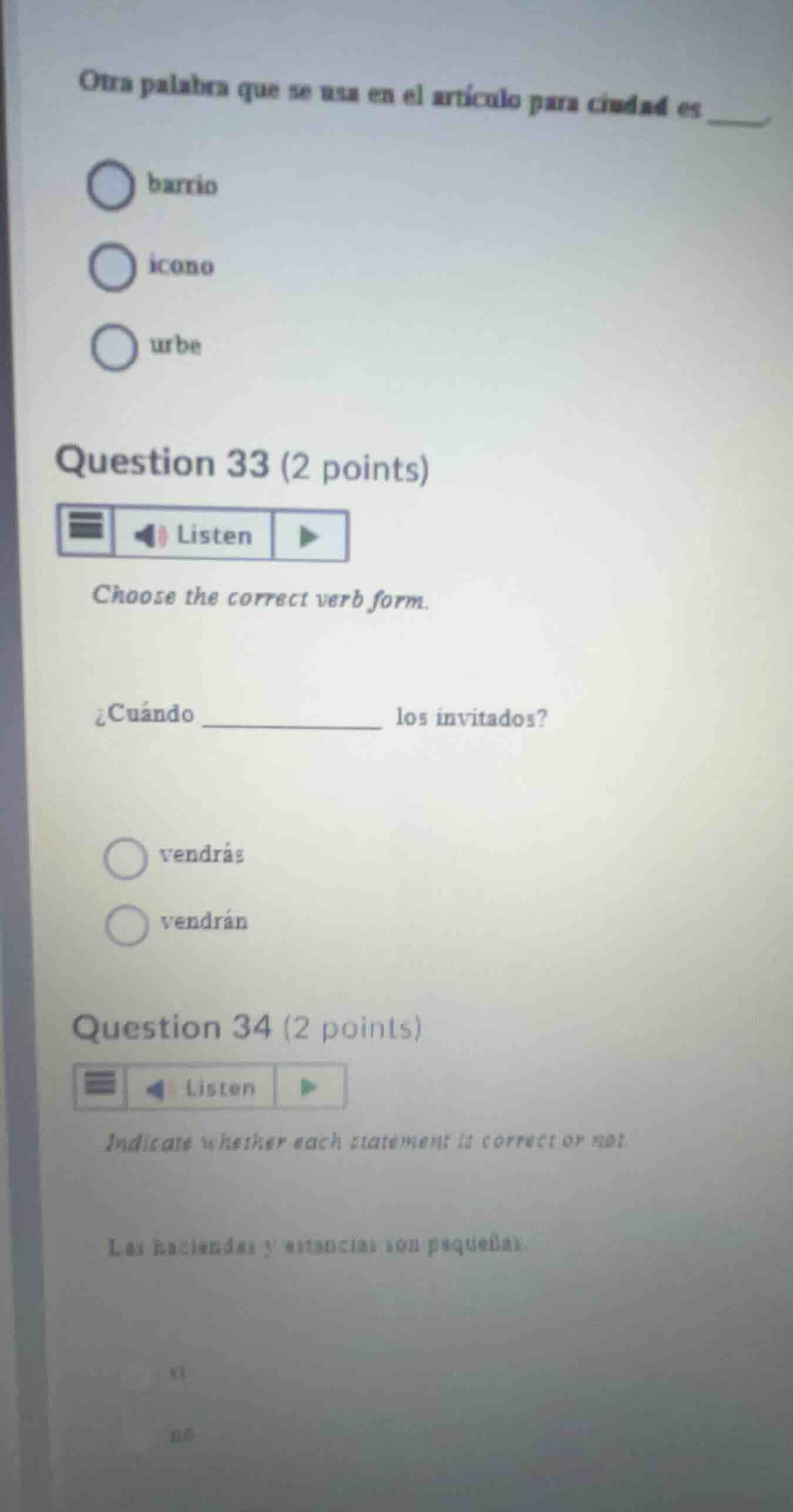
otra palabra que se usa en el artículo para ciudad es ___
barrio
icono
urbe
question 33 (2 points)
choose the correct verb form.
¿cuándo _________ los invitados?
vendrás
vendrán
question 34 (2 points)
indicate whether each statement is correct or not.
las haciendas y estancias son pequeñas.
<pre_analysis>
{
"quality": "clear",
"question_count": 3,
"skills_matched": [
"direct_cot",
"multiple_choice_formatter",
"explain_then_answer",
"quick"
],
"needs_drawing": false,
"concepts_used": [],
"new_concepts": [
"Spanish Synonyms",
"Spanish Future Tense",
"Spanish Reading Comprehension"
],
"current_concepts": [
"Spanish Synonyms",
"Spanish Future Tense",
"Spanish Reading Comprehension"
]
}
</pre_analysis>
<reasoning>
Analyze the first question
The prompt asks for another word used in the article for "ciudad" (city). Among the choices:
- "barrio" means neighborhood.
- "icono" means icon.
- "urbe" means large city or metropolis.
Therefore, "urbe" is the correct synonym for "ciudad".
Analyze Question 33
The sentence is: "¿Cuándo ______ los invitados?" (When ______ the guests?).
- "los invitados" (the guests) is a third-person plural subject (ellos).
- "vendrás" is the second-person singular (tú) form of the future tense of "venir".
- "vendrán" is the third-person plural (ellos/ellas/ustedes) form of the future tense of "venir".
Therefore, "vendrán" is the correct verb form to agree with "los invitados".
Analyze Question 34
The statement is: "Las haciendas y estancias son pequeñas." (Haciendas and ranches are small).
Historically and culturally, haciendas and estancias are large estates or ranches, not small ones. Thus, the statement is incorrect ("no").
</reasoning>
<answer>
Question 1
<mcq-option>(A) barrio</mcq-option>
<mcq-option>(B) icono</mcq-option>
<mcq-correct>(C) urbe</mcq-correct>
Question 33
<mcq-option>(A) vendrás</mcq-option>
<mcq-correct>(B) vendrán</mcq-correct>
Question 34
<mcq-option>(A) sí</mcq-option>
<mcq-correct>(B) no</mcq-correct>
</answer>
<post_analysis>
{
"subject": "Others",
"question_type": "Multiple Choice",
"knowledge_point": [
"Others",
"Spanish",
"Spanish Grammar and Vocabulary"
]
}
</post_analysis>
Snap & solve any problem in the app
Get step-by-step solutions on Sovi AI
Photo-based solutions with guided steps
Explore more problems and detailed explanations
<pre_analysis>
{
"quality": "clear",
"question_count": 3,
"skills_matched": [
"direct_cot",
"multiple_choice_formatter",
"explain_then_answer",
"quick"
],
"needs_drawing": false,
"concepts_used": [],
"new_concepts": [
"Spanish Synonyms",
"Spanish Future Tense",
"Spanish Reading Comprehension"
],
"current_concepts": [
"Spanish Synonyms",
"Spanish Future Tense",
"Spanish Reading Comprehension"
]
}
</pre_analysis>
<reasoning>
Analyze the first question
The prompt asks for another word used in the article for "ciudad" (city). Among the choices:
- "barrio" means neighborhood.
- "icono" means icon.
- "urbe" means large city or metropolis.
Therefore, "urbe" is the correct synonym for "ciudad".
Analyze Question 33
The sentence is: "¿Cuándo ______ los invitados?" (When ______ the guests?).
- "los invitados" (the guests) is a third-person plural subject (ellos).
- "vendrás" is the second-person singular (tú) form of the future tense of "venir".
- "vendrán" is the third-person plural (ellos/ellas/ustedes) form of the future tense of "venir".
Therefore, "vendrán" is the correct verb form to agree with "los invitados".
Analyze Question 34
The statement is: "Las haciendas y estancias son pequeñas." (Haciendas and ranches are small).
Historically and culturally, haciendas and estancias are large estates or ranches, not small ones. Thus, the statement is incorrect ("no").
</reasoning>
<answer>
Question 1
<mcq-option>(A) barrio</mcq-option>
<mcq-option>(B) icono</mcq-option>
<mcq-correct>(C) urbe</mcq-correct>
Question 33
<mcq-option>(A) vendrás</mcq-option>
<mcq-correct>(B) vendrán</mcq-correct>
Question 34
<mcq-option>(A) sí</mcq-option>
<mcq-correct>(B) no</mcq-correct>
</answer>
<post_analysis>
{
"subject": "Others",
"question_type": "Multiple Choice",
"knowledge_point": [
"Others",
"Spanish",
"Spanish Grammar and Vocabulary"
]
}
</post_analysis>