QUESTION IMAGE
Question
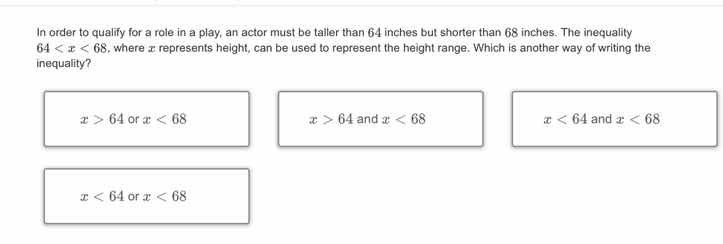
in order to qualify for a role in a play, an actor must be taller than 64 inches but shorter than 68 inches. the inequality 64 < x < 68, where x represents height, can be used to represent the height range. which is another way of writing the inequality?
$x > 64$ or $x < 68$
$x > 64$ and $x < 68$
$x < 64$ and $x < 68$
$x < 64$ or $x < 68$
Step1: Analyze the original inequality
The inequality \( 64 < x < 68 \) means that \( x \) has to satisfy two conditions at the same time: \( x \) is greater than 64 (\( x>64 \)) and \( x \) is less than 68 (\( x < 68 \)).
Step2: Evaluate each option
- Option 1: \( x>64 \) or \( x < 68 \). The word "or" here means that \( x \) can satisfy either one of the inequalities, not both. For example, a number like 70 satisfies \( x>64 \) but not \( x < 68 \), and a number like 60 satisfies \( x < 68 \) but not \( x>64 \). But we need a number that satisfies both, so this is incorrect.
- Option 2: \( x>64 \) and \( x < 68 \). The word "and" here means that \( x \) has to satisfy both inequalities simultaneously, which is exactly what \( 64 < x < 68 \) means.
- Option 3: \( x < 64 \) and \( x < 68 \). This would mean \( x \) is less than 64, which is the opposite of what we need (we need \( x>64 \)), so this is incorrect.
- Option 4: \( x < 64 \) or \( x < 68 \). This is also incorrect because it allows \( x \) to be less than 64 (which we don't want) or less than 68 (but we also need \( x>64 \)).

Snap & solve any problem in the app
Get step-by-step solutions on Sovi AI
Photo-based solutions with guided steps
Explore more problems and detailed explanations
\( x>64 \) and \( x < 68 \) (the second option)