QUESTION IMAGE
Question
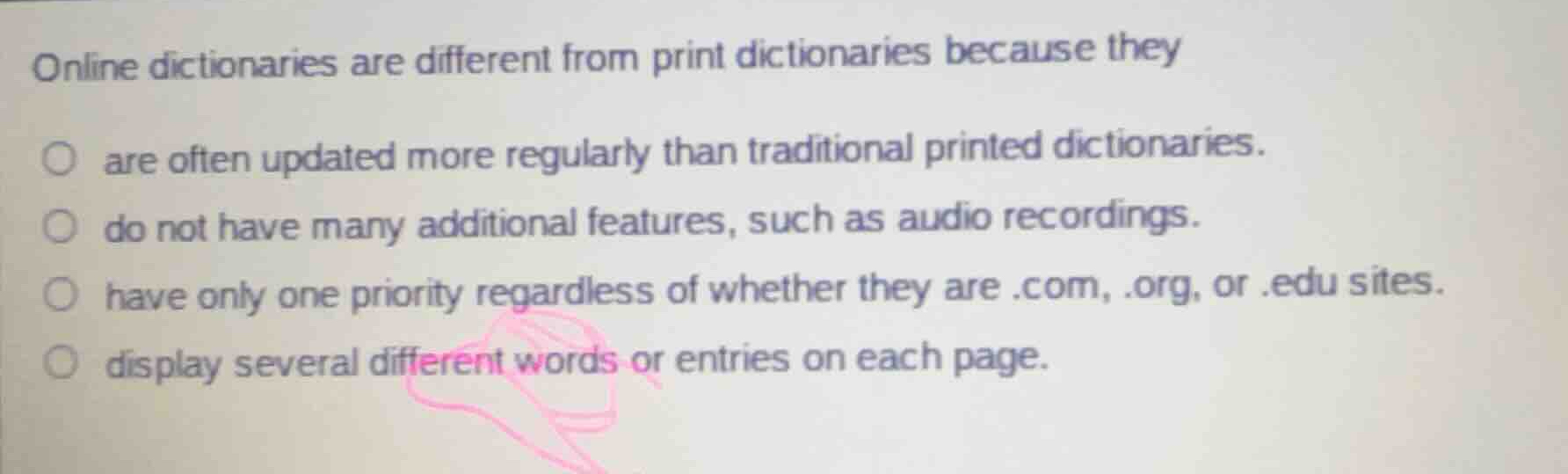
online dictionaries are different from print dictionaries because they
are often updated more regularly than traditional printed dictionaries.
do not have many additional features, such as audio recordings.
have only one priority regardless of whether they are .com, .org, or .edu sites.
display several different words or entries on each page.
Analyze the characteristics of online dictionaries
Online dictionaries are digital platforms hosted on the internet, allowing them to be edited and updated instantly as language evolves, unlike printed books which require new physical editions to be published.
Evaluate the given options
- Option 1: "are often updated more regularly than traditional printed dictionaries." This is a primary advantage and difference of digital media.
- Option 2: "do not have many additional features, such as audio recordings." Incorrect, as online dictionaries frequently feature audio pronunciations.
- Option 3: "have only one priority regardless of whether they are .com, .org, or .edu sites." Incorrect, as different domains have varying purposes (commercial, non-profit, educational).
- Option 4: "display several different words or entries on each page." Incorrect, as print dictionaries display many entries per page, whereas online dictionaries typically focus on one searched term per page view.

Snap & solve any problem in the app
Get step-by-step solutions on Sovi AI
Photo-based solutions with guided steps
Explore more problems and detailed explanations
- are often updated more regularly than traditional printed dictionaries. (Correct answer)
- do not have many additional features, such as audio recordings.
- have only one priority regardless of whether they are .com, .org, or .edu sites.
- display several different words or entries on each page.