QUESTION IMAGE
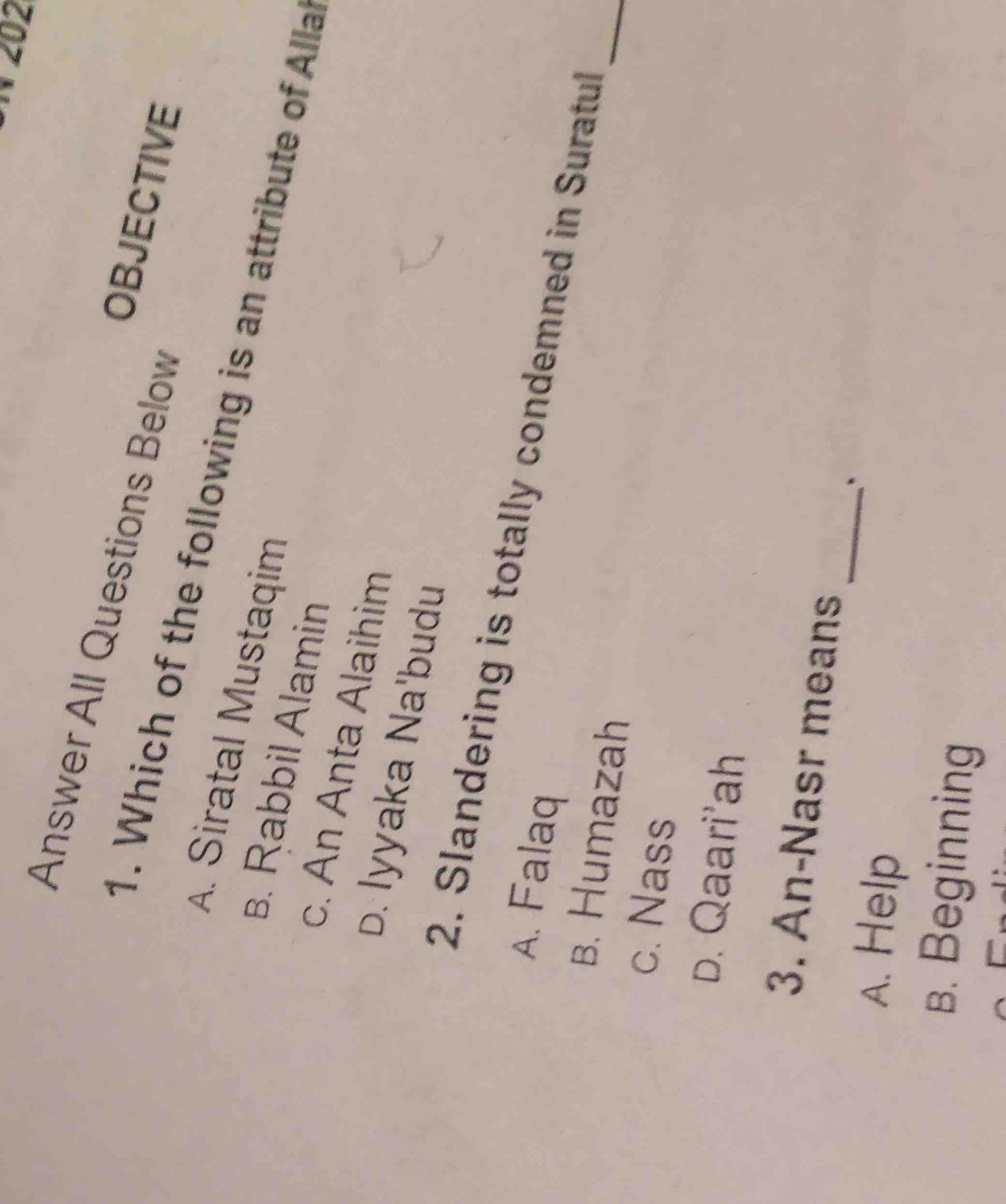
Question
objective
answer all questions below
- which of the following is an attribute of allah
a. siratal mustaqim
b. rabbil alamin
c. an anta alaihim
d. iyyaka nabudu
- slandering is totally condemned in suratul ______.
a. falaq
b. humazah
c. nass
d. qaariah
- an-nasr means ______.
a. help
b. beginning
Analyze Question 1
The question asks which of the options is an attribute of Allah. Let's evaluate the choices:
- A. Siratal Mustaqim: Means "the straight path" (from Surah Al-Fatiha).
- B. Rabbil Alamin: Means "Lord of the worlds" (from Surah Al-Fatiha), which is a direct attribute and title of Allah.
- C. An Anta Alaihim: Part of a verse meaning "You have bestowed favor upon them".
- D. Iyyaka Na'budu: Means "You alone we worship".
Therefore, "Rabbil Alamin" is the attribute of Allah.
Analyze Question 2
The question asks in which Surah slandering is totally condemned. Let's evaluate the choices:
- A. Falaq: Focuses on seeking refuge from external evils.
- B. Humazah: Surah Al-Humazah explicitly condemns slandering, backbiting, and mocking others ("Woe to every slanderer and backbiter").
- C. Nass: Focuses on seeking refuge from internal whispers.
- D. Qaari'ah: Focuses on the Day of Judgment.
Therefore, slandering is condemned in Surah Al-Humazah.
Analyze Question 3
The question asks for the meaning of "An-Nasr". Let's evaluate the choices:
- A. Help: "Nasr" in Arabic means help, victory, or assistance (as in Surah An-Nasr, which speaks of the help of Allah and victory).
- B. Beginning: Not the meaning of Nasr.
Therefore, "An-Nasr" means Help.

Snap & solve any problem in the app
Get step-by-step solutions on Sovi AI
Photo-based solutions with guided steps
Explore more problems and detailed explanations
Question 1
- (A) Siratal Mustaqim
- (B) Rabbil Alamin (Correct answer)
- (C) An Anta Alaihim
- (D) Iyyaka Na'budu
Question 2
- (A) Falaq
- (B) Humazah (Correct answer)
- (C) Nass
- (D) Qaari'ah
Question 3
- (A) Help (Correct answer)
- (B) Beginning