QUESTION IMAGE
Question
notes
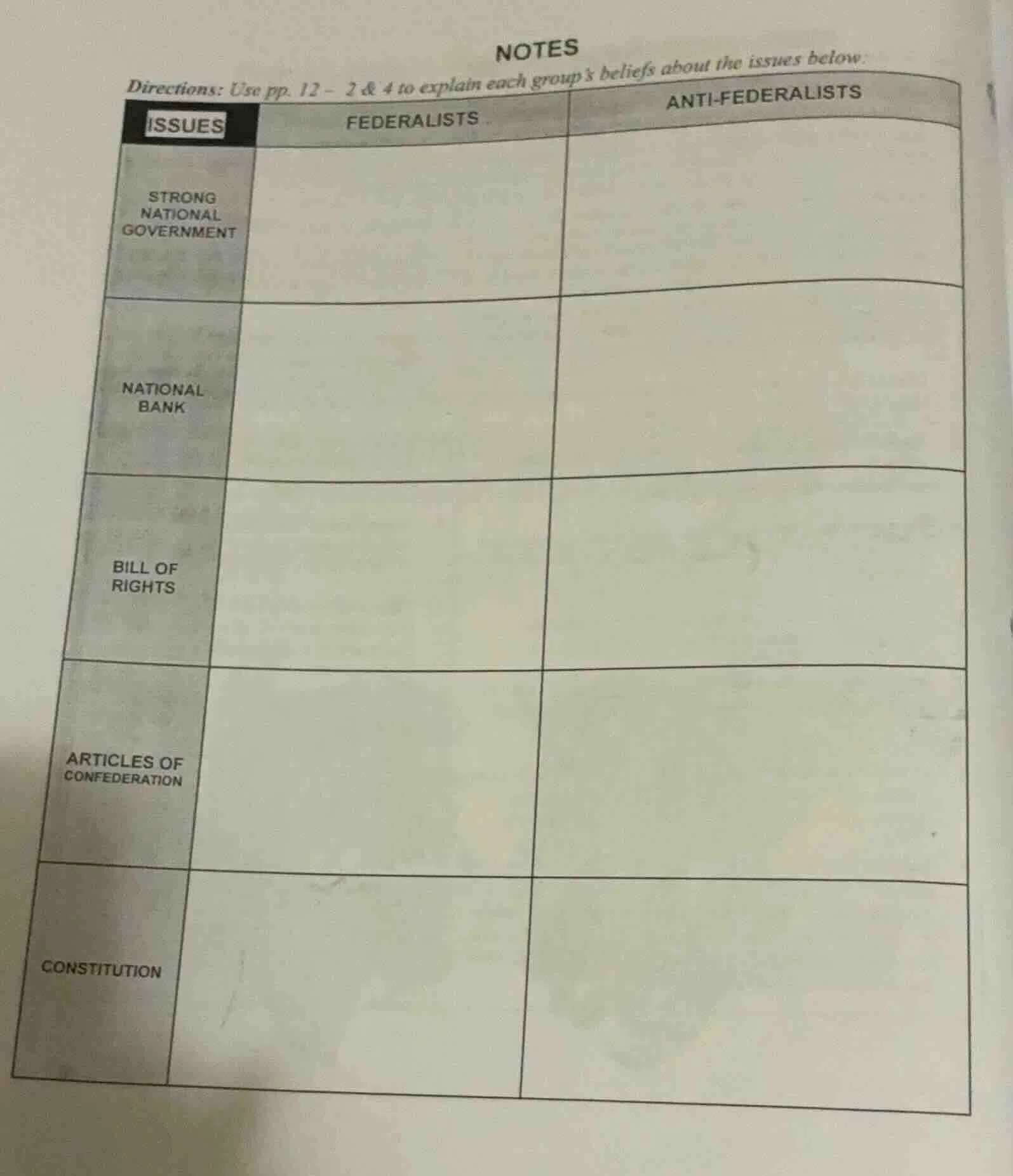
directions: use pp. 12 - 2 & 4 to explain each groups beliefs about the issues below:
issues federalists anti - federalists
strong national government
national bank
bill of rights
articles of confederation
constitution
Brief Explanations
To fill the table, we analyze each issue based on Federalists' and Anti - Federalists' historical stances:
1. Strong National Government
- Federalists: Supported a strong national government. They believed that a powerful central government was necessary to maintain order, promote economic growth, and ensure the stability of the new nation. A weak central government (like under the Articles of Confederation) led to chaos, as seen in events such as Shays' Rebellion.
- Anti - Federalists: Opposed a strong national government. They feared that a strong central government would become tyrannical, similar to the British government they had just fought against. They preferred more power to be held by the states, as they believed states were more in touch with the needs and wishes of the people.
2. National Bank
- Federalists: Supported the creation of a national bank. Alexander Hamilton, a leading Federalist, argued that a national bank would help in managing the nation's finances, providing a stable currency, and facilitating trade and economic development. It would also help the government in borrowing money and managing debt.
- Anti - Federalists: Opposed the national bank. They saw it as an institution that would benefit the wealthy and commercial interests at the expense of farmers and the common people. They also believed that the power to create a bank was not granted to the federal government by the Constitution (a strict constructionist view of the Constitution).
3. Bill of Rights
- Federalists: Initially, many Federalists did not think a Bill of Rights was necessary. They argued that the Constitution already provided sufficient protection of rights through the separation of powers and the system of checks and balances. Also, they were concerned that listing rights might be incomplete and could be used to limit rights not listed.
- Anti - Federalists: Insisted on a Bill of Rights. They were worried that the Constitution, with its strong central government, did not do enough to protect individual liberties and states' rights. They wanted explicit guarantees of rights such as freedom of speech, religion, and the right to a fair trial.
4. Articles of Confederation
- Federalists: Criticized the Articles of Confederation. They pointed out its weaknesses, such as the lack of a strong central government, the inability to tax, the lack of a national currency, and the requirement of unanimous consent for amendments. These weaknesses made it difficult for the nation to function effectively.
- Anti - Federalists: Had more favorable views of the Articles of Confederation (or at least were more hesitant to abandon it completely). They saw the Articles as a system that protected states' rights and local control. They were concerned that replacing the Articles with the new Constitution would lead to a loss of state sovereignty.
5. Constitution
- Federalists: Supported the Constitution. They believed it created a strong but balanced government through the separation of powers (legislative, executive, judicial) and a system of checks and balances. It also provided a framework for a more effective national government that could address the nation's problems.
- Anti - Federalists: Opposed the Constitution (until a Bill of Rights was promised). They were concerned about the strong central government it created, the lack of a Bill of Rights, and the potential for the government to become too powerful and oppressive. They also disliked the fact that the Constitution was drafted in secret…

Snap & solve any problem in the app
Get step-by-step solutions on Sovi AI
Photo-based solutions with guided steps
Explore more problems and detailed explanations
| ISSUES | FEDERALISTS | ANTI - FEDERALISTS |
|---|---|---|
| National Bank | Supported; saw it as key for financial stability, trade, and government finance (Hamilton’s plan). | Opposed; saw it as benefiting the wealthy/commercial interests and believed it was unconstitutional (strict construction). |
| Bill of Rights | Initially opposed; thought the Constitution’s structure (checks/balances) protected rights and listing rights could be limiting. | Insisted on it; feared the Constitution didn’t protect liberties/states’ rights enough. |
| Articles of Confederation | Criticized its weaknesses (no tax, weak central gov, unanimous amendments, etc.). | Favored (or were hesitant to abandon); saw it as protecting state sovereignty/local control. |
| Constitution | Supported; believed it created a balanced, effective government (separation of powers, checks/balances). | Opposed (until Bill of Rights promised); feared strong central gov, lack of rights protection, and loss of state power. |