QUESTION IMAGE
Question
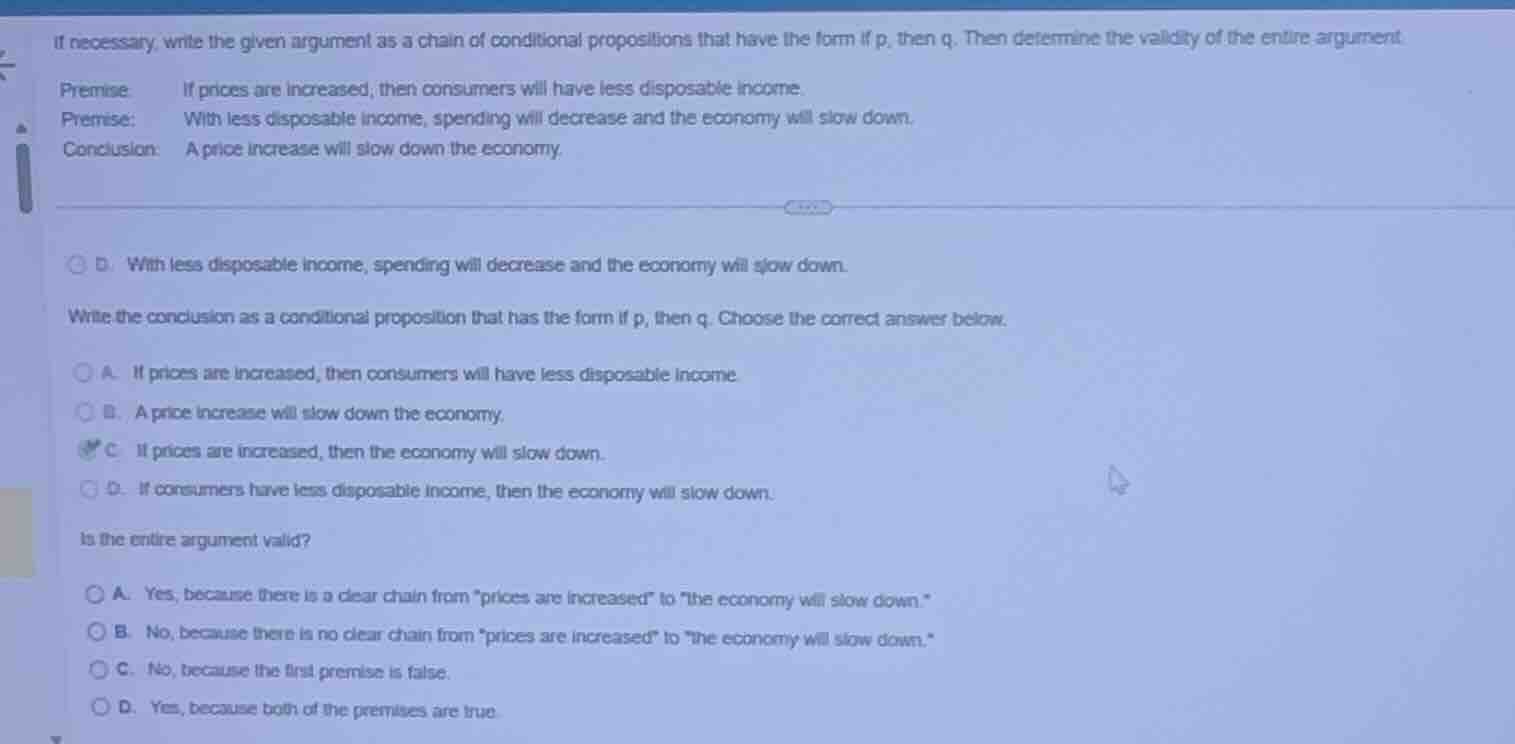
if necessary, write the given argument as a chain of conditional propositions that have the form if p, then q. then determine the validity of the entire argument.
premise: if prices are increased, then consumers will have less disposable income.
premise: with less disposable income, spending will decrease and the economy will slow down.
conclusion: a price increase will slow down the economy.
write the conclusion as a conditional proposition that has the form if p, then q. choose the correct answer below.
a. if prices are increased, then consumers will have less disposable income.
b. a price increase will slow down the economy.
c. if prices are increased, then the economy will slow down.
d. if consumers have less disposable income, then the economy will slow down.
is the entire argument valid?
a. yes, because there is a clear chain from \prices are increased\ to \the economy will slow down.\
b. no, because there is no clear chain from \prices are increased\ to \the economy will slow down.\
c. no, because the first premise is false.
d. yes, because both of the premises are true.
Translate the conclusion to conditional form
Using the Conditional Statements knowledge point
The original conclusion is "A price increase will slow down the economy." In conditional "if \(p\), then \(q\)" form, this translates to: "If prices are increased, then the economy will slow down." This matches option C.
Analyze the logical chain
Using the Hypothetical Syllogism knowledge point
Let:
- \(p\): prices are increased
- \(q\): consumers will have less disposable income
- \(r\): the economy will slow down (which is part of the second premise: "With less disposable income, spending will decrease and the economy will slow down")
The premises form a chain:
- Premise 1: If \(p\), then \(q\).
- Premise 2: If \(q\), then \(r\).
- Conclusion: If \(p\), then \(r\).
Determine the argument validity
Using the Logical Validity knowledge point
Because the premises form a direct chain \(p
ightarrow q
ightarrow r\), the conclusion \(p
ightarrow r\) is logically valid. This matches option A: "Yes, because there is a clear chain from 'prices are increased' to 'the economy will slow down.'"

Snap & solve any problem in the app
Get step-by-step solutions on Sovi AI
Photo-based solutions with guided steps
Explore more problems and detailed explanations
Question 1
- (A) If prices are increased, then consumers will have less disposable income.
- (B) A price increase will slow down the economy.
- (C) If prices are increased, then the economy will slow down. (Correct answer)
- (D) If consumers have less disposable income, then the economy will slow down.
Question 2
- (A) Yes, because there is a clear chain from "prices are increased" to "the economy will slow down." (Correct answer)
- (B) No, because there is no clear chain from "prices are increased" to "the economy will slow down."
- (C) No, because the first premise is false.
- (D) Yes, because both of the premises are true.