QUESTION IMAGE
Question
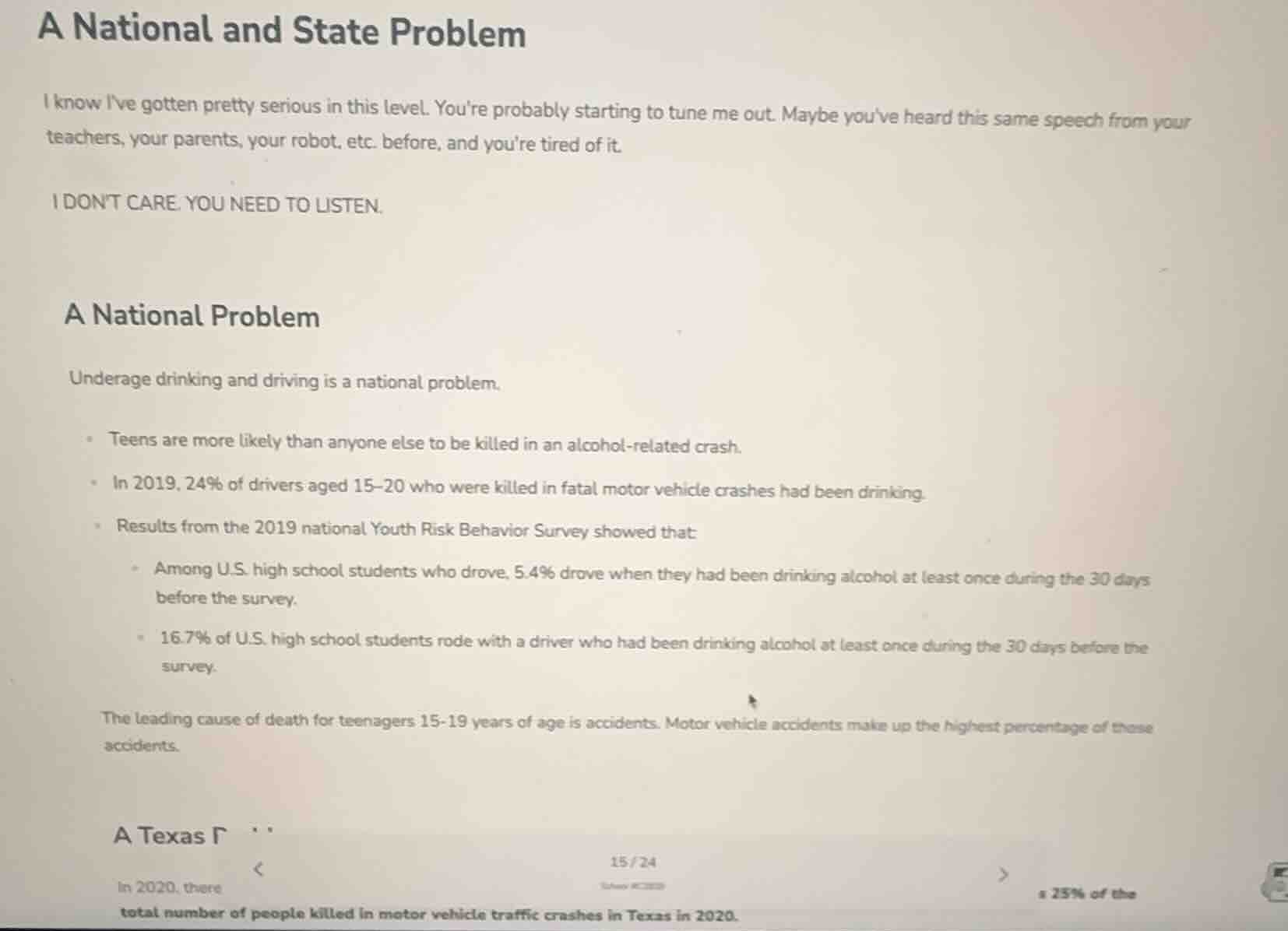
a national and state problem
i know ive gotten pretty serious in this level. youre probably starting to tune me out. maybe youve heard this same speech from your teachers, your parents, your robot, etc. before, and youre tired of it.
i dont care. you need to listen.
a national problem
underage drinking and driving is a national problem.
- teens are more likely than anyone else to be killed in an alcohol-related crash.
- in 2019, 24% of drivers aged 15-20 who were killed in fatal motor vehicle crashes had been drinking.
- results from the 2019 national youth risk behavior survey showed that:
- among u.s. high school students who drove, 5.4% drove when they had been drinking alcohol at least once during the 30 days before the survey.
- 16.7% of u.s. high school students rode with a driver who had been drinking alcohol at least once during the 30 days before the survey.
the leading cause of death for teenagers 15-19 years of age is accidents. motor vehicle accidents make up the highest percentage of those accidents.
a texas problem
in 2020, there were cut off total number of people killed in motor vehicle traffic crashes in texas in 2020.
Analyze statistical overrepresentation
The provided text highlights that underage drinking and driving is a major national issue. In 2019, \(24\%\) of drivers aged 15–20 killed in fatal crashes had been drinking. This age group is disproportionately affected because of a combination of inexperience behind the wheel and developmental factors that influence decision-making. Using our understanding of Impaired Driving Statistics, we can see that young drivers have a much higher crash risk per mile driven than older drivers, which is compounded significantly when alcohol is introduced.
Examine developmental and behavioral factors
In Driver Education, we learn that the prefrontal cortex—the part of the brain responsible for hazard assessment, impulse control, and weighing long-term consequences—is still developing during the teenage years and early twenties. This biological factor leads to:
- Underestimating dangerous situations (lower risk perception).
- Increased susceptibility to peer pressure, especially with passengers in the vehicle.
- A tendency to engage in sensation-seeking behaviors.
Evaluate driving inexperience
Young drivers are still developing their scanning, hazard detection, and vehicle control skills. When an inexperienced driver is impaired by alcohol, their already limited capacity to handle unexpected road hazards is severely degraded. This combination of developmental risk-taking and lack of driving experience explains why the 14-to-20 age group is statistically overrepresented in fatal alcohol-related crashes.

Snap & solve any problem in the app
Get step-by-step solutions on Sovi AI
Photo-based solutions with guided steps
Explore more problems and detailed explanations
The statistical overrepresentation of the 14-to-20 age group in impaired driving crashes is primarily driven by the combination of two main factors:
- Inexperience: Young drivers are still developing fundamental vehicle control, hazard recognition, and situational awareness skills. Alcohol severely degrades these newly acquired, non-automatic driving skills.
- Developmental Factors: The prefrontal cortex, which governs risk assessment, impulse control, and executive decision-making, is not fully developed until the mid-twenties. This leads to a lower perception of risk, a higher likelihood of engaging in sensation-seeking behaviors, and increased vulnerability to peer influence.