QUESTION IMAGE
Question
multiplying polynomials: practice
\\( (2x + 1)(x + 1) \\)
\\( x(x + 4) \\)
\\( 2(x + 1) \\)
\\( (x + 2)(x + 2) \\)
🆕 New Concept Discovered: Algebra Tiles
Visualizing polynomial multiplication using area models
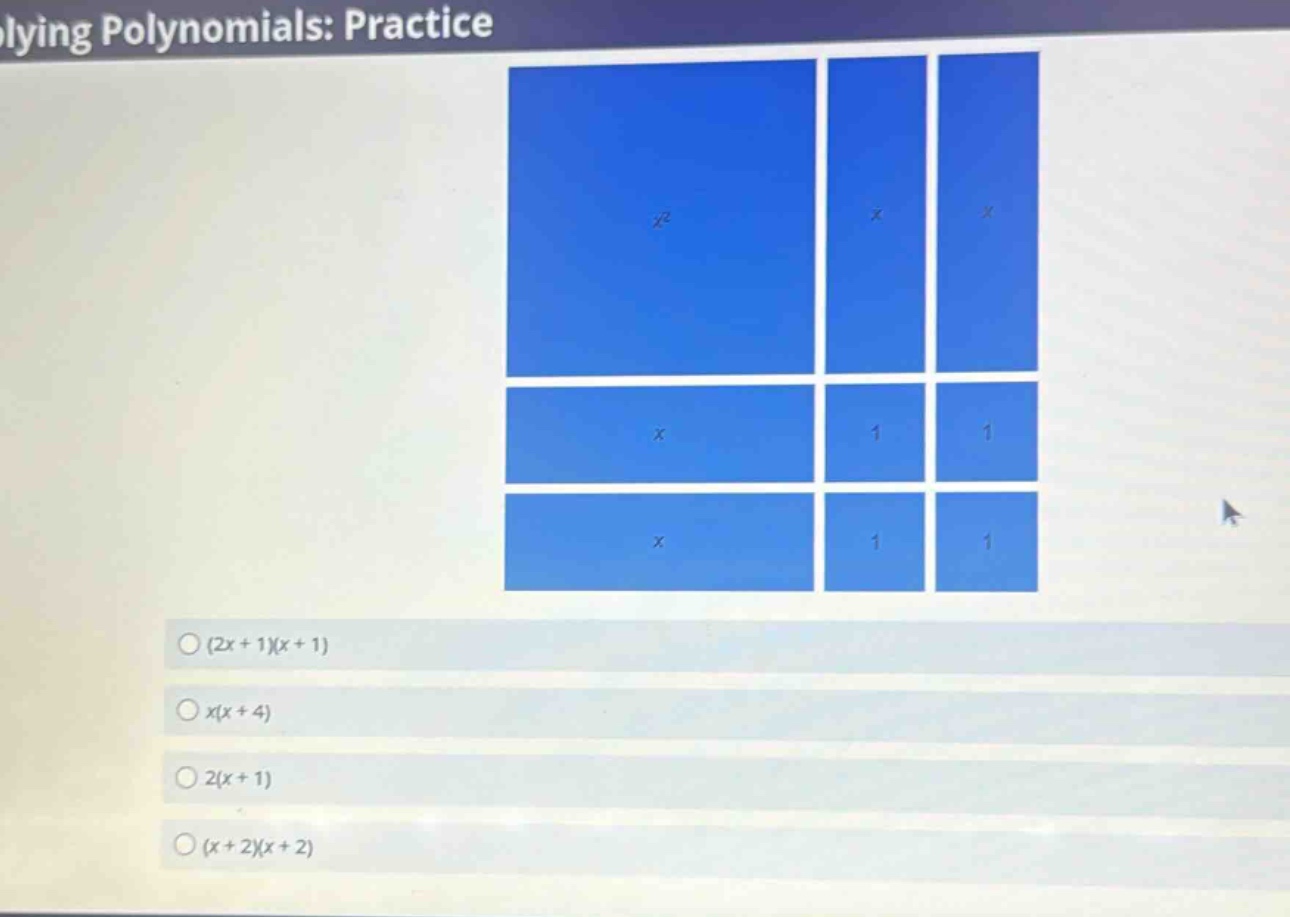
Step 1: Analyze the side lengths of the large square tile
The large blue square in the top-left has an area of \(x^2\). This means its dimensions are:
Step 2: Determine the total width of the model
To the right of the \(x^2\) tile, there are two vertical rectangular tiles, each with an area of \(x\).
Since their height matches the height of the \(x^2\) tile (which is \(x\)), their width must be \(1\) each:
Step 3: Determine the total height of the model
Below the \(x^2\) tile, there are two horizontal rectangular tiles, each with an area of \(x\).
Since their width matches the width of the \(x^2\) tile (which is \(x\)), their height must be \(1\) each:
Step 4: Write the area as a product of dimensions
The total area of the algebra tile model is represented by multiplying its total width by its total height:

Snap & solve any problem in the app
Get step-by-step solutions on Sovi AI
Photo-based solutions with guided steps
Explore more problems and detailed explanations
\((x + 2)(x + 2)\)