QUESTION IMAGE
Question
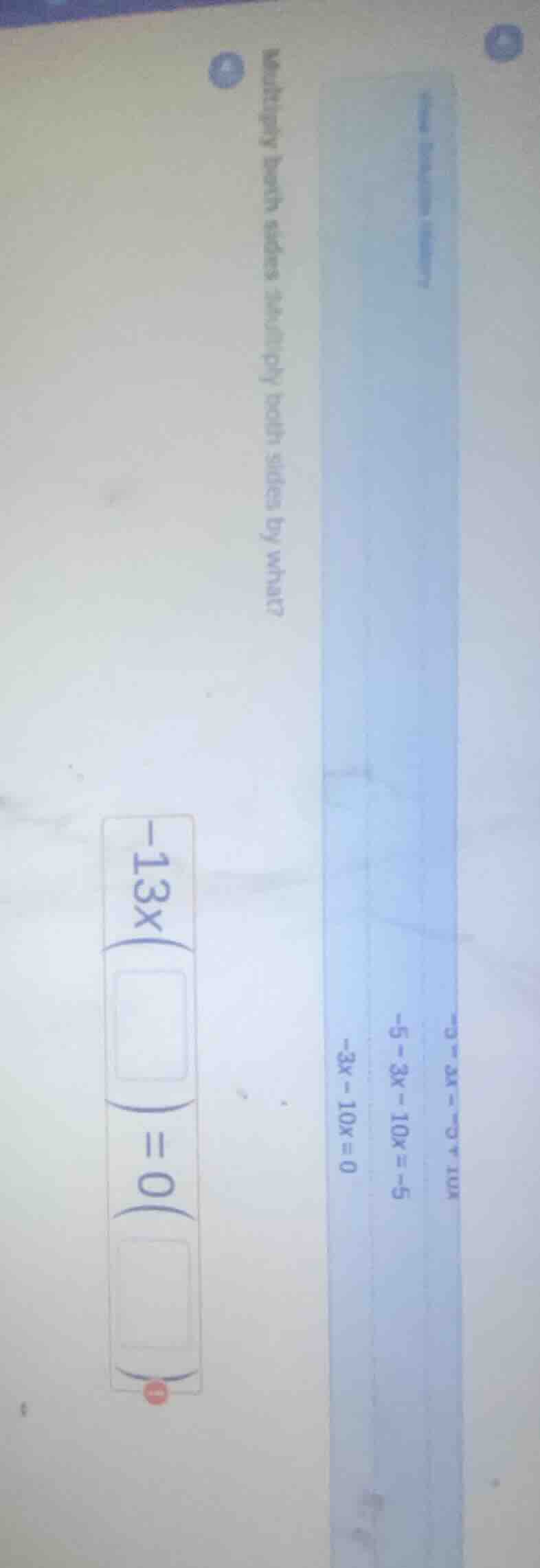
multiply both sides. multiply both sides by what?
-13x(□)=0(□)
-3 - 2x - 3 + 10x
-5 - 3x - 10x = -5
-3x - 10x = 0
Step1: Analyze the equation structure
We have \(-13x \times (\text{something}) = 0 \times (\text{something})\). We know that any number multiplied by \(0\) is \(0\), and we want to find what to multiply both sides by. But actually, if we consider the property of equations: if \(a\times b = c\times b\) (when \(b
eq0\)), but here we have \(-13x\times k=0\times k\) for some \(k\). Wait, maybe the original equation before this step was something like dividing or multiplying, but looking at the form, we need to find the value that when we multiply both sides (of an equation that led to \(-13x = 0\)) by the reciprocal or a value to solve. Wait, actually, if we have \(-13x = 0\), to solve for \(x\), we can multiply both sides by \(\frac{1}{-13}\) (or \(-\frac{1}{13}\)) because \(-13x\times\frac{1}{-13}=x\) and \(0\times\frac{1}{-13}=0\). So let's assume the equation is \(-13x = 0\), and we multiply both sides by \(\frac{1}{-13}\).
Step2: Multiply both sides by \(\frac{1}{-13}\)
Left side: \(-13x\times\frac{1}{-13}=x\)
Right side: \(0\times\frac{1}{-13}=0\)
So the value to multiply both sides by is \(\frac{1}{-13}\) (or \(-\frac{1}{13}\)). But looking at the box, maybe it's the reciprocal. Wait, the equation given is \(-13x(\quad)=0(\quad)\). So we need to put the same value in both boxes. Let's denote the value as \(k\). Then \(-13x\times k = 0\times k\). For this to hold for the solution, if we have \(-13x = 0\), then \(k\) can be \(\frac{1}{-13}\) (since multiplying both sides by \(\frac{1}{-13}\) gives \(x = 0\)). So the value to put in both boxes is \(\frac{1}{-13}\) (or \(-\frac{1}{13}\)). Alternatively, if we consider that any number multiplied by \(0\) is \(0\), but here we need to solve \(-13x = 0\), so multiply both sides by \(\frac{1}{-13}\).
Wait, maybe the original equation was \(-13x = 0\), and we are to multiply both sides by \(\frac{1}{-13}\) to get \(x = 0\). So the value in the boxes is \(\frac{1}{-13}\) (or \(-\frac{1}{13}\)). Let's check: \(-13x\times(-\frac{1}{13}) = x\) and \(0\times(-\frac{1}{13}) = 0\), so \(x = 0\). So the value to multiply both sides by is \(-\frac{1}{13}\) (or \(\frac{1}{-13}\)).

Snap & solve any problem in the app
Get step-by-step solutions on Sovi AI
Photo-based solutions with guided steps
Explore more problems and detailed explanations
The value to put in both boxes is \(\boldsymbol{-\frac{1}{13}}\) (or \(\frac{1}{-13}\), but \(-\frac{1}{13}\) is simpler). So both boxes should have \(-\frac{1}{13}\) (or \(\frac{1}{-13}\)).