QUESTION IMAGE
Question
multiple select question
select all that apply
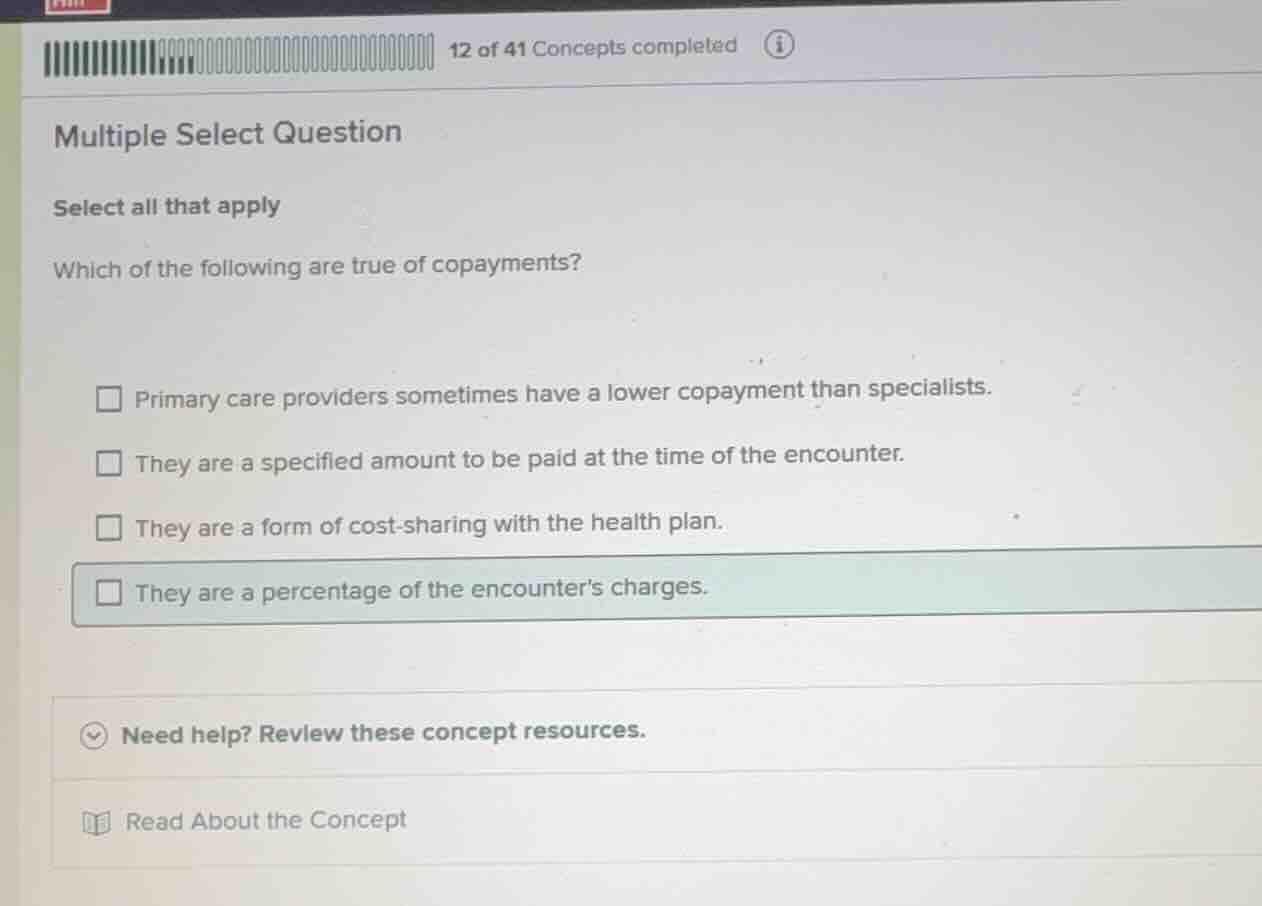
which of the following are true of copayments?
- primary care providers sometimes have a lower copayment than specialists.
- they are a specified amount to be paid at the time of the encounter.
- they are a form of cost-sharing with the health plan.
- they are a percentage of the encounters charges.
Define copayments and cost-sharing
Using the Medical Insurance Policy and Managed Care Plans knowledge points, we analyze the basic definition of a copayment. A copayment (or copay) is a fixed, predetermined fee that an insured individual pays out-of-pocket for a specific medical service or visit. Because both the patient and the insurance plan contribute to the cost of the service, copayments represent a standard form of cost-sharing between the policyholder and the health plan.
Analyze the payment timing
Copayments are typically collected at the time of service, which is often referred to in medical billing as the "encounter." Therefore, the statement that they are a specified amount to be paid at the time of the encounter is correct.
Compare provider tier copayments
In many managed care networks, insurance plans structure their benefits to encourage patients to see primary care providers (PCPs) first. To incentivize this, plans frequently set a lower copayment for a PCP visit compared to a specialist visit. Thus, the statement that primary care providers sometimes have a lower copayment than specialists is correct.
Distinguish copayment from coinsurance
The final option states that copayments are a percentage of the encounter's charges. This is incorrect. A percentage-based cost-sharing mechanism is defined as coinsurance, whereas a copayment is always a fixed dollar amount (e.g., \$20 per visit).

Snap & solve any problem in the app
Get step-by-step solutions on Sovi AI
Photo-based solutions with guided steps
Explore more problems and detailed explanations
- Primary care providers sometimes have a lower copayment than specialists. (Correct answer)
- They are a specified amount to be paid at the time of the encounter. (Correct answer)
- They are a form of cost-sharing with the health plan. (Correct answer)
- They are a percentage of the encounter's charges.