QUESTION IMAGE
Question
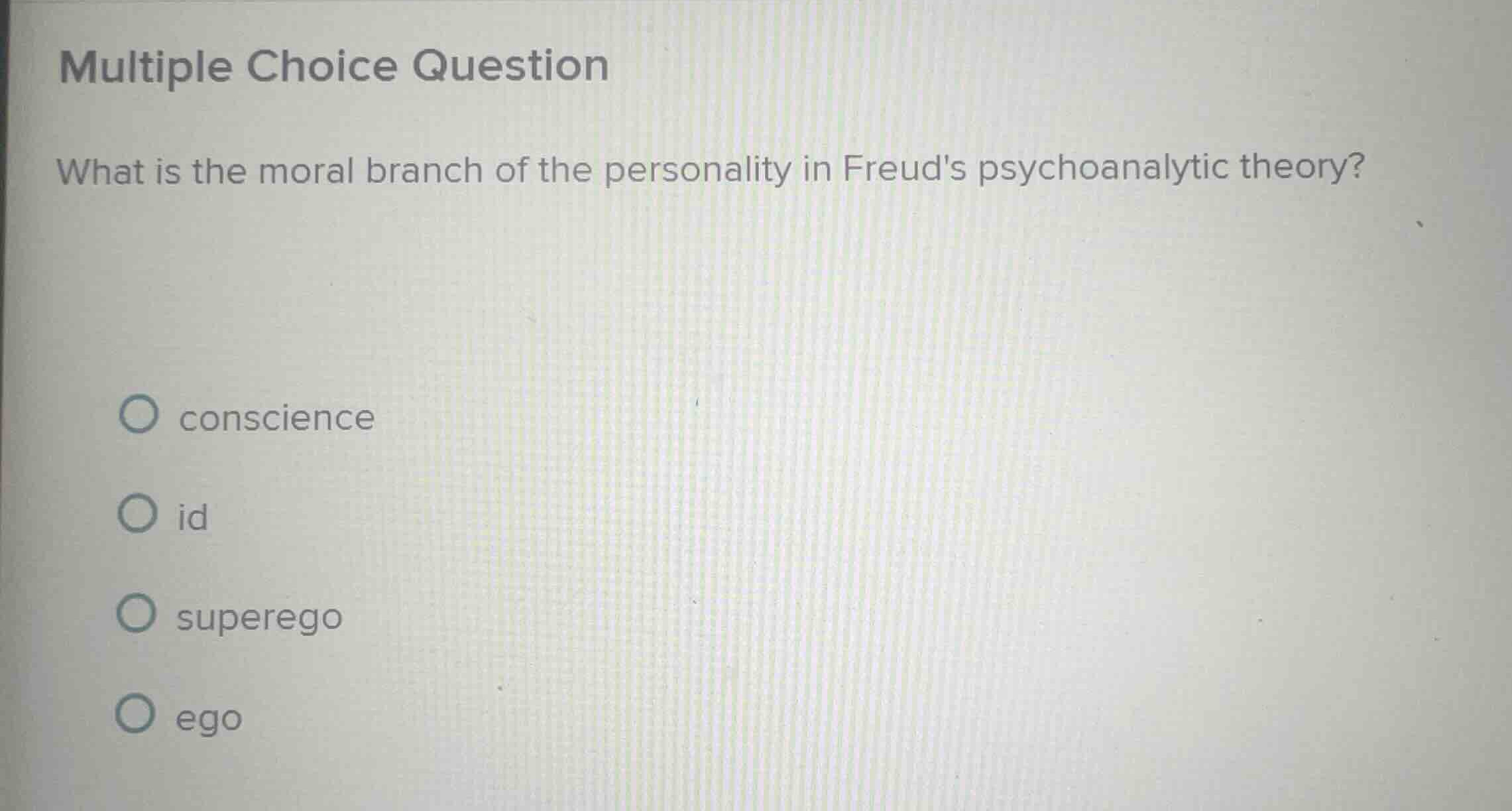
multiple choice question
what is the moral branch of the personality in freuds psychoanalytic theory?
conscience
id
superego
ego
Identify the core question
The question asks for the "moral branch" of the personality according to Sigmund Freud's psychoanalytic theory.
Analyze Freud's structural model of personality
Freud proposed that personality consists of three main components:
- Id: The primitive, instinctive component that operates on the pleasure principle, seeking immediate gratification of basic urges.
- Ego: The realistic, decision-making component that operates on the reality principle, mediating between the desires of the id and the constraints of the real world.
- Superego: The moral component of personality that incorporates social standards, values, and rules about what is right and wrong.
Evaluate the given options
- conscience: While the conscience is a part of the superego (representing internalized punishments and moral prohibitions), it is not the name of the overall structural branch itself.
- id: Represents basic biological drives, not morality.
- superego: Represents the moral branch of personality, striving for perfection and enforcing moral standards.
- ego: Represents the rational, reality-oriented mediator, not the moral branch.
Formulate the final conclusion
The superego is explicitly defined in psychoanalytic theory as the moral branch of personality because it represents internalized societal values, ideals, and moral standards.

Snap & solve any problem in the app
Get step-by-step solutions on Sovi AI
Photo-based solutions with guided steps
Explore more problems and detailed explanations
- conscience
- id
- superego (Correct answer)
- ego