QUESTION IMAGE
Question
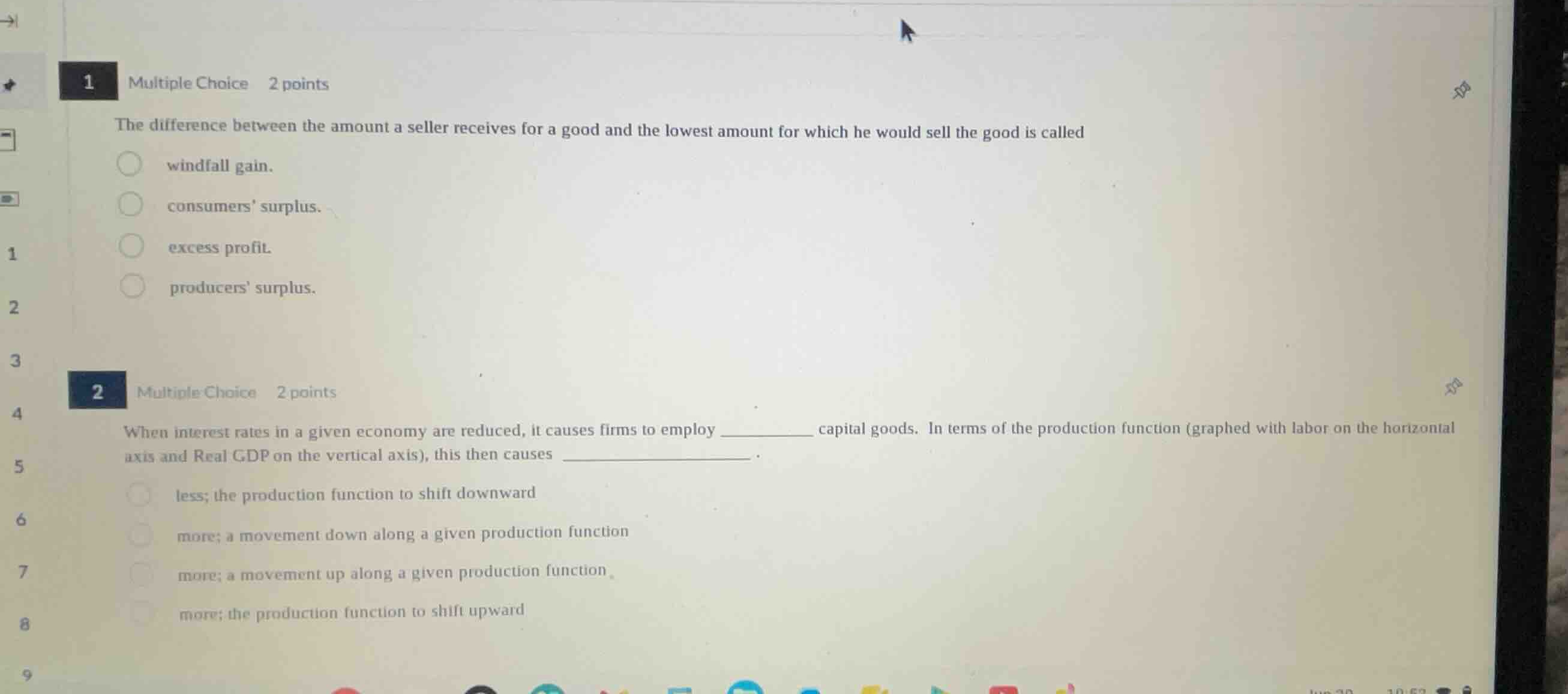
1 multiple choice 2 points
the difference between the amount a seller receives for a good and the lowest amount for which he would sell the good is called
windfall gain.
consumers surplus.
excess profit.
producers surplus.
2 multiple choice 2 points
when interest rates in a given economy are reduced, it causes firms to employ ____ capital goods. in terms of the production function (graphed with labor on the horizontal axis and real gdp on the vertical axis), this then causes ____.
less; the production function to shift downward
more; a movement down along a given production function
more; a movement up along a given production function
more; the production function to shift upward
Define producer surplus
The first question asks for the term describing the difference between the actual price a seller receives for a good and the minimum price they would be willing to accept to sell it. By definition, this economic measure of seller welfare is called producers' surplus.
Analyze interest rate effects on capital
The second question asks about the impact of reducing interest rates on a firm's capital employment. A lower interest rate reduces the cost of borrowing, which encourages firms to invest in and employ more capital goods.
Determine the shift in the production function
The production function is graphed with labor on the horizontal axis and Real GDP on the vertical axis: \(Y = f(K, L)\). Since capital \(K\) is held constant along a single curve, an increase in the quantity of capital employed shifts the entire production function upward, allowing more output to be produced at every level of labor.

Snap & solve any problem in the app
Get step-by-step solutions on Sovi AI
Photo-based solutions with guided steps
Explore more problems and detailed explanations
Question 1
- windfall gain.
- consumers' surplus.
- excess profit.
- producers' surplus. (Correct answer)
Question 2
- less; the production function to shift downward
- more; a movement down along a given production function
- more; a movement up along a given production function
- more; the production function to shift upward (Correct answer)