QUESTION IMAGE
Question
4 multiple choice 1 point
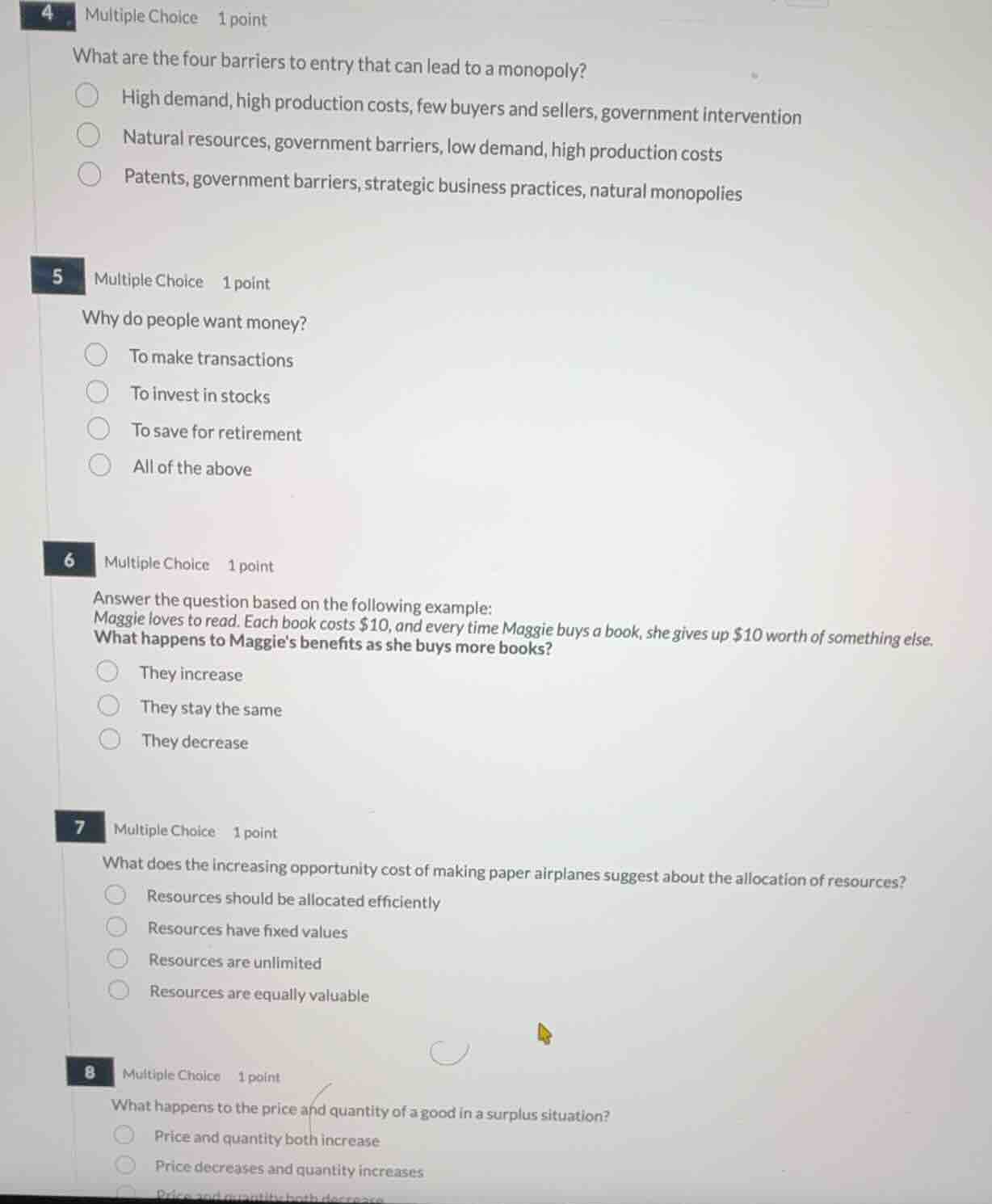
what are the four barriers to entry that can lead to a monopoly?
high demand, high production costs, few buyers and sellers, government intervention
natural resources, government barriers, low demand, high production costs
patents, government barriers, strategic business practices, natural monopolies
5 multiple choice 1 point
why do people want money?
to make transactions
to invest in stocks
to save for retirement
all of the above
6 multiple choice 1 point
answer the question based on the following example:
maggie loves to read. each book costs $10, and every time maggie buys a book, she gives up $10 worth of something else.
what happens to maggies benefits as she buys more books?
they increase
they stay the same
they decrease
7 multiple choice 1 point
what does the increasing opportunity cost of making paper airplanes suggest about the allocation of resources?
resources should be allocated efficiently
resources have fixed values
resources are unlimited
resources are equally valuable
8 multiple choice 1 point
what happens to the price and quantity of a good in a surplus situation?
price and quantity both increase
price decreases and quantity increases
Analyze barriers to entry for monopolies
Barriers to entry prevent competitors from entering a market. The primary barriers include control of natural resources, government-enforced barriers (like patents and copyrights), strategic business practices, and natural monopolies (due to high start-up costs or economies of scale). The third option in Question 4 lists these four barriers.
Determine the reasons people want money
Money serves three main functions: a medium of exchange (to make transactions), a store of value (to save for retirement), and a unit of account/standard for investment (to invest in stocks). Therefore, all the listed reasons are valid motivations for wanting money.
Evaluate marginal benefits of consumption
According to the law of diminishing marginal utility, as a consumer purchases and consumes more of a specific good (books), the additional benefit (marginal benefit) derived from each additional unit decreases.
Analyze increasing opportunity cost and resource allocation
The law of increasing opportunity cost states that as you produce more of one good, the opportunity cost of producing it increases because resources are not equally adaptable to all uses. This implies that resources are not equally valuable for all tasks, meaning they have different productive capabilities.
Determine market adjustments in a surplus
In a surplus situation, quantity supplied exceeds quantity demanded. To clear the excess supply, sellers lower their prices. As price decreases, quantity demanded increases and quantity supplied decreases until equilibrium is restored.

Snap & solve any problem in the app
Get step-by-step solutions on Sovi AI
Photo-based solutions with guided steps
Explore more problems and detailed explanations
Question 4
- High demand, high production costs, few buyers and sellers, government intervention
- Natural resources, government barriers, low demand, high production costs
- Patents, government barriers, strategic business practices, natural monopolies (Correct answer)
Question 5
- To make transactions
- To invest in stocks
- To save for retirement
- All of the above (Correct answer)
Question 6
- They increase
- They stay the same
- They decrease (Correct answer)
Question 7
- Resources should be allocated efficiently
- Resources have fixed values
- Resources are unlimited
- Resources are equally valuable (Correct answer)
Question 8
- Price and quantity both increase
- Price decreases and quantity increases (Correct answer)
- Price and quantity both decrease