QUESTION IMAGE
Question
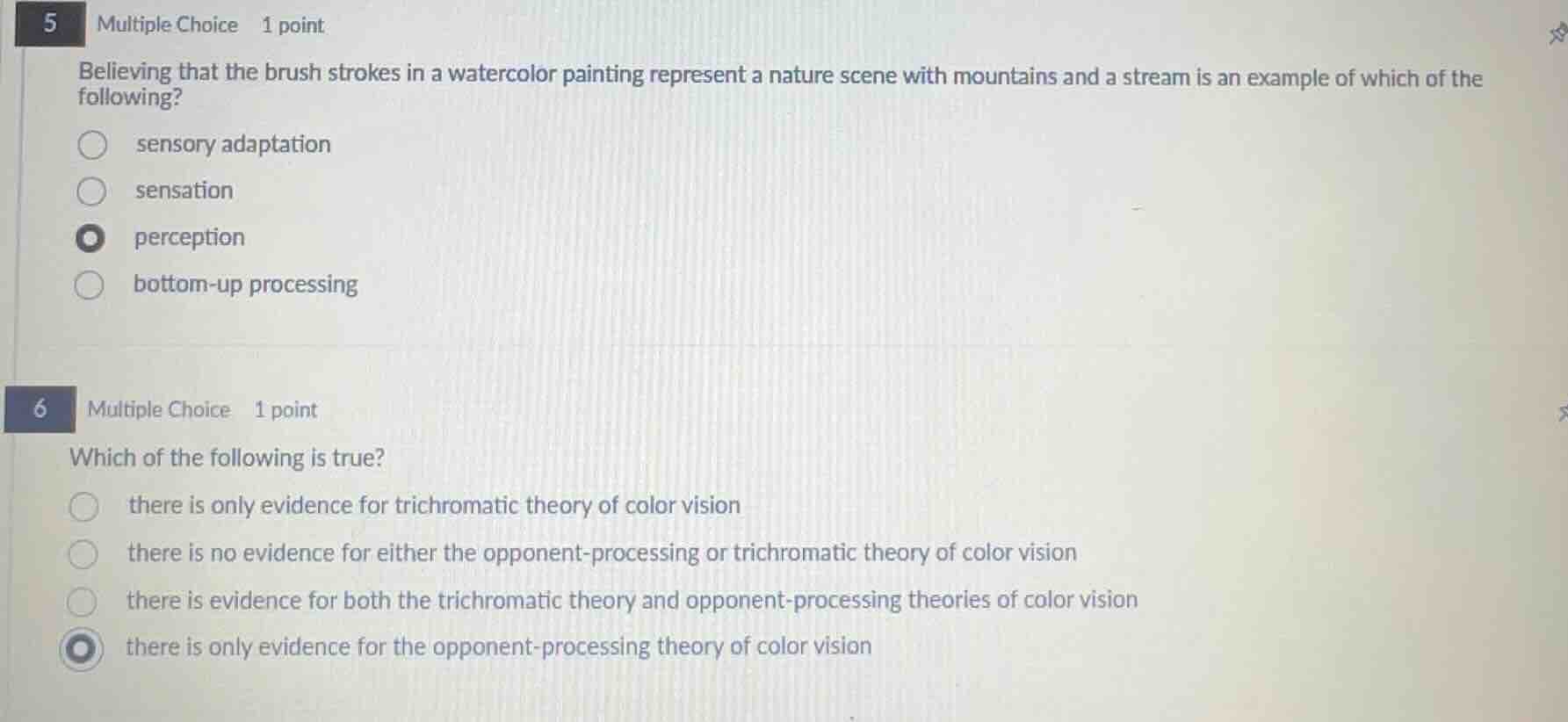
5 multiple choice 1 point
believing that the brush strokes in a watercolor painting represent a nature scene with mountains and a stream is an example of which of the following?
sensory adaptation
sensation
perception
bottom-up processing
6 multiple choice 1 point
which of the following is true?
there is only evidence for trichromatic theory of color vision
there is no evidence for either the opponent-processing or trichromatic theory of color vision
there is evidence for both the trichromatic theory and opponent-processing theories of color vision
there is only evidence for the opponent-processing theory of color vision
Analyze Question 5
The question asks about interpreting brush strokes in a watercolor painting as a nature scene with mountains and a stream.
- Sensation is the detection of physical energy from the environment by our sensory receptors.
- Perception is the process of organizing and interpreting sensory information, enabling us to recognize meaningful objects and events. Interpreting abstract brush strokes as a meaningful scene (mountains and a stream) is a clear example of perception.
- Sensory adaptation is diminished sensitivity as a consequence of constant stimulation.
- Bottom-up processing is analysis that begins with the sensory receptors and works up to the brain's integration of sensory information. Interpreting the scene based on prior knowledge or expectations is top-down, but the overall act of interpretation itself is Sensation and Perception.
Analyze Question 6
The question asks which statement is true regarding the theories of color vision.
- The trichromatic theory (Young-Helmholtz) explains color vision at the level of the retina's cones (red, green, and blue receptors).
- The opponent-process theory (Hering) explains color vision at the level of the bipolar/ganglion cells and the thalamus (red-green, yellow-blue, and white-black opponent channels).
- Modern research shows that both theories are correct and work together to explain how we see color at different stages of visual processing. Therefore, there is evidence for both theories.

Snap & solve any problem in the app
Get step-by-step solutions on Sovi AI
Photo-based solutions with guided steps
Explore more problems and detailed explanations
Question 5
- sensory adaptation
- sensation
- perception (Correct answer)
- bottom-up processing
Question 6
- there is only evidence for trichromatic theory of color vision
- there is no evidence for either the opponent-processing or trichromatic theory of color vision
- there is evidence for both the trichromatic theory and opponent-processing theories of color vision (Correct answer)
- there is only evidence for the opponent-processing theory of color vision