QUESTION IMAGE
Question
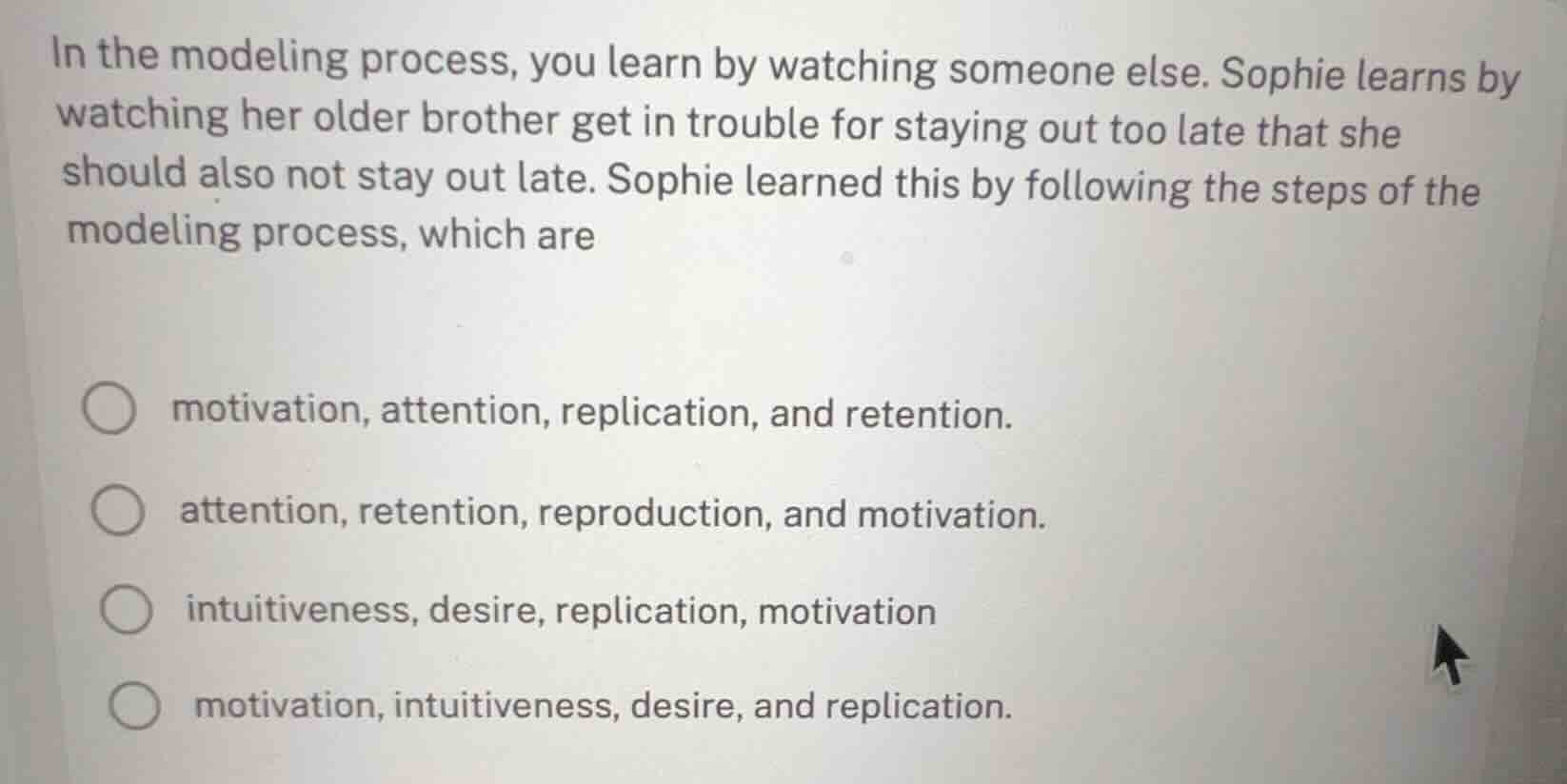
in the modeling process, you learn by watching someone else. sophie learns by watching her older brother get in trouble for staying out too late that she should also not stay out late. sophie learned this by following the steps of the modeling process, which are
motivation, attention, replication, and retention.
attention, retention, reproduction, and motivation.
intuitiveness, desire, replication, motivation
motivation, intuitiveness, desire, and replication.
<pre_analysis>
{
"quality": "clear",
"question_count": 1,
"skills_matched": [
"direct_cot",
"multiple_choice_formatter",
"explain_then_answer",
"tutor",
"mastery_adaptive_brevity"
],
"needs_drawing": false,
"concepts_used": [
"Observational Learning"
],
"new_concepts": [
"Modeling Process Steps",
"Albert Bandura Theory"
],
"current_concepts": [
"Observational Learning",
"Modeling Process Steps",
"Albert Bandura Theory"
]
}
</pre_analysis>
<reasoning>
Identify the core psychological concept
Using the Observational Learning knowledge point, we analyze Albert Bandura's social learning theory, which outlines how individuals learn by watching a model.
Determine the correct sequence of steps
The four sequential steps of the modeling process are:
- Attention: The observer must focus on the model's behavior.
- Retention: The observer must remember the observed behavior.
- Reproduction: The observer must be able to perform the behavior.
- Motivation: The observer must have a reason to replicate or avoid the behavior.
This matches the sequence: attention, retention, reproduction, and motivation.
</reasoning>
<answer>
<mcq-option>motivation, attention, replication, and retention.</mcq-option>
<mcq-correct>attention, retention, reproduction, and motivation.</mcq-correct>
<mcq-option>intuitiveness, desire, replication, motivation</mcq-option>
<mcq-option>motivation, intuitiveness, desire, and replication.</mcq-option>
</answer>
<post_analysis>
{
"subject": "Social Science",
"question_type": "Multiple Choice",
"knowledge_point": [
"Social Science",
"Psychology",
"Observational Learning"
]
}
</post_analysis>
Snap & solve any problem in the app
Get step-by-step solutions on Sovi AI
Photo-based solutions with guided steps
Explore more problems and detailed explanations
<pre_analysis>
{
"quality": "clear",
"question_count": 1,
"skills_matched": [
"direct_cot",
"multiple_choice_formatter",
"explain_then_answer",
"tutor",
"mastery_adaptive_brevity"
],
"needs_drawing": false,
"concepts_used": [
"Observational Learning"
],
"new_concepts": [
"Modeling Process Steps",
"Albert Bandura Theory"
],
"current_concepts": [
"Observational Learning",
"Modeling Process Steps",
"Albert Bandura Theory"
]
}
</pre_analysis>
<reasoning>
Identify the core psychological concept
Using the Observational Learning knowledge point, we analyze Albert Bandura's social learning theory, which outlines how individuals learn by watching a model.
Determine the correct sequence of steps
The four sequential steps of the modeling process are:
- Attention: The observer must focus on the model's behavior.
- Retention: The observer must remember the observed behavior.
- Reproduction: The observer must be able to perform the behavior.
- Motivation: The observer must have a reason to replicate or avoid the behavior.
This matches the sequence: attention, retention, reproduction, and motivation.
</reasoning>
<answer>
<mcq-option>motivation, attention, replication, and retention.</mcq-option>
<mcq-correct>attention, retention, reproduction, and motivation.</mcq-correct>
<mcq-option>intuitiveness, desire, replication, motivation</mcq-option>
<mcq-option>motivation, intuitiveness, desire, and replication.</mcq-option>
</answer>
<post_analysis>
{
"subject": "Social Science",
"question_type": "Multiple Choice",
"knowledge_point": [
"Social Science",
"Psychology",
"Observational Learning"
]
}
</post_analysis>