Sovi.AI - AI Math Tutor

Scan to solve math questions

QUESTION IMAGE

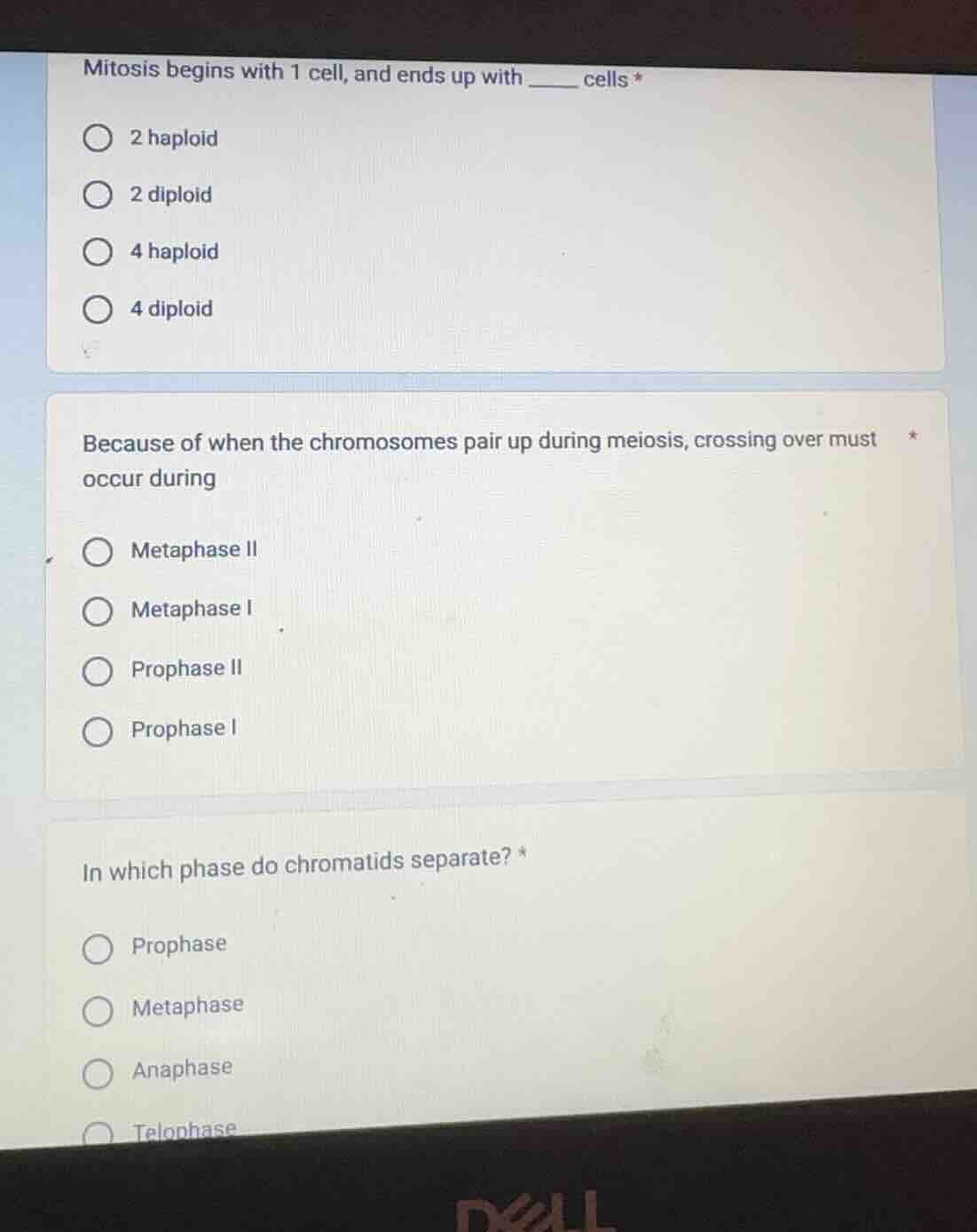
mitosis begins with 1 cell, and ends up with _____ cells * 2 haploid 2 …

Question

mitosis begins with 1 cell, and ends up with _____ cells *

2 haploid
2 diploid
4 haploid
4 diploid

because of when the chromosomes pair up during meiosis, crossing over must occur during *

metaphase ii
metaphase i
prophase ii
prophase i

in which phase do chromatids separate? *

prophase
metaphase
anaphase
telophase

Explanation:

Response

<pre_analysis>
{
"quality": "clear",
"question_count": 3,
"skills_matched": [
"direct_cot",
"multiple_choice_formatter",
"explain_then_answer",
"quick"
],
"needs_drawing": false,
"concepts_used": [
"Eukaryotic Cell Division",
"Crossing Over",
"Mitosis Stages"
],
"new_concepts": [],
"current_concepts": [
"Eukaryotic Cell Division",
"Crossing Over",
"Mitosis Stages"
]
}
</pre_analysis>

<reasoning>

Analyze the outcome of mitosis

Mitosis is a process of cell division that results in two genetically identical daughter cells. Since the parent cell is diploid, the resulting cells are also diploid. Thus, mitosis begins with 1 cell and ends up with 2 diploid cells.

Determine the phase of crossing over

Crossing over occurs when homologous chromosomes pair up to form tetrads. This pairing (synapsis) and subsequent genetic exchange occur during the first prophase of meiosis, which is Prophase I.

Identify the phase where chromatids separate

During cell division, sister chromatids are pulled apart toward opposite poles of the cell. This separation of sister chromatids occurs during Anaphase.
</reasoning>

<answer>

Question 1

<mcq-option>(A) 2 haploid</mcq-option>
<mcq-correct>(B) 2 diploid</mcq-correct>
<mcq-option>(C) 4 haploid</mcq-option>
<mcq-option>(D) 4 diploid</mcq-option>

Question 2

<mcq-option>(A) Metaphase II</mcq-option>
<mcq-option>(B) Metaphase I</mcq-option>
<mcq-option>(C) Prophase II</mcq-option>
<mcq-correct>(D) Prophase I</mcq-correct>

Question 3

<mcq-option>(A) Prophase</mcq-option>
<mcq-option>(B) Metaphase</mcq-option>
<mcq-correct>(C) Anaphase</mcq-correct>
<mcq-option>(D) Telophase</mcq-option>
</answer>

<post_analysis>
{
"subject": "Natural Science",
"question_type": "Multiple Choice",
"knowledge_point": [
"Natural Science",
"Biology",
"Cell Division"
]
}
</post_analysis>

Answer:

<pre_analysis>
{
"quality": "clear",
"question_count": 3,
"skills_matched": [
"direct_cot",
"multiple_choice_formatter",
"explain_then_answer",
"quick"
],
"needs_drawing": false,
"concepts_used": [
"Eukaryotic Cell Division",
"Crossing Over",
"Mitosis Stages"
],
"new_concepts": [],
"current_concepts": [
"Eukaryotic Cell Division",
"Crossing Over",
"Mitosis Stages"
]
}
</pre_analysis>

<reasoning>

Analyze the outcome of mitosis

Mitosis is a process of cell division that results in two genetically identical daughter cells. Since the parent cell is diploid, the resulting cells are also diploid. Thus, mitosis begins with 1 cell and ends up with 2 diploid cells.

Determine the phase of crossing over

Crossing over occurs when homologous chromosomes pair up to form tetrads. This pairing (synapsis) and subsequent genetic exchange occur during the first prophase of meiosis, which is Prophase I.

Identify the phase where chromatids separate

During cell division, sister chromatids are pulled apart toward opposite poles of the cell. This separation of sister chromatids occurs during Anaphase.
</reasoning>

<answer>

Question 1

<mcq-option>(A) 2 haploid</mcq-option>
<mcq-correct>(B) 2 diploid</mcq-correct>
<mcq-option>(C) 4 haploid</mcq-option>
<mcq-option>(D) 4 diploid</mcq-option>

Question 2

<mcq-option>(A) Metaphase II</mcq-option>
<mcq-option>(B) Metaphase I</mcq-option>
<mcq-option>(C) Prophase II</mcq-option>
<mcq-correct>(D) Prophase I</mcq-correct>

Question 3

<mcq-option>(A) Prophase</mcq-option>
<mcq-option>(B) Metaphase</mcq-option>
<mcq-correct>(C) Anaphase</mcq-correct>
<mcq-option>(D) Telophase</mcq-option>
</answer>

<post_analysis>
{
"subject": "Natural Science",
"question_type": "Multiple Choice",
"knowledge_point": [
"Natural Science",
"Biology",
"Cell Division"
]
}
</post_analysis>