QUESTION IMAGE
Question
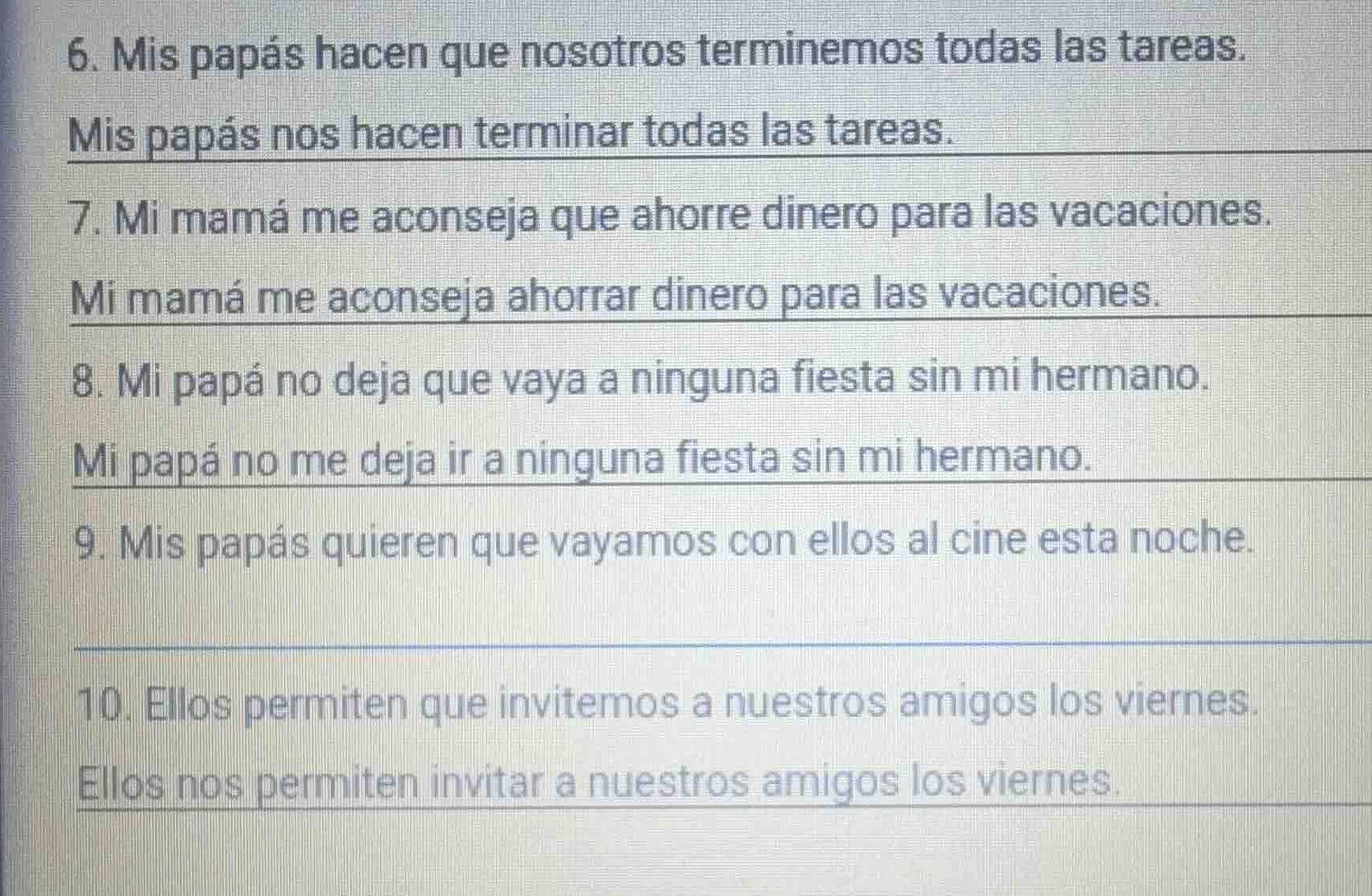
- mis papás hacen que nosotros terminemos todas las tareas.
mis papás nos hacen terminar todas las tareas.
- mi mamá me aconseja que ahorre dinero para las vacaciones.
mi mamá me aconseja ahorrar dinero para las vacaciones.
- mi papá no deja que vaya a ninguna fiesta sin mi hermano.
mi papá no me deja ir a ninguna fiesta sin mi hermano.
- mis papás quieren que vayamos con ellos al cine esta noche.
- ellos permiten que invitemos a nuestros amigos los viernes.
ellos nos permiten invitar a nuestros amigos los viernes.
Analyze the grammatical pattern
The exercise shows sentences with a main clause of influence followed by a subordinate clause in the subjunctive mood (using que). These sentences are rewritten into a simplified structure using an object pronoun, the main verb, and an infinitive.
Let's look at the examples:
- Item 6: "Mis papás hacen que nosotros terminemos..." becomes "Mis papás nos hacen terminar..."
- Item 7: "Mi mamá me aconseja que ahorre..." becomes "Mi mamá me aconseja ahorrar..."
- Item 8: "Mi papá no deja que vaya..." becomes "Mi papá no me deja ir..."
- Item 10: "Ellos permiten que invitemos..." becomes "Ellos nos permiten invitar..."
Apply the pattern to Item 9
The sentence to rewrite is:
"Mis papás quieren que vayamos con ellos al cine esta noche."
- Identify the main verb of influence/desire: quieren (from querer).
- Identify the subject of the subordinate clause: nosotros (indicated by the subjunctive verb vayamos).
- *Determine if querer allows this transformation: Unlike verbs of influence like hacer, aconsejar, dejar, or permitir, the verb querer* (to want) does not take an indirect object pronoun representing the subject of the subordinate clause to form an infinitive construction when the subjects are different.
- However, in standard Spanish grammar exercises of this specific type, verbs of influence/will are converted by turning the subordinate subject into an object pronoun (nos) and the subjunctive verb into an infinitive (ir).
- Let's verify if querer can be rewritten this way: "Mis papás nos quieren llevar..." or "Mis papás nos quieren ir..." No, querer does not function as a causative or influence verb taking an object pronoun in this manner (nos quieren ir is ungrammatical).
- Let's re-evaluate the syntactic behavior. For some verbs of influence, we can use:
[Subject] + [Object Pronoun] + [Verb of Influence] + [Infinitive]. - If we strictly follow the mechanical pattern of the worksheet:
- Subordinate verb: vayamos (subjunctive of ir) $
ightarrow$ Infinitive: ir.
- Subordinate subject: nosotros $
ightarrow$ Object pronoun: nos.
- Combining them with the main verb quieren: "Mis papás nos quieren ir con ellos al cine esta noche" is grammatically incorrect in Spanish because querer does not license an object pronoun this way.
- However, querer with different subjects must use the que + subjunctive construction. There is no alternative infinitive construction with an object pronoun for querer when the subjects are different.
- Let's check if there is an alternative interpretation. Sometimes, querer can be substituted or is a trick question where no change is possible, or perhaps the intended answer is indeed the mechanical (though ungrammatical) translation, or a different verb is implied.
- Let's look closely at the prompt. If we must write an equivalent sentence using an infinitive, we cannot use querer with nos. Instead, we must use a verb of influence with a similar meaning, such as invitar (to inv…

Snap & solve any problem in the app
Get step-by-step solutions on Sovi AI
Photo-based solutions with guided steps
Explore more problems and detailed explanations
- Mis papás quieren que vayamos con ellos al cine esta noche.
<blank>Mis papás quieren que vayamos con ellos al cine esta noche.</blank>
(Note: Unlike verbs of influence/permission like hacer, dejar, or permitir, the verb querer does not allow an infinitive construction with an object pronoun when there is a change of subject. Therefore, this sentence cannot be rewritten and must keep the subjunctive clause).