QUESTION IMAGE
Question
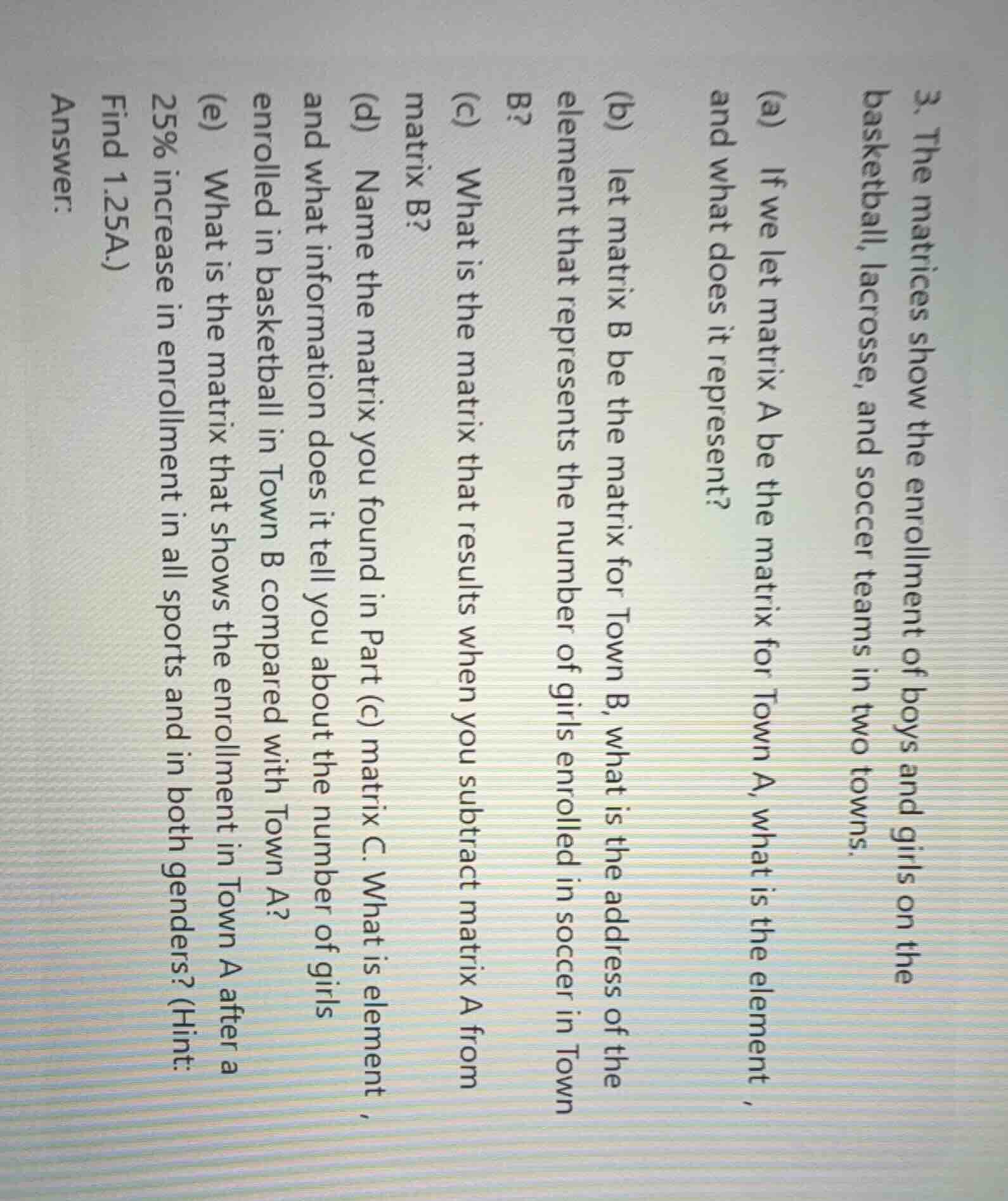
- the matrices show the enrollment of boys and girls on the basketball, lacrosse, and soccer teams in two towns.
(a) if we let matrix a be the matrix for town a, what is the element, and what does it represent?
(b) let matrix b be the matrix for town b, what is the address of the element that represents the number of girls enrolled in soccer in town b?
(c) what is the matrix that results when you subtract matrix a from matrix b?
(d) name the matrix you found in part (c) matrix c. what is element, and what information does it tell you about the number of girls enrolled in basketball in town b compared with town a?
(e) what is the matrix that shows the enrollment in town a after a 25% increase in enrollment in all sports and in both genders? (hint: find 1.25a.)
answer:
To solve part (e), we assume matrix \( A \) represents the enrollment in Town A for boys and girls in basketball, lacrosse, and soccer. A 25% increase means we multiply each element of \( A \) by \( 1.25 \) (since \( 1 + 0.25 = 1.25 \)).
Step 1: Understand the Operation
A 25% increase in enrollment means the new enrollment is \( 125\% \) of the original, which is \( 1.25 \) times the original matrix \( A \).
Step 2: Multiply Matrix \( A \) by \( 1.25 \)
If \( A =
\) (where rows represent genders and columns represent sports), then \( 1.25A =
\). Each element of \( A \) is multiplied by \( 1.25 \) to get the new enrollment matrix after the 25% increase.
For example, if \( A =
\) (boys: 40 basketball, 30 lacrosse, 50 soccer; girls: 20 basketball, 15 lacrosse, 25 soccer), then:
\( 1.25A = 1.25 \times
=
=
\)

Snap & solve any problem in the app
Get step-by-step solutions on Sovi AI
Photo-based solutions with guided steps
Explore more problems and detailed explanations
The matrix showing the enrollment in Town A after a 25% increase is obtained by multiplying each element of matrix \( A \) by \( 1.25 \). If \( A \) has elements \( a_{ij} \), the new matrix is \(
\) (or the numerical matrix if \( A \)'s values are known). For the example above, it is \(
\).