QUESTION IMAGE
Question
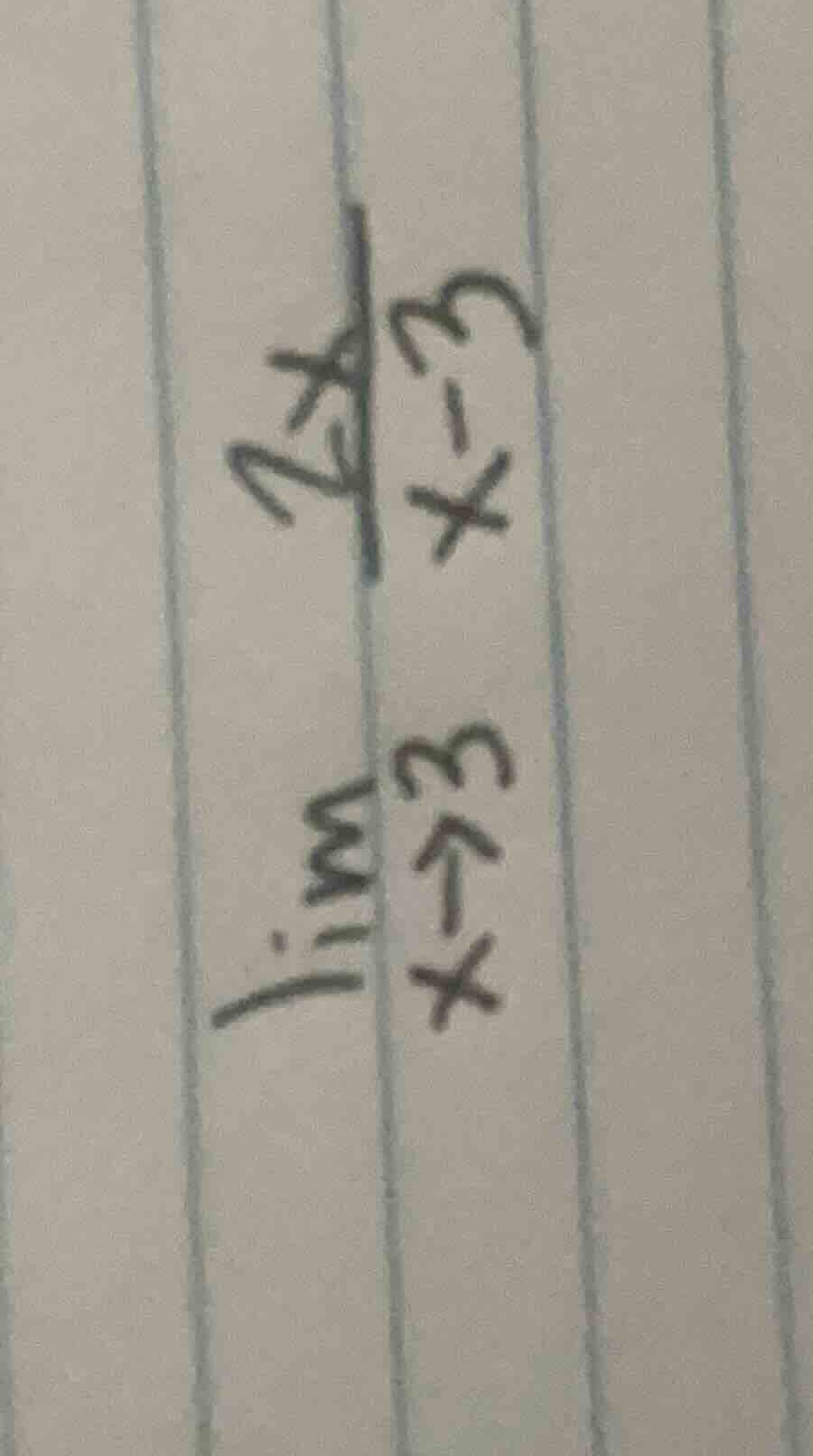
\\\lim_{x \to 3} \frac{2x}{x-3}\\
Identify the limit expression
We analyze the given limit:
We need to evaluate the behavior of the function as \(x\) approaches \(3\).
Evaluate direct substitution
We substitute \(x = 3\) into the numerator and denominator:
- Numerator: \(2(3) = 6\)
- Denominator: \(3 - 3 = 0\)
Since the limit is of the form \(\frac{c}{0}\) where \(c
eq 0\), the limit does not exist as a finite real number and represents an infinite limit.
Analyze the left-hand limit
We examine the limit as \(x\) approaches \(3\) from the left (\(x \to 3^-\)):
- For \(x < 3\), the term \(x - 3 < 0\).
- The numerator \(2x\) remains positive (close to \(6\)).
- Thus, the ratio is positive divided by negative:
Analyze the right-hand limit
We examine the limit as \(x\) approaches \(3\) from the right (\(x \to 3^+\)):
- For \(x > 3\), the term \(x - 3 > 0\).
- The numerator \(2x\) remains positive (close to \(6\)).
- Thus, the ratio is positive divided by positive:
Determine the overall limit
Since the left-hand limit and the right-hand limit do not agree:
The overall limit does not exist (DNE).

Snap & solve any problem in the app
Get step-by-step solutions on Sovi AI
Photo-based solutions with guided steps
Explore more problems and detailed explanations
The limit does not exist (DNE) because the one-sided limits are unequal: