QUESTION IMAGE
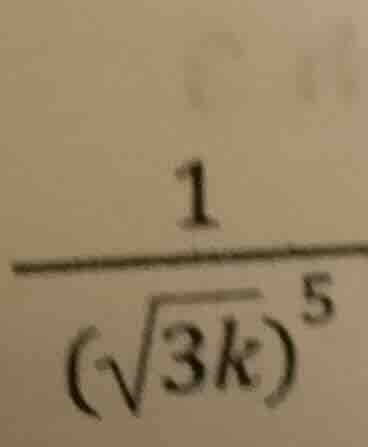
Question
\\\frac{1}{(\sqrt{3k})^5}\\
⚡ Using what you learned: Rationalizing Denominators · Expressions with Negative Exponents
Step 1: Rewrite using rational exponents
$$
\frac{1}{(\sqrt{3k})^5} = \frac{1}{(3k)^{5/2}} = (3k)^{-5/2}
$$
Step 2: Simplify the radical in the denominator
$$
(\sqrt{3k})^5 = (\sqrt{3k})^4 \cdot \sqrt{3k} = (3k)^2 \sqrt{3k} = 9k^2 \sqrt{3k}
$$
$$
\frac{1}{(\sqrt{3k})^5} = \frac{1}{9k^2 \sqrt{3k}}
$$
Step 3: Rationalize the denominator
Multiply the numerator and denominator by \(\sqrt{3k}\):
$$
\frac{1 \cdot \sqrt{3k}}{9k^2 \sqrt{3k} \cdot \sqrt{3k}} = \frac{\sqrt{3k}}{9k^2 (3k)} = \frac{\sqrt{3k}}{27k^3}
$$

Snap & solve any problem in the app
Get step-by-step solutions on Sovi AI
Photo-based solutions with guided steps
Explore more problems and detailed explanations
The expression can be written in the following equivalent forms:
In exponential form:
$$
(3k)^{-5/2}
$$
With a rationalized denominator:
$$
\frac{\sqrt{3k}}{27k^3}
$$