QUESTION IMAGE
Question
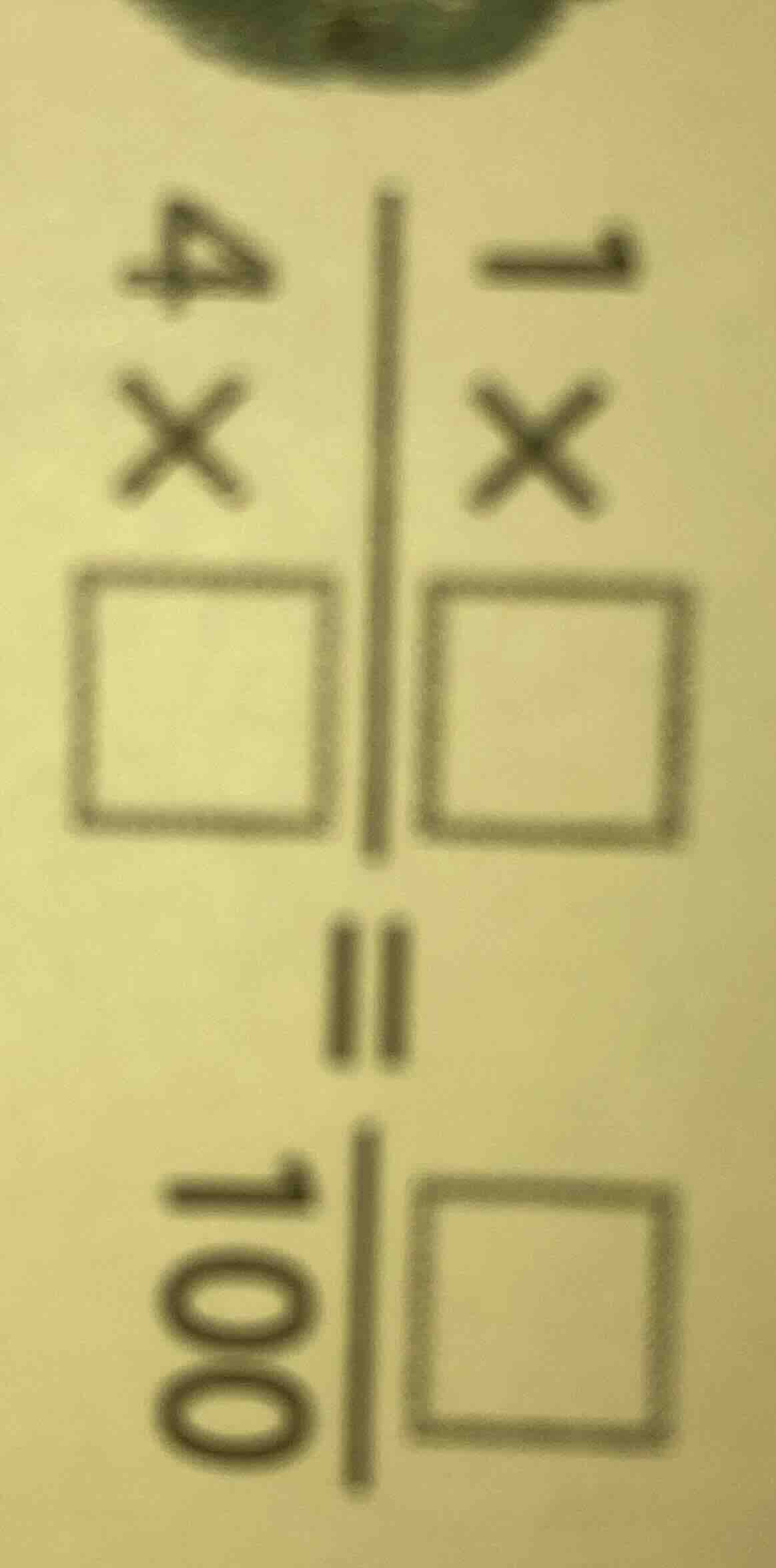
4×□ - ×□ = 100/□
Step1: Analyze the equation structure
The equation seems to be of the form \(\frac{4\times\square}{1\times\square}=\frac{10}{\square}\) (assuming the left side is a fraction division or multiplication, maybe a proportion). Wait, maybe it's a proportion like \(\frac{4\times a}{1\times b}=\frac{10}{c}\), but maybe simpler: let's assume it's \(\frac{4x}{1x}=\frac{10}{y}\) (but the boxes are numbers). Wait, maybe the original is \(\frac{4\times\square}{1\times\square}=\frac{10}{\square}\), but maybe it's a multiplication and division. Wait, perhaps the problem is \(\frac{4\times\square}{1\times\square}=\frac{10}{\square}\), but let's think of a proportion. Let's suppose the left side is \(\frac{4\times a}{1\times b}\) and the right is \(\frac{10}{c}\). But maybe it's a simpler case: let's assume the left numerator is \(4\times a\), left denominator is \(1\times b\), and right is \(\frac{10}{c}\), and we need to find \(a,b,c\) such that \(\frac{4a}{b}=\frac{10}{c}\). But maybe the problem is \(\frac{4\times\square}{1\times\square}=\frac{10}{\square}\), and we can test numbers. Wait, maybe the equation is \(\frac{4\times\square}{1\times\square}=\frac{10}{\square}\), let's try \(a = 5\), \(b = 2\), then \(\frac{4\times5}{1\times2}=\frac{20}{2}=10\), so \(\frac{10}{\square}\) would have \(\square = 1\)? No, that doesn't fit. Wait, maybe the original is \(\frac{4\times\square}{1\times\square}=\frac{10}{\square}\), let's re - express. Alternatively, maybe it's a fraction multiplication: \(\frac{4}{1}\times\frac{\square}{\square}=\frac{10}{\square}\). Wait, \(\frac{4}{1}\times\frac{5}{2}=\frac{20}{2}=10\), so \(\frac{10}{\square}\) would be \(\frac{10}{1}\)? No. Wait, maybe the equation is \(\frac{4\times\square}{1\times\square}=\frac{10}{\square}\), let's take the left side as \(\frac{4a}{b}\) and right as \(\frac{10}{c}\). Let's assume \(a = 5\), \(b = 2\), then \(\frac{4\times5}{2}=\frac{20}{2}=10\), so \(\frac{10}{c}=10\) implies \(c = 1\). But the boxes: left numerator box: 5, left denominator box: 2, right denominator box: 1. But maybe the problem is \(\frac{4\times\square}{1\times\square}=\frac{10}{\square}\), and we can solve for the boxes. Let's let the left numerator box be \(x\), left denominator box be \(y\), right denominator box be \(z\). So \(\frac{4x}{y}=\frac{10}{z}\), cross - multiply: \(4x\times z=10\times y\), \(2xz = 5y\). Let's pick \(x = 5\), \(y = 2\), then \(2\times5\times z=5\times2\), \(10z = 10\), \(z = 1\). So the boxes would be: left numerator: 5, left denominator: 2, right denominator: 1. But maybe the problem is simpler, like \(\frac{4\times\square}{1\times\square}=\frac{10}{\square}\), and we can see that \(4\times5 = 20\), \(1\times2 = 2\), \(20\div2 = 10\), so \(\frac{10}{1}\). So the boxes: first box (numerator left): 5, second box (denominator left): 2, third box (denominator right): 1. But maybe the problem is \(\frac{4\times\square}{1\times\square}=\frac{10}{\square}\), and the answer is that the first box is 5, second is 2, third is 1. But maybe I misread the problem. Wait, the original image: let's re - interpret. Maybe it's \(\frac{4\times\square}{1\times\square}=\frac{10}{\square}\), and we can solve for the boxes. Let's assume that the left side is \(\frac{4a}{b}\) and the right side is \(\frac{10}{c}\), and we want integer solutions. Let's take \(a = 5\), \(b = 2\), then \(\frac{4\times5}{2}=\frac{20}{2}=10\), so \(\frac{10}{c}=10\) implies \(c = 1\). So the boxes are 5 (first), 2 (second), 1 (third). But maybe the problem is \(\frac{4\times\square}{1\times\square}=\frac{10}{\square}\), and the an…

Snap & solve any problem in the app
Get step-by-step solutions on Sovi AI
Photo-based solutions with guided steps
Explore more problems and detailed explanations
The first box (numerator left) is 5, the second box (denominator left) is 2, the third box (denominator right) is 1. (Or other possible solutions, but this is a valid one)