QUESTION IMAGE
Question
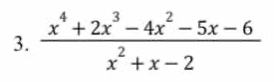
- \\(\frac{x^4 + 2x^3 - 4x^2 - 5x - 6}{x^2 + x - 2}\\)
Step1: Factor denominator
First, factor the quadratic in the denominator. The denominator is \(x^2 + x - 2\). We need two numbers that multiply to -2 and add to 1. Those numbers are 2 and -1. So, \(x^2 + x - 2=(x + 2)(x - 1)\).
Step2: Divide numerator by denominator (polynomial long division)
Divide the numerator \(x^4 + 2x^3 - 4x^2 - 5x - 6\) by the denominator \(x^2 + x - 2\).
First term: \(\frac{x^4}{x^2}=x^2\). Multiply \(x^2 + x - 2\) by \(x^2\) to get \(x^4 + x^3 - 2x^2\). Subtract this from the numerator:
\((x^4 + 2x^3 - 4x^2 - 5x - 6)-(x^4 + x^3 - 2x^2)=x^3 - 2x^2 - 5x - 6\)
Next term: \(\frac{x^3}{x^2}=x\). Multiply \(x^2 + x - 2\) by \(x\) to get \(x^3 + x^2 - 2x\). Subtract this from the previous result:
\((x^3 - 2x^2 - 5x - 6)-(x^3 + x^2 - 2x)=-3x^2 - 3x - 6\)
Next term: \(\frac{-3x^2}{x^2}=-3\). Multiply \(x^2 + x - 2\) by -3 to get \(-3x^2 - 3x + 6\). Subtract this from the previous result:
\((-3x^2 - 3x - 6)-(-3x^2 - 3x + 6)=-12\)
So, the division gives \(x^2 + x - 3+\frac{-12}{x^2 + x - 2}\), but we can also factor the numerator to check. Let's try to factor \(x^4 + 2x^3 - 4x^2 - 5x - 6\). We know the denominator factors are \((x + 2)(x - 1)\), so we can use synthetic division or factor theorem.
Testing \(x = -2\): \((-2)^4 + 2(-2)^3 - 4(-2)^2 - 5(-2) - 6 = 16 - 16 - 16 + 10 - 6 = -12
eq0\). Wait, maybe I made a mistake in long division. Let's try again.
Wait, let's use polynomial long division correctly. Dividend: \(x^4 + 2x^3 - 4x^2 - 5x - 6\), Divisor: \(x^2 + x - 2\).
First term: \(x^4\div x^2 = x^2\). Multiply divisor by \(x^2\): \(x^4 + x^3 - 2x^2\). Subtract from dividend:
\((x^4 + 2x^3 - 4x^2 - 5x - 6)-(x^4 + x^3 - 2x^2)=x^3 - 2x^2 - 5x - 6\)
Second term: \(x^3\div x^2 = x\). Multiply divisor by \(x\): \(x^3 + x^2 - 2x\). Subtract:
\((x^3 - 2x^2 - 5x - 6)-(x^3 + x^2 - 2x)=-3x^2 - 3x - 6\)
Third term: \(-3x^2\div x^2 = -3\). Multiply divisor by -3: \(-3x^2 - 3x + 6\). Subtract:
\((-3x^2 - 3x - 6)-(-3x^2 - 3x + 6)=-12\). So the result is \(x^2 + x - 3-\frac{12}{x^2 + x - 2}\). Alternatively, maybe factor the numerator. Let's try \(x = -1\): \((-1)^4 + 2(-1)^3 - 4(-1)^2 - 5(-1) - 6 = 1 - 2 - 4 + 5 - 6 = -6
eq0\). \(x = 3\): \(81 + 54 - 36 - 15 - 6 = 81 + 54 = 135; 135 - 36 = 99; 99 - 15 = 84; 84 - 6 = 78
eq0\). \(x = -3\): \(81 - 54 - 36 + 15 - 6 = 0\). Ah, \(x = -3\) is a root. So we can factor the numerator as \((x + 3)(x^3 - x^2 - x - 2)\). Now factor \(x^3 - x^2 - x - 2\). Test \(x = 2\): \(8 - 4 - 2 - 2 = 0\). So \(x^3 - x^2 - x - 2=(x - 2)(x^2 + x + 1)\). Wait, but denominator is \(x^2 + x - 2=(x + 2)(x - 1)\). Hmm, maybe my initial approach is wrong. Wait, maybe the numerator can be factored as \((x^2 + x - 3)(x^2 + x - 2)-12\)? No, that's not helpful. Wait, let's do the division again.
Dividend: \(x^4 + 2x^3 - 4x^2 - 5x - 6\)
Divisor: \(x^2 + x - 2\)
First term: \(x^4 / x^2 = x^2\). Multiply divisor by \(x^2\): \(x^4 + x^3 - 2x^2\). Subtract:
\(x^4 + 2x^3 - 4x^2 - 5x - 6 - x^4 - x^3 + 2x^2 = x^3 - 2x^2 - 5x - 6\)
Second term: \(x^3 / x^2 = x\). Multiply divisor by \(x\): \(x^3 + x^2 - 2x\). Subtract:
\(x^3 - 2x^2 - 5x - 6 - x^3 - x^2 + 2x = -3x^2 - 3x - 6\)
Third term: \(-3x^2 / x^2 = -3\). Multiply divisor by -3: \(-3x^2 - 3x + 6\). Subtract:
\(-3x^2 - 3x - 6 + 3x^2 + 3x - 6 = -12\). So the quotient is \(x^2 + x - 3\) and the remainder is -12. So the expression simplifies to \(x^2 + x - 3-\frac{12}{x^2 + x - 2}\). Alternatively, we can factor the denominator as \((x + 2)(x - 1)\) and try to decompose the fraction, but the question is probably to simplify the rational func…

Snap & solve any problem in the app
Get step-by-step solutions on Sovi AI
Photo-based solutions with guided steps
Explore more problems and detailed explanations
\(x^2 + x - 3 - \dfrac{12}{x^2 + x - 2}\) (or simplified further by factoring the denominator, but this is the result of polynomial long division)