QUESTION IMAGE
Question
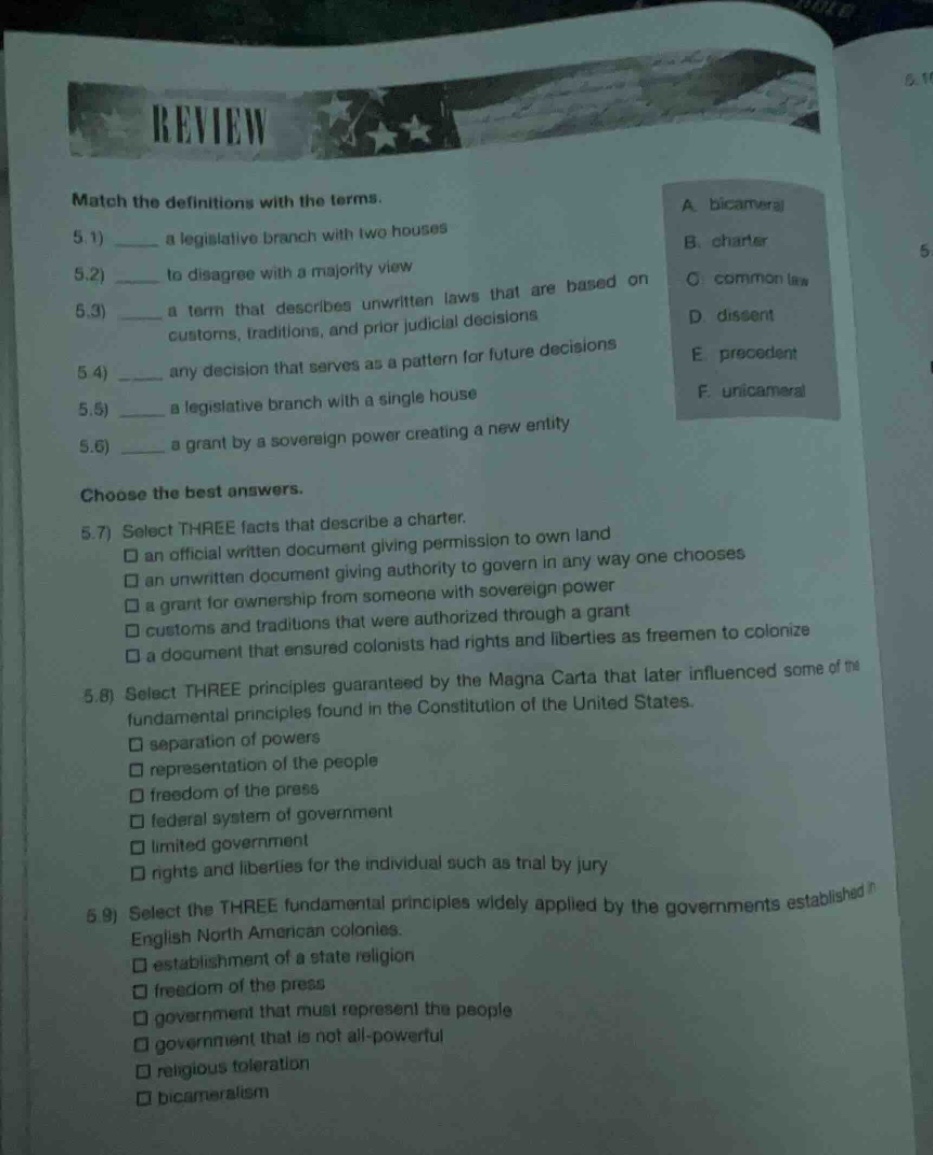
match the definitions with the terms.
5.1) ___ a legislative branch with two houses
5.2) ___ to disagree with a majority view
5.3) ___ a term that describes unwritten laws that are based on customs, traditions, and prior judicial decisions
5.4) ___ any decision that serves as a pattern for future decisions
5.5) ___ a legislative branch with a single house
5.6) ___ a grant by a sovereign power creating a new entity
a. bicameral
b. charter
c. common law
d. dissent
e. precedent
f. unicameral
choose the best answers.
5.7) select three facts that describe a charter.
an official written document giving permission to own land
an unwritten document giving authority to govern in any way one chooses
a grant for ownership from someone with sovereign power
customs and traditions that were authorized through a grant
a document that ensured colonists had rights and liberties as freemen to colonize
5.8) select three principles guaranteed by the magna carta that later influenced some of the fundamental principles found in the constitution of the united states.
separation of powers
representation of the people
freedom of the press
federal system of government
limited government
rights and liberties for the individual such as trial by jury
5.9) select the three fundamental principles widely applied by the governments established in english north american colonies.
establishment of a state religion
freedom of the press
government that must represent the people
government that is not all-powerful
religious toleration
bicameralism
Match definitions with terms (5.1–5.6)
- 5.1: A legislative branch with two houses is bicameral (A).
- 5.2: To disagree with a majority view is to dissent (D).
- 5.3: Unwritten laws based on customs, traditions, and prior judicial decisions describe common law (C).
- 5.4: Any decision that serves as a pattern for future decisions is a precedent (E).
- 5.5: A legislative branch with a single house is unicameral (F).
- 5.6: A grant by a sovereign power creating a new entity is a charter (B).
Analyze charter characteristics (5.7)
A charter is:
- An official written document giving permission to own land (Option 1).
- A grant for ownership from someone with sovereign power (Option 3).
- A document that ensured colonists had rights and liberties as freemen to colonize (Option 5).
Analyze Magna Carta principles (5.8)
The Magna Carta guaranteed:
- Representation of the people (Option 2).
- Limited government (Option 5).
- Rights and liberties for the individual such as trial by jury (Option 6).
Analyze colonial government principles (5.9)
The three fundamental principles widely applied in English North American colonies are:
- Government that must represent the people (Option 3).
- Government that is not all-powerful (Option 4).
- Bicameralism (Option 6).

Snap & solve any problem in the app
Get step-by-step solutions on Sovi AI
Photo-based solutions with guided steps
Explore more problems and detailed explanations
Question 5.1
(A) bicameral
Question 5.2
(D) dissent
Question 5.3
(C) common law
Question 5.4
(E) precedent
Question 5.5
(F) unicameral
Question 5.6
(B) charter
Question 5.7
- An official written document giving permission to own land
- A grant for ownership from someone with sovereign power
- A document that ensured colonists had rights and liberties as freemen to colonize
Question 5.8
- representation of the people
- limited government
- rights and liberties for the individual such as trial by jury
Question 5.9
- government that must represent the people
- government that is not all-powerful
- bicameralism