QUESTION IMAGE
Question
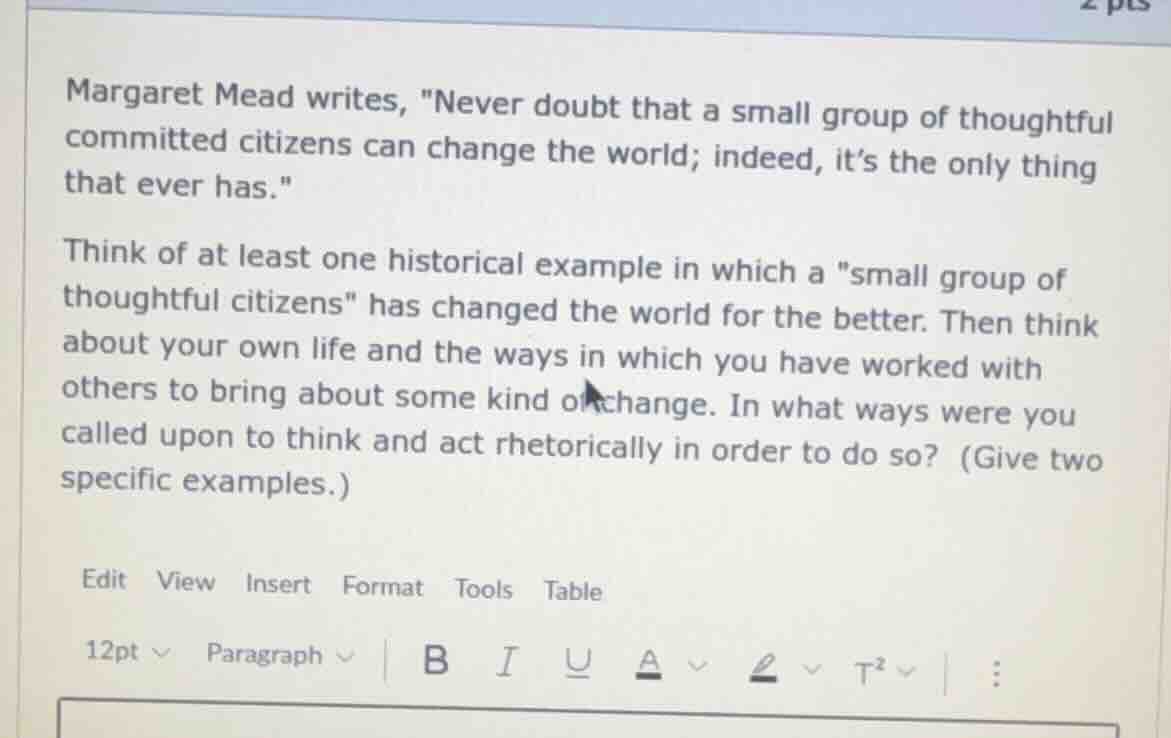
margaret mead writes,
ever doubt that a small group of thoughtful committed citizens can change the world; indeed, it’s the only thing that ever has.\ think of at least one historical example in which a \small group of thoughtful citizens\ has changed the world for the better. then think about your own life and the ways in which you have worked with others to bring about some kind of change. in what ways were you called upon to think and act rhetorically in order to do so? (give two specific examples.)
Brief Explanations
- Historical Example: The Montgomery Improvement Association (MIA), a small group of Black community leaders and citizens including Rosa Parks and Martin Luther King Jr., organized the 1955-1956 Montgomery Bus Boycott. This sustained protest against segregated public transit led to the U.S. Supreme Court ruling bus segregation unconstitutional, catalyzing the broader American Civil Rights Movement and advancing global racial justice efforts.
- Personal Rhetorical Action 1: When organizing a campus food drive, I used anecdotal rhetoric in a student assembly: I shared a specific story of a peer struggling with food insecurity to evoke empathy, then clearly outlined the food drive's logistics and impact to persuade peers to donate time and items.
- Personal Rhetorical Action 2: To convince my local library to extend after-school hours for low-income students, I used data-driven rhetoric in a meeting with library administrators. I presented local census data showing 62% of nearby students lacked supervised after-school space, paired with testimonials from students, to argue the extension would fill a critical community need and align with the library's public service mission.

Snap & solve any problem in the app
Get step-by-step solutions on Sovi AI
Photo-based solutions with guided steps
Explore more problems and detailed explanations
- Historical example: The small group behind the 1955-1956 Montgomery Bus Boycott (including the Montgomery Improvement Association, Rosa Parks, and Martin Luther King Jr.) successfully challenged U.S. bus segregation, sparking the Civil Rights Movement and advancing global racial equality.
- Personal rhetorical example 1: I used empathetic anecdotes about a food-insecure peer in a campus assembly to persuade classmates to volunteer and donate to a student food drive.
- Personal rhetorical example 2: I presented local census data on unsupervised after-school students and student testimonials to convince my local library to extend its after-school hours for low-income youth.